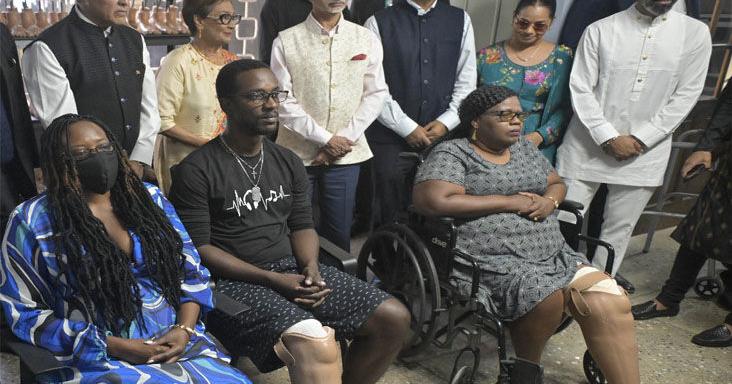
On a historic Saturday in Siparia constituency, Trinidad and Tobago Prime Minister Kamla Persad-Bissessar formally opened the country’s first permanent National Prosthetics Centre, a landmark collaborative project between the Trinidad and Tobago government, the Government of India, and U.S.-based non-profit Jaipur Foot USA. The opening ceremony was attended by India’s Minister of External Affairs Dr. Subrahmanyam Jaishankar, marking another milestone in the deepening bilateral partnership between the two nations.
In her keynote address delivered at the centre’s Penal compound on Clarke Road, Persad-Bissessar framed the new facility as a transformative step forward for the Caribbean nation’s differently-abled community. For years, Trinidadian patients requiring prosthetic limbs faced a daunting set of barriers: they were forced to travel abroad for care, absorb prohibitive treatment costs, and endure months-long waiting periods for life-changing support. Now, all essential prosthetic and rehabilitation services will be provided completely free of charge to citizens right at home, eliminating those systemic barriers.
“This centre does more than provide physical devices—it restores dignity, confidence, and independence to thousands of our citizens,” Persad-Bissessar emphasized. “It opens the door for people to return to work, to participate fully in their communities, and to live life on their own terms.” The project embodies her administration’s core promise to expand specialized healthcare access and ensure no citizen is left behind due to disability, she added.
Beyond serving domestic needs, the new centre is poised to reshape prosthetic care across the entire Caribbean. Persad-Bissessar noted that the facility positions Trinidad and Tobago as a regional hub for specialized rehabilitation, with capacity to treat patients from across the Caricom bloc and eventually grow into a regional training centre for prosthetic expertise. She tied the project’s success to the 2025 state visit of Indian Prime Minister Narendra Modi, saying the centre stands as tangible, people-centered proof of what bilateral cooperation can deliver for ordinary communities.
This latest initiative expands a growing healthcare partnership between the two nations, which already includes joint development of haemodialysis units, pharmaceutical cooperation, and the deployment of two sea ambulances to Trinidad and Tobago. Persad-Bissessar offered public gratitude to both the Indian government and Jaipur Foot USA for their partnership, noting that she was moved to “tears of emotion and joy” after reviewing patient testimonies from a preliminary prosthetic fitment camp held at Divali Nagar last year. That camp, organized with support from the Indian High Commission in Trinidad and Tobago, was the first of its kind held outside of India, a distinction she highlighted while praising the work of High Commissioner Dr. Pradeep Singh Rajpurohit and his team.
Speaking at the ceremony, one early beneficiary of the partnership, limb recipient Joshua Gloud, shared his excitement about the permanent centre. “It is an encouragement to see that something like this is taking place in our nation,” Gloud said. “I really thank the honourable prime minister and everyone that has done everything possible to get this done, and I look forward to all the good this centre will do in the years ahead.”
Trinidad and Tobago Health Minister Lackram Bodoe echoed that sentiment, framing the centre as a practical, compassionate response to a long-unmet national need. Operating under the oversight of the Ministry of Health and the South-West Regional Health Authority, the facility will clear the existing backlog of patients waiting for prosthetic care while meeting ongoing demand into the future. Local energy firm Heritage Petroleum Company Ltd supported the project by facilitating acquisition of the centre’s building, Bodoe confirmed.
The centre will deliver a full spectrum of care, from initial patient assessment and prosthetic fitting to long-term follow-up care, while also building local capacity by providing technical training for Trinidadian healthcare workers. “Right now, more than 200 patients are on our waiting list for prosthetic services and follow-up care, and work is already underway to see those patients,” Bodoe said. He added that clinical teams have already taken measurements for the first two patients, who will receive their custom limbs in the coming weeks.
In his remarks at the inauguration, Jaishankar reaffirmed the Indian government’s long-term commitment to supporting the centre and expanding access to care. He noted that demand for prosthetic services was far higher than initial projections from last year’s fitment camp, and India is prepared to go the extra mile to meet that growing need.
“Following the success of last year’s camp, we as partners to Trinidad and Tobago recognized how transformative this permanent service would be for this country,” Jaishankar said. “This initiative does more than restore mobility—it reduces vulnerability, strengthens human dignity, and imparts the self-confidence that lets people rebuild their lives.” He commended Prime Minister Persad-Bissessar for prioritizing the project and locating the centre in her own constituency, a choice that reflects her deep personal commitment to supporting vulnerable communities, and confirmed that India will continue providing all necessary support to the centre as it grows.