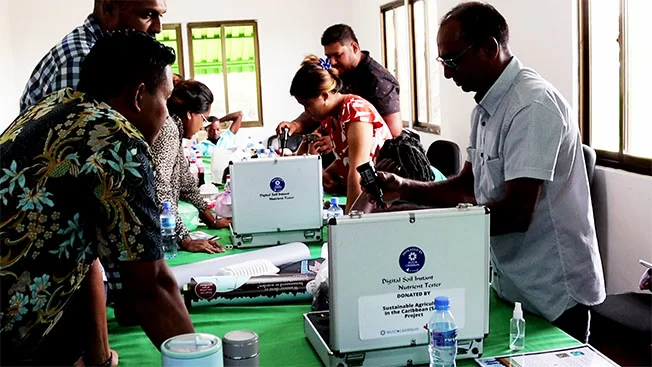
Suriname’s agricultural sector is stepping into a new era of efficient, data-driven farming thanks to a new initiative rolled out by the country’s Ministry of Agriculture, Livestock and Fisheries (LVV), in partnership with the World University Service of Canada (WUSC). At the heart of the program are portable soil nutrient tester kits that cut down wait times for soil analysis results from months to less than a single working day, bringing life-changing improvements to small-scale and commercial farmers across the country.
Before the introduction of these portable kits, the process of soil nutrient testing was notoriously slow and cumbersome. Agricultural extension officers based in rural districts across the country, including Nickerie, Coronie, Wanica, and Saramacca, were required to collect soil samples from local farms and ship them all the way to the capital city of Paramaribo for laboratory analysis. According to LVV extension officers, this process could take anywhere from three to six months to complete. By the time the test results were returned, planting seasons had often already passed, farmers had already harvested their crops, or many had moved forward with plans to plant a new crop, rendering the delayed analysis useless for informed decision-making.
The new portable tester kits eliminate this entire delay. Extension officers can now conduct full nutrient analysis on-site directly after collecting soil samples, sharing accurate, actionable results with farmers the same day. All test findings are officially documented in a personalized agricultural report that is given directly to the participating farmer, and the entire testing and advisory service is provided completely free of charge by LVV.
Soekarina Ardjosentono, a senior researcher in the Ministry’s Department of Soil Research and Agrohydrology, explained that two key benefits set the new system apart from the old process: unmatched speed and the ability to deliver far more targeted, context-specific advice to farmers. To ensure widespread, consistent use of the new technology, the Ministry has rolled out sequential training programs for extension officers across all regions. Trainings for extension staff in the northern districts of Wanica, Saramacca, and Paramaribo have already been completed, with training for officers in the western districts of Nickerie and Coronie wrapping up just last week.
William Waidoe, LVV’s Deputy Director for the Western Region, noted that the faster testing framework enables extension officers to guide farmers far earlier in the planning process, before farmers make costly investments in seeds, fertilizer, and new planting. With immediate access to clear data on their soil’s nutrient profile, farmers can make timely, informed decisions about the type and amount of fertilizer to apply at each growth stage of their crops, matching inputs to their soil’s exact needs.
Netasha Badal, an LVV extension officer based in Nickerie, one of the country’s key agricultural regions, emphasized the practical, on-the-ground difference the kits have made. “Previously, we had no option but to send samples off to Paramaribo. By the time we got the results back, in many cases the farmer had already planted or even harvested their crop,” Badal explained. “Now, we can share results and give targeted advice on appropriate fertilizer in a fraction of the time.”
Revillio Vriesde, an extension officer and acting district lead for LVV in Coronie, echoed this sentiment, calling the new system a major step forward for the region’s farming community. “Where farmers once waited three to six months for results, they can now get full data the same day we collect their sample,” Vriesde noted.
The portable soil nutrient tester kits were donated to the Ministry by WUSC as part of the organization’s climate-smart agriculture programming in Suriname. Varsha Boejharat, WUSC’s Climate Smart Agriculture Officer, explained that the donation and accompanying training program were developed in direct response to feedback from local farmers who identified slow soil analysis as a major barrier to more productive, sustainable farming. Accurate, timely soil analysis is foundational to sustainable farming: it gives farmers clear insight into key nutrient levels, including nitrogen, potassium, and phosphorus, that determine crop health and yield. With this data in hand, farmers can not only select the right fertilizer regimen for each growing stage but also decide which crop varieties are best suited to their land, reducing unnecessary input costs and boosting overall productivity.
The program represents a collaborative effort to bring modern, accessible agricultural technology to rural farmers in Suriname, with the goal of supporting more resilient, productive farming across the country.