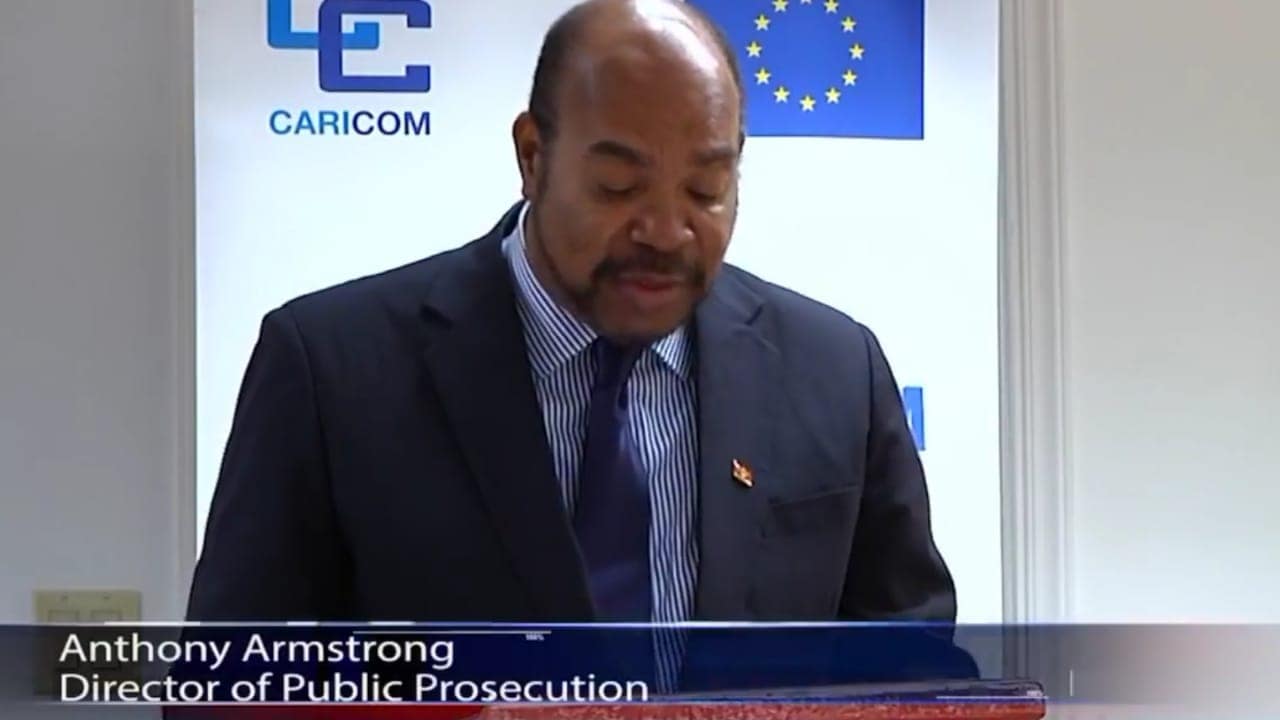
In a landmark May 2024 ruling, Jamaica’s Court of Appeal has formally upheld a professional misconduct finding against Anthony Armstrong, a former Director of Public Prosecutions of Antigua and Barbuda, dismissing all eight grounds of his appeal challenging a disciplinary ruling over false document attestation.
The legal dispute traces its origins back to a 2019 complaint lodged by Michael Adams, a man serving a U.S. prison sentence for drug-related offenses. Adams alleged that Armstrong had illicitly sold three of his Jamaican properties—located at Columbus Heights, Brompton Road, and Fairview Court—between 2004 and 2005 without his knowledge or formal authorization. While the Disciplinary Committee of the General Legal Council (GLC) ultimately failed to prove broader allegations of fraudulent sales beyond a reasonable doubt, and confirmed Adams had previously authorized the transactions, the probe uncovered a critical breach of legal ethics rules.
During cross-examination before the disciplinary panel, Armstrong openly admitted that he had signed property transfer documents as a witness to Adams’ signature, despite the fact that Adams was not physically present when the paperwork was executed. This admission directly put Armstrong in violation of Canon I(b) of the Legal Profession (Canons of Professional Ethics) Rules, a core regulation that requires all practicing attorneys to uphold the honor and dignity of the legal profession and avoid any conduct that could bring the field into disrepute. The GLC disciplinary committee subsequently issued a reprimand, imposed a JMD $250,000 fine, and ordered Armstrong to cover $30,000 in GLC legal costs, labeling his actions “the height of recklessness.”
Armstrong launched an appeal challenging this ruling on eight separate grounds, ranging from claims of abuse of process stemming from the 15-year gap between the property sales and the 2019 complaint, to temporary exclusion from portions of the virtual Zoom disciplinary hearing, alleged witness interference by the complainant’s legal team, claims of bias against the disciplinary panel chair, and objection to the hearing being held in private rather than open to the public.
A three-justice panel comprising Justices Carol Edwards, Marcia Dunbar Green, and Georgiana Fraser rejected every one of Armstrong’s arguments. Writing the court’s 52-page official opinion, Justice Dunbar Green emphasized that even false attestation of a genuine signature inflicts lasting harm on the legal system: “A false attestation, even where the signature is genuine, undermines the reliability of legal documents and erodes public confidence in the profession.” The justice also rejected Armstrong’s defense that his long-standing familiarity with Adams’ signature from a prior transaction made his attestation acceptable, noting that “Attestation is not a speculative exercise in signature recognition; it is a solemn affirmation of presence and observation.”
On the claim of prejudicial delay, the court ruled that while the 15-year gap between the conduct and the complaint was “inordinate,” it caused no material harm to Armstrong’s defense, as his direct admission of false attestation required no reconstruction of lost historical evidence. Regarding the temporary exclusions from the Zoom hearing, the court confirmed that Armstrong’s lead attorney Hugh Wildman remained present for all proceedings, no evidence was presented while Armstrong was absent, and no prejudice occurred. Claims of witness interference were also dismissed for lack of proof: the court found no evidence that contact from the complainant’s attorney had deterred the witness or altered testimony, and no substantive review of the communication’s content found wrongdoing.
Allegations of bias against the disciplinary panel chair—who had previously worked at a firm involved in an unrelated earlier property transaction—were similarly rejected, with the court finding no financial interest in the outcome and no circumstances that would lead a reasonable observer to suspect bias. Finally, the court upheld the constitutionality of private disciplinary hearings under Rule 14 of the Legal Profession (Disciplinary Proceedings) Rules, which requires private proceedings but public release of final findings, confirming the rule aligns with the Charter of Fundamental Rights and Freedoms.
Representing the GLC on appeal, King’s Counsel Sandra Minott-Phillips argued that the original misconduct finding was “unimpeachable, particularly in the light of the appellant’s own admission of dishonest conduct,” per the ruling. Minott-Phillips emphasized that attorney attestation is far more than a procedural formality: it constitutes a formal public affirmation that the attorney directly observed the signatory execute the document. When that affirmation is knowingly false, she argued, it creates severe risk for all parties who rely on the document’s integrity and unquestionably qualifies as professional misconduct. The Court of Appeal’s ruling left the original disciplinary sanctions fully intact, and ordered Armstrong to cover the GLC’s appeal legal fees.