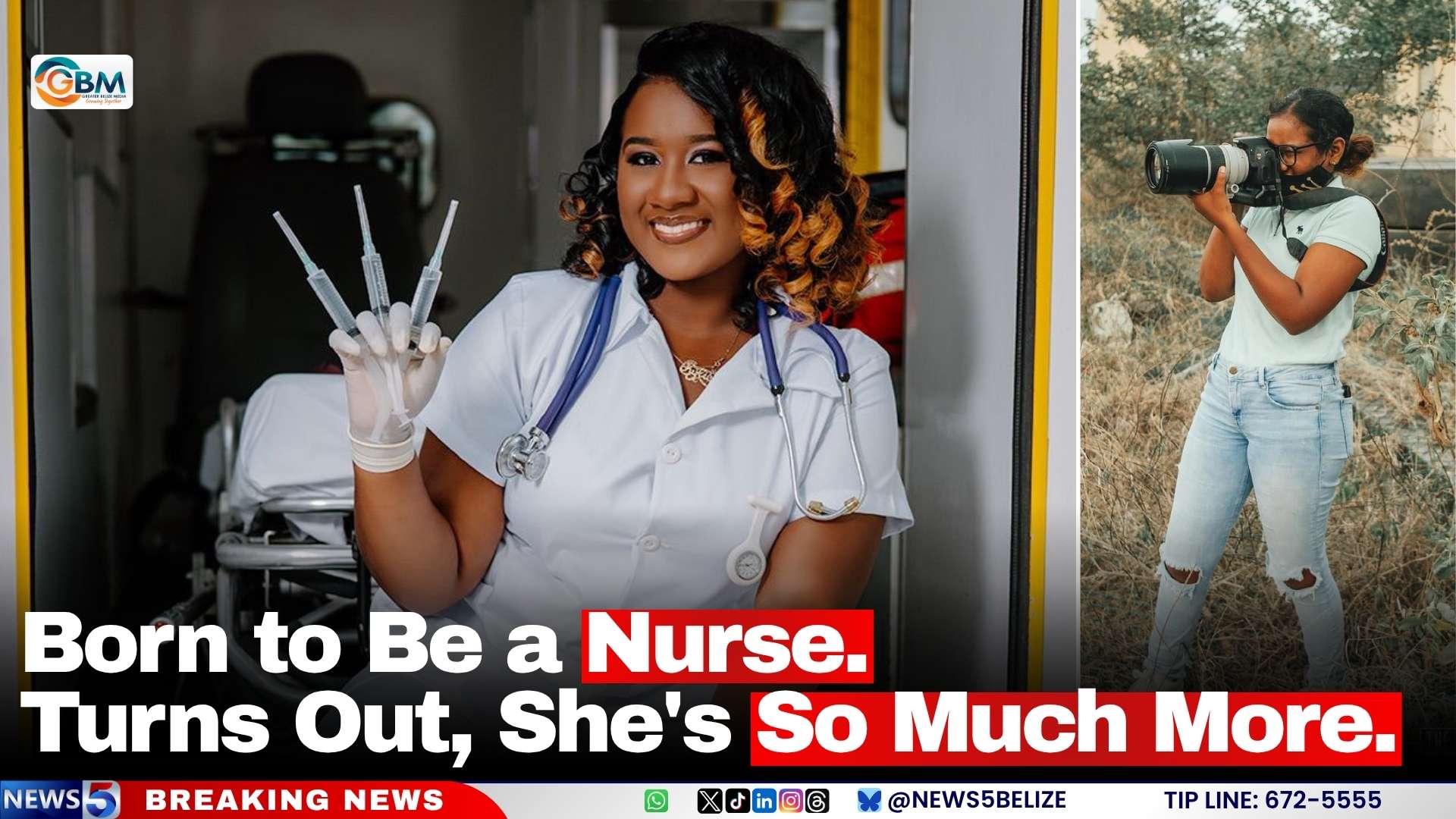
Kylie Rhamdas’ calling to nursing was not a late-in-life discovery—it took root when she was just five years old, clutching a plastic toy stethoscope and already imagining a future caring for others. By age 22, that childhood dream has become a reality: she just wrapped up her first full year as a Licensed Practical Nurse in the emergency department of Belize’s Karl Heusner Memorial Hospital, a milestone that arrived just as 2026 Nurses Week, a national observance honoring frontline healthcare workers, drew to a close. Looking back on the winding path that brought her to this point, Rhamdas says she would tell her five-year-old self, “We did it.”
Growing up as a frequent hospital patient managing sickle cell disease only strengthened Rhamdas’ desire to work in healthcare. Those long stays gave her a front-row seat to the compassion and steady care nurses brought to patients in crisis, a memory that stayed with her for decades. “All my life when I was younger, I was always in the hospital,” she recalled. “I used to watch the nurses and think, I want to be a doctor or a nurse.”
The road to nursing was anything but straightforward. After finishing secondary school, Rhamdas did not enroll immediately in college. Instead, she honed her skills as a photographer while never letting go of her childhood dream. When she eventually enrolled in nursing school, she worked three part-time jobs to cover her costs, relying on income from photography to pay for transportation, meals, and school fees. It was a nursing scholarship that finally made her enrollment possible, after years of planning and saving.
Even with the scholarship, daily life as a student presented steep challenges. Nursing school was based in Belmopan, while Rhamdas made her home in Belize City—meaning she had to wake up at 4:30 every morning to catch a 6 a.m. bus, just to arrive on time for 8 a.m. classes. “Some days used to be really hard. I don’t know if I want to go to school today, but you have to push yourself,” she said. “If that’s something you like and that you really want, you have to push yourself and motivate yourself to continue.”
Now one year into her emergency department role, Rhamdas already has her next professional goals in sight: she plans to earn a Bachelor of Science in Nursing before pursuing specialized training in psychiatric care. What many patients do not see when they interact with her in the busy ER, however, is the full, layered life she carries beneath her scrubs. Beyond her reputation for arriving 30 minutes early to every shift, few know she manages her own chronic sickle cell pain through long, demanding shifts, that she worked her way through school as a professional photographer, or that as a new graduate nurse she prayed silently for a critically ill patient to pull through.
That patient survived after a 16-hour shift where Rhamdas never left her side. Later, the patient thanked her for her care—a small moment Rhamdas returns to again and again on days when she doubts her own work. “When I feel like I’m a bad nurse or I’m not doing as much as I want to do, I would think back to that moment,” she said.
This unspoken side of nursing is rarely discussed in public: the emotional weight that nurses carry home with them after hard shifts, the self-doubt that comes with working in a high-stakes environment, and the overwhelm that hits new nurses when classroom training cannot fully prepare them for the breakneck pace of an emergency department. Rhamdas openly shares that she cried through her first week in the ER, overwhelmed by self-doubt. “I was like, I don’t think I’m a good nurse. I don’t think I’m getting this. I feel like I’m too slow for this unit,” she recalled. “I used to cry about it, but I got over it. I continued to push myself.”
A common public misconception, Rhamdas notes, is that nurses are expected to be infallible—when in reality, they are human, just like the patients they care for. “People always expect us to not make mistakes. We’re prone to mistakes. We might not be able to answer all the questions that you have. But we try our best,” she said.
What carried Rhamdas through her early challenges was a determined mindset, the core childhood memories that reminded her why she chose the field, and a supportive team of colleagues who invested in her growth. That combination earned her the 2026 Adrenaline Ace Award at Karl Heusner Memorial Hospital, an honor that recognizes exceptional performance in the emergency department. “I don’t think that I would have got that award if it weren’t for most of my co-workers there who strengthened me,” she said. “Whether it was teaching me a new skill, correcting me when I was wrong, or just teaching me something new every day.”
Outside of the hospital walls, Rhamdas still works as a photographer, scheduling photoshoots around her nursing shifts and prioritizing activities that help her manage workplace stress on her days off: traveling, listening to music, and relaxing by the ocean. “Anything to deal with the stress… Just find something that suits you and calms you,” she advised.
For anyone considering a career in nursing who feels unsure about taking the first step, Rhamdas has clear advice: “Go for it.” “The journey might not always be as easy as you think it is. But push through. And always think about the ending goal,” she said. “When you become a nurse, you might not feel appreciated at first. But you’re going to meet patients who remind you of why you’re a nurse.” She also emphasizes that it is never too late to pursue education: “Schooling has no age. I believe you can go back to school whenever you feel like.”
At its core, 2026 Nurses Week is about more than just honoring the work of nursing—it is a reminder that the person caring for you at your bedside is navigating a full, complicated, deeply human life of their own. For Rhamdas, that humanity is what makes the work worth it. “We’re always there to help,” she said. “We might not always be perfect. But we’re always there.”