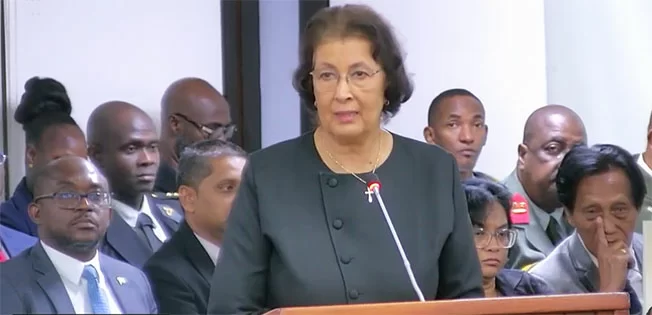
On Friday, Suriname marked a historic milestone: 160 years of representative parliamentary governance, with President Jennifer Simons using the occasion to outline both progress made and critical adaptations the National Assembly (DNA) must make to meet 21st-century challenges.
During a special public plenary session held to commemorate the anniversary, President Simons walked attendees through the decades-long evolution of Suriname’s parliamentary system, highlighting how far the institution has come since its founding. 160 years ago, the body only represented a narrow, privileged segment of Suriname’s population. Today, it boasts representation from nearly every demographic group across the South American nation, a shift driven by targeted reforms to the country’s electoral and governance frameworks.
“More and more of our people now have a seat at the political table,” Simons noted, emphasizing that expanded representation has not only made the parliament more inclusive but also strengthened Suriname’s democratic foundations as a whole. Beyond looking back at the 160-year history of the legislature, the president centered her address on the collective work of government, parliament, and civil society to build resilient, effective democratic institutions for coming generations.
A core focus of Simons’ speech was the disruption and opportunity brought by shifting communication norms, particularly the rise of social media. Where parliamentary debates were once confined to the walls of the legislative chamber, modern lawmakers now operate in a constant digital spotlight, where every statement and vote draws immediate public reaction via online platforms.
“Members of the National Assembly receive instant, nonstop feedback from the public on their work,” Simons said. She noted that this direct engagement can be positive and supportive of democratic accountability, but it also carries risks: much immediate online feedback can be negative, or rooted in incomplete understanding of the complex context and tradeoffs that shape legislative decision-making. Simons added that the presence of cameras and social media has already reshaped lawmaker behavior during public sessions, contrasting with closed-door committee meetings that often proceed in a more constructive, solution-focused manner. “We have long understood the impact of cameras on parliamentary dynamics, and now the influence of social media has added an entirely new layer,” she explained.
Simons stressed that both parliament and the executive branch must grapple seriously with how modern communication reshapes public trust in government and civic engagement in governance. Beyond digital platforms, she highlighted that emerging technologies, most notably artificial intelligence, will bring transformative changes to the daily work of lawmakers and government officials. To meet these shifts, she argued, legislators must proactively prepare and remain flexible to adapt to evolving societal needs.
Even as the president called for urgent adaptation, she reaffirmed that the core mission of Suriname’s parliament remains unchanged. “This institution exists to represent the people, hold the government to account, and the executive branch – including the presidency – owes its accountability to the National Assembly,” she stated. The fundamental principle of checks and balances, she emphasized, must never be abandoned, and should instead be strengthened to meet modern challenges.
Simons also underscored the critical need for robust expertise within the legislative branch, noting that the DNA must maintain sufficient independent knowledge to rigorously review government budgets, draft legislation, and assess policy proposals from an impartial, substantive perspective. Closing her address, she framed the 160-year survival of Suriname’s parliamentary system as proof of the resilience of the nation and its people. “Through every upheaval and every transformation, we remain rooted in a democratic system that lets us build our collective future together,” she said.