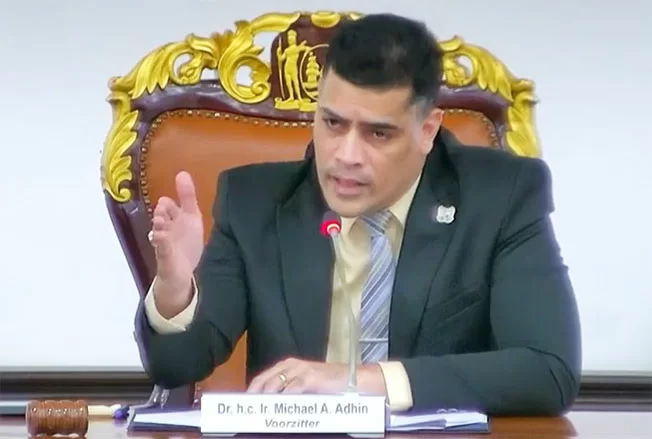
On the 160th anniversary of Suriname’s people’s representative system, National Assembly Speaker Ashwin Adhin delivered a landmark address on Friday, calling for deep, transformative institutional, economic, and democratic reforms to guide the South American nation through what he frames as a defining historical turning point.
Addressing assembled attendees, Adhin emphasized that newly emerging oil revenues must not become a trap of resource dependence, but rather serve as a catalyst to build a stronger, more inclusive Suriname that leaves no group behind. He laid out a sweeping, long-term vision for the country’s future that covers broad priorities from economic diversification to democratic strengthening, social inclusion, and parliamentary governance reform.
Central to Adhin’s economic vision is a break from Suriname’s long-standing reliance on natural resource extraction. “Oil is not a destination, it is a bridge,” he stressed. Instead of centering the entire economy on oil and gas extraction, the country should evolve to what Adhin terms a “network identity” that leverages its comparative advantages across multiple sectors: agriculture, water resources, renewable energy, tourism, services, knowledge development, and digital innovation. He noted that Suriname’s strategic geographic position between the Caribbean and South America, paired with its existing port and airport infrastructure, untapped potential for data center development, and growing capacity in medical and educational services, positions the nation to become a regional hub for finance, logistics, digital technology, and education.
Adhin made clear that natural resources alone can never deliver lasting, shared prosperity for the nation. To achieve sustainable growth, Suriname must first build robust public institutions, update outdated legal frameworks, and invest in a well-educated, skilled workforce. He called for rapid modernization of national legislation across key areas: labor market regulation, investment attraction, environmental protection, anti-money laundering protocols, and technical vocational education. “Fifty years of sustainable growth does not start with the first barrel of oil, it starts with the laws we write today,” he said.
The speaker also drew attention to marginalized groups that have historically been excluded from Suriname’s national development agenda, including people living with disabilities and Surinamese communities in the diaspora. After a recent visit to the Betheljada care facility, Adhin questioned whether people with disabilities in the country feel abandoned by state institutions. He also addressed the status of Surinamese people residing in the Netherlands, noting that at the time of Suriname’s independence, this community was “made foreigners in their own history with a single stroke of a pen.”
Under the banner of “Together Suriname,” Adhin called for building a national society where no community is sidelined, and advocated for stronger legal and social protections for people of Surinamese origin living abroad. Turning to the role of the National Assembly (Dutch acronym DNA), Adhin pushed back against the common misunderstanding that parliament serves solely as a legislative body. He reminded attendees that the body has three core, equally important mandates: representing the people, co-writing legislation, and exercising oversight over the executive branch. “We are the people’s representative power,” he stated, adding that unchecked power always comes at the expense of the public good. For this reason, he said, strong checks and balances are non-negotiable for a functioning democratic constitutional order.
To cement the parliament’s commitment to higher standards of governance, Adhin announced that a commemorative plaque will be unveiled inside the DNA building bearing the inscription: “If we are the highest organ of the state, we must also embody the highest level of integrity, debate, transparency, and vision.” He also laid out a broader agenda for governance reform, calling for further administrative decentralization, the creation of an independent national planning agency, improved spatial planning, and the establishment of a politically independent land board to manage national land resources. These reforms, he argued, are critical to prevent future oil revenues from being squandered through weak regulation or poor governance.
Adhin framed the current moment as unprecedented in Suriname’s modern history: for the first time, the country can plan for long-term growth from a position of projected economic abundance, rather than reacting to constant scarcity. “One hundred and sixty years ago, a conversation began here between the people and authority,” he said in closing. “My wish is that in 10 years’ time, we can say we did not waste the abundance of our time, that we built the strong institutions we need, and that we left no one behind.” The full text of Adhin’s speech is available for public download.