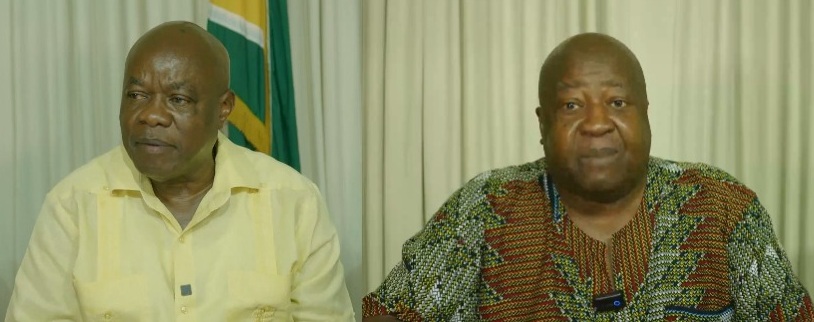
GEORGETOWN, Guyana – In a press conference held Friday, Aubrey Norton, leader of Guyana’s main opposition party People’s National Congress Reform (PNCR), issued a forceful rebuttal of recent claims raised before the International Court of Justice (ICJ) that his party’s 1970s government considered ceding a portion of the disputed Essequibo Region to Venezuela to resolve the long-running border conflict between the two nations.
Norton stressed that the allegation carried by Venezuela’s legal team at the ICJ is entirely unfounded. “This is untrue. When Venezuela made the proposal, it was rejected out of hand by the then PNC government,” Norton told reporters. The border dispute centers on the validity of the 1899 Arbitral Tribunal Award, which established the current boundary between Guyana and Venezuela and grants Guyana sovereignty over the 159,000-square-kilometer Essequibo Region, rich in offshore oil and mineral resources. Venezuela has for decades rejected the 1899 ruling and claims full sovereignty over the territory.
Venezuela’s lead legal representative before the ICJ, international law professor Andreas Zimmermann, told the UN court last week that during 1977 bilateral negotiations, then-Guyanese foreign minister proposed a border adjustment at Punta Playa that would shift the existing borderline from its northwest orientation to a northeast route – a change that would cede territory to Venezuela. Zimmermann also told the court that during 1995 talks, both parties explored creative settlement options that included returning partial control of the disputed territory to Venezuela, including a potential lease arrangement that would leave Guyana administering some portions. He added that former Guyanese President Janet Jagan reaffirmed in an August 1998 letter that the UN Good Officer Process established under the 1966 Geneva Agreement was intended to explore all possible pathways to a negotiated settlement.
Beyond refuting the 1970s concession claim, Norton pushed back against the Guyanese government’s current approach to the dispute, saying while he welcomes U.S. Secretary of State Marco Rubio’s recent pledge to defend Guyana from Venezuelan aggression, Guyana should have pursued a far more robust, proactive independent diplomatic strategy long before now. The comment comes amid Venezuela’s continued refusal to recognize the ICJ’s jurisdiction to rule on the validity of the 1899 award, a stance that has raised regional and international concerns over potential escalation.
Norton outlined that a comprehensive Guyanese strategy should combine public education, targeted political influence, and proactive economic diplomacy that leverages the country’s valuable natural resources to build global support for its sovereignty claim, rather than relying on shallow transactional engagement with international partners. He also called for long-overdue formal recognition of Rashleigh Jackson, Guyana’s foreign minister during the 1970s talks, who Norton says was critical to securing resources for foundational research that underpins Guyana’s legal case. “It is unfair, and it should be rectified,” Norton said of the lack of public recognition for Jackson’s work.
Joining the call for a more proactive public outreach strategy was Dr. David Hinds, co-leader of the Working People’s Alliance (WPA), who urged the Guyanese government to launch a large-scale, structured public education campaign to reinforce national awareness that Essequibo is an integral part of Guyana. Hinds noted that even at this late stage, an aggressive social media-focused campaign could not only educate Guyanese citizens about their country’s sovereign claim, but also reach audiences in Venezuela and across the Caribbean Community (CARICOM) to build broader regional and international understanding of Guyana’s position.
Hinds added that such public outreach would also create grassroots pressure on the Guyanese government to prioritize protecting the country’s territorial integrity and embed a clear national understanding of the dispute across all segments of society, as tensions over the resource-rich region remain at a decades-long high.