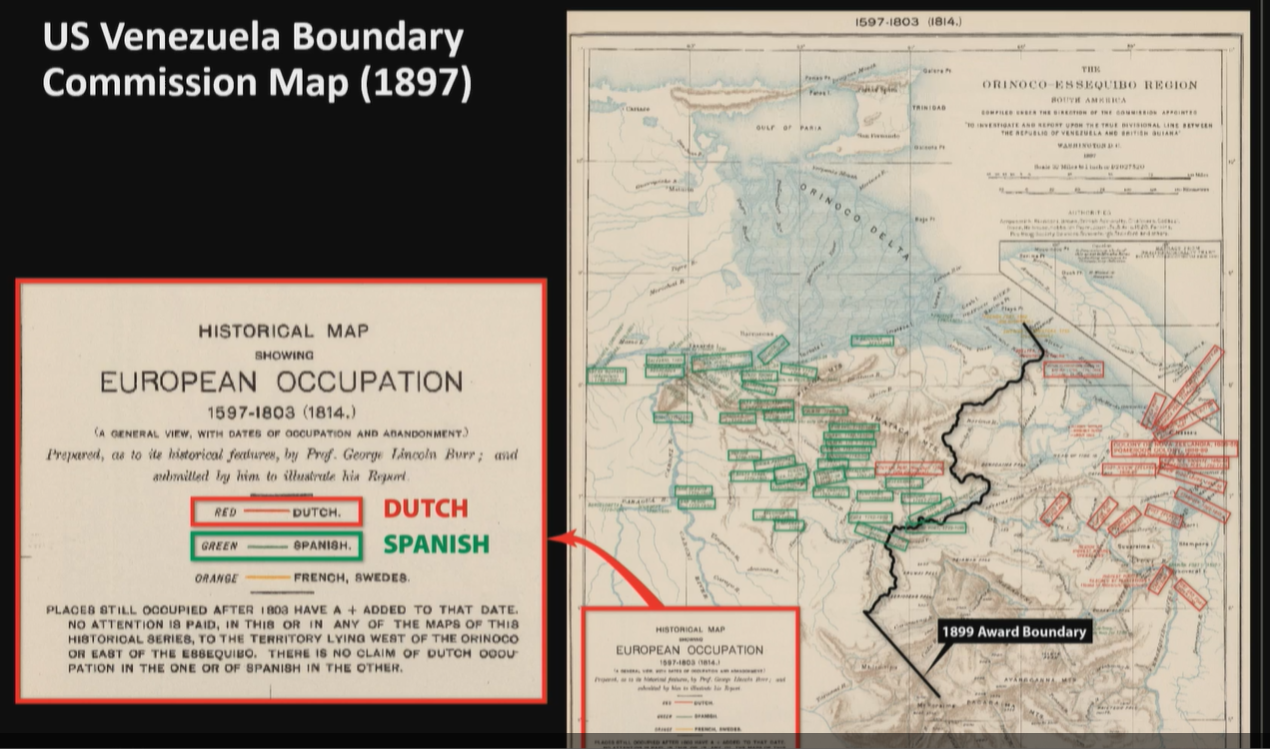
On Friday, 8 May 2026, Guyana delivered new documentary evidence to the United Nations’ highest judicial body, the International Court of Justice (ICJ), to strengthen its position in the long-running border dispute over the Essequibo Region with Venezuela. The submission centers on historical cartographic and archival records that Guyana argues disprove Venezuela’s core territorial claims.
Paul Reichler, lead legal counsel for Guyana, presented a collection of historical maps to the court, including one that clearly marks the boundary demarcated by the 1899 Arbitral Tribunal Award — the original ruling that established the territorial division at the center of the modern dispute. One key document, a map published by the joint United States-Venezuela Boundary Commission in February 1897, the exact same month that the 1897 bilateral treaty to resolve the dispute was signed, confirms that Spanish forces never established occupation in the territory east of the agreed preliminary boundary line, Reichler explained.
Reichler emphasized that this finding aligns with Guyana’s long-held position that the Essequibo Region was historically occupied by Dutch colonizers, not Spanish, a fact echoed by the more than 30 Dutch place names still in use across the area today. He added that neither the 1899 arbitration proceedings nor the current ICJ case have ever produced credible evidence from Venezuela proving that it or Spain ever held actual occupation of any portion of the territory ultimately awarded to Great Britain. He urged ICJ justices to review the full official transcripts of both the US-Venezuela Boundary Commission and the 1899 Arbitral Tribunal to verify this finding.
Clarifying the core question before the court, Reichler noted that the current proceedings are focused on the legal validity of the 1899 Arbitral Award, not on whether the tribunal drew the geographically correct boundary. Per the ICJ’s 2020 preliminary ruling, the court will only assess the accuracy of the boundary line if it first determines the 1899 award is legally invalid.
Venezuela has previously argued before the court that 19th-century Britain repeatedly engaged in territorial aggression against Spanish holdings in the region, and claims that the 1966 Geneva Agreement replaced the 1899 award as the valid framework for settling the controversy. But Reichler pushed back against this interpretation, reading key excerpts of the 1966 agreement into the court record that contradict Venezuela’s position.
The text of the Geneva Agreement explicitly states that no provision of the document can be read as a renunciation or reduction of any territorial sovereignty claim by either party, and that no activities taking place during the agreement’s term create new legal basis for any territorial claim outside of a mutually agreed settlement by the mixed commission established by the pact. Reichler stressed that Venezuela’s argument that the 1966 agreement completely set aside and replaced the 1899 award cannot be reconciled with the actual written text of the agreement, calling Venezuela’s reading a novel reinterpretation that does not align with the agreement’s original wording.
Professor Pierre d’Argent, another member of Guyana’s legal team, added that the Geneva Agreement explicitly grants the United Nations Secretary General the authority to refer the unresolved dispute to the ICJ for a final settlement after decades of failed negotiations. After more than 60 years of discussions without a resolution, the referral to the ICJ was fully consistent with the terms of the 1966 agreement, he confirmed.