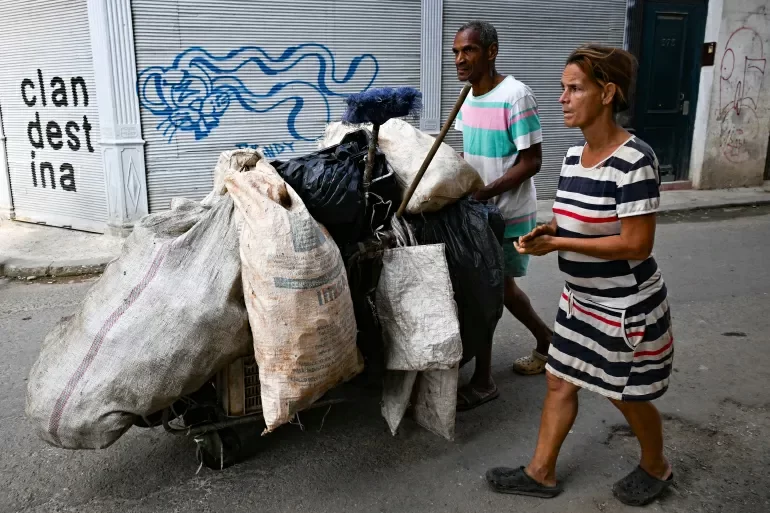
On Thursday, the United States rolled out a fresh slate of economic sanctions targeting Cuba, expanding on a months-long pressure campaign that has steadily ratcheted up tensions between Washington and Havana. The announcement came just hours after independent United Nations experts condemned the ongoing U.S. fuel blockade against the island nation as a form of “energy starvation” that inflicts severe damage on Cubans’ fundamental human rights.
The latest penalties target high-profile Cuban entities and individuals, headlined by Grupo de Administracion Empresarial SA (GAESA), a large business conglomerate controlled by the Cuban military that holds sway over nearly every major sector of the country’s economy. Ania Guillermina Lastres Morera, who serves as president of both GAESA and Moa Nickel SA (MNSA) — a nickel industry joint venture between Canadian firm Sherritt International and Cuba’s state-owned nickel enterprise — was also sanctioned. Within hours of the U.S. announcement, Sherritt International confirmed it had temporarily suspended all of its operational activities in Cuba to comply with the new measures.
U.S. Secretary of State Marco Rubio stated via social platform X that the new sanctions make clear the Trump administration will not tolerate what it frames as threats to regional security from the Cuban government. “We will continue taking action until the regime implements the necessary political and economic reforms, Rubio said.
Cuba’s government has not issued an immediate official response to Thursday’s new round of sanctions, but earlier this week, Cuban officials already denounced U.S. restrictive measures as unilateral coercive tools that amount to collective punishment of the entire Cuban population.
Washington has significantly ramped up pressure on Havana since the start of 2026, a shift that followed the kidnapping of Venezuelan leader Nicolas Maduro on January 3. Since that event, the U.S. has cut off all oil shipments from Venezuela to Cuba, and issued an executive order imposing secondary sanctions on any third countries that supply fuel to Cuba, effectively creating a full fuel blockade. President Trump has repeatedly repeated threatened military action to overthrow the Cuban government.
The three UN special rapporteurs who released Thursday’s human rights assessment emphasized that the illegal blockade not only disrupts daily life across the island, but also systematically undermines the exercise of basic human rights for all Cubans. They defined the situation as “energy starvation”, a crisis where widespread fuel shortages paralyze the essential services that are required for a dignified human existence.
The experts also noted that only one Russian oil tanker has reached Cuban ports in recent months, a shortage that has drastically worsened the existing energy crisis sparked by long-term economic stagnation on the island. Local reports confirm that fuel shortages have blocked thousands of Cubans from accessing hospitals and prevented children from traveling to school. Cuba’s public health system alone is now backlogged with more than 96,000 delayed surgeries, including over 11,000 procedures for pediatric patients.
“Energy starvation used as a tool of coercion is incompatible with international human rights standards, the UN rapporteurs warned.