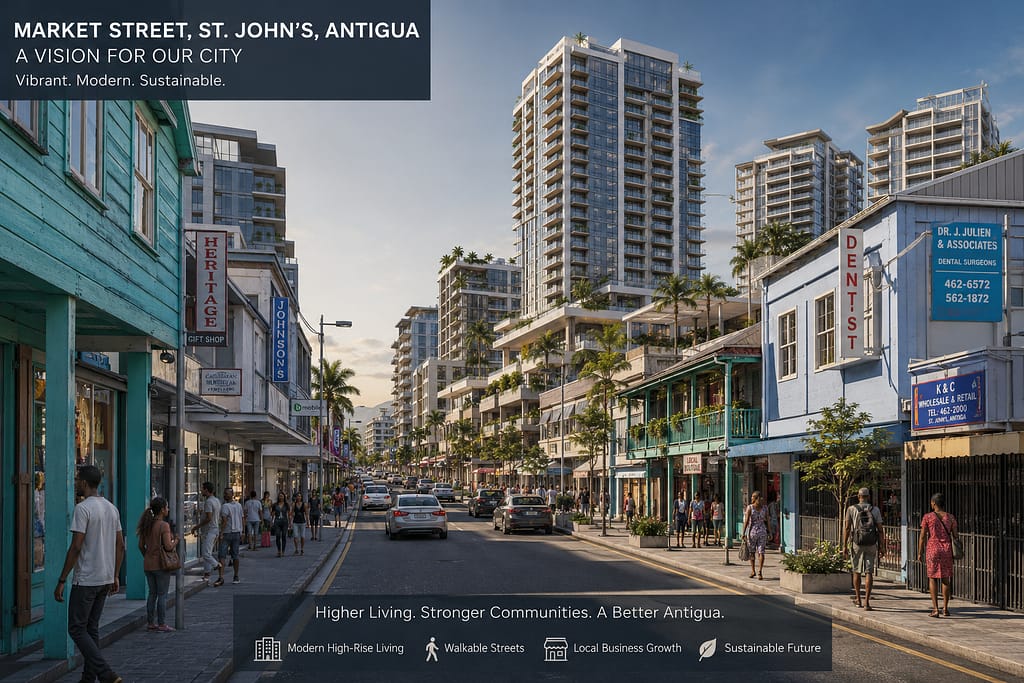
For decades, political candidates across Antigua and Barbuda have ridden a popular campaign promise into office: pledges of more available land and more standalone housing to help working families achieve the long-held dream of property ownership. This pledge resonates deeply with populations that have long tied personal and financial security to owning a stretch of land and a detached home, but the small twin-island nation can no longer ignore the growing unsustainability of its current approach to residential development.
Antigua and Barbuda’s total land supply is inherently finite, yet national development policy has clung stubbornly to a decades-old model: one plot of land, one single-family home per household. Across the islands, entire unspoiled communities are being split into thousands of tiny residential lots, paved road networks are cutting deeper into untouched natural terrain, and successive governments continue to open new swathes of land for private residential sale, acting as though crippling land scarcity remains a distant problem rather than a rapidly approaching crisis.
This fragmented, low-density model may have made practical sense generations ago, when Antigua and Barbuda’s population was far smaller, land was abundant and affordable, and the pressures of rapid development were minimal. Today, that equation no longer adds up. Every new low-density subdivision requires major public investments in extended infrastructure: new roads, expanded power grids, longer water pipelines, upgraded drainage systems, new schools, and improved highway access to connect far-flung neighborhoods to urban centers. This kind of urban sprawl places unnecessary, long-term financial strain on taxpayers, while inflicting severe environmental harm on a small island nation already on the frontlines of climate change, facing heightened risks of flooding, chronic water scarcity, and coastal erosion.
Most critically, this approach is fundamentally unsustainable for future generations. If current consumption patterns hold, what will be left of Antigua and Barbuda’s undeveloped land in 30 or 40 years? What becomes of the nation’s domestic agricultural sector when all prime farmland is converted to residential lots? How will young working people ever afford to buy property when the limited land supply is either exhausted or concentrated in the hands of a small number of private owners? These are questions the nation can no longer afford to put off answering, writes contributor Marcus Jeffers.
To avoid this bleak future, Antigua and Barbuda must immediately begin pursuing intentional, well-planned higher-density housing solutions as a core part of national housing policy. The country’s future cannot rely on endless low-density subdivisions creeping further into rural and natural landscapes. Instead, sustainable housing policy must embrace a range of alternative options: multi-unit apartment buildings, attached townhouses, condominium complexes, and even thoughtfully designed high-rise residential developments in appropriate, well-located urban zones.
For too long, cultural attitudes across many Caribbean societies have framed multi-unit apartment living as a less desirable, inferior alternative to owning a standalone single-family home on a private plot. But Jeffers points to a clear global precedent: densely populated, developed nations around the world have already adapted to limited land supplies by embracing vertical, high-density living as a pragmatic, practical solution.
Well-designed higher-density housing delivers widespread benefits that align with both affordability and sustainability goals. It makes homeownership accessible to more low- and middle-income families while preserving large tracts of open, undeveloped land. Shared infrastructure for multi-unit developments is far more cost-efficient than building separate, extended networks for sprawling subdivisions, supporting cheaper utility costs for all residents. Public transit systems become far more feasible and cost-effective to operate when more people live in concentrated areas, and residents gain easier access to jobs, schools, and essential services without the need for long commutes from far-flung neighborhoods.
This call for policy change is not an attack on the dream of homeownership, Jeffers emphasizes. It is a push for pragmatic, sustainable planning that preserves that dream for future generations rather than allowing it to be destroyed by short-term overconsumption. The dream of owning a home should not turn into a collective nightmare where the entire nation’s land supply is exhausted, putting property ownership out of reach for all coming generations.
As a small island state, Antigua and Barbuda cannot sustainably apply the sprawling land-use models designed for much larger, land-rich nations indefinitely. Opening this conversation about shifting to higher-density development may be politically uncomfortable, and may challenge long-held cultural attitudes about property and housing. But it is a conversation that cannot wait, Jeffers argues. If the nation continues to consume land at its current pace without reforming how it develops residential housing, future Antiguans and Barbudans will inherit an island where the dream of land ownership is permanently out of reach.