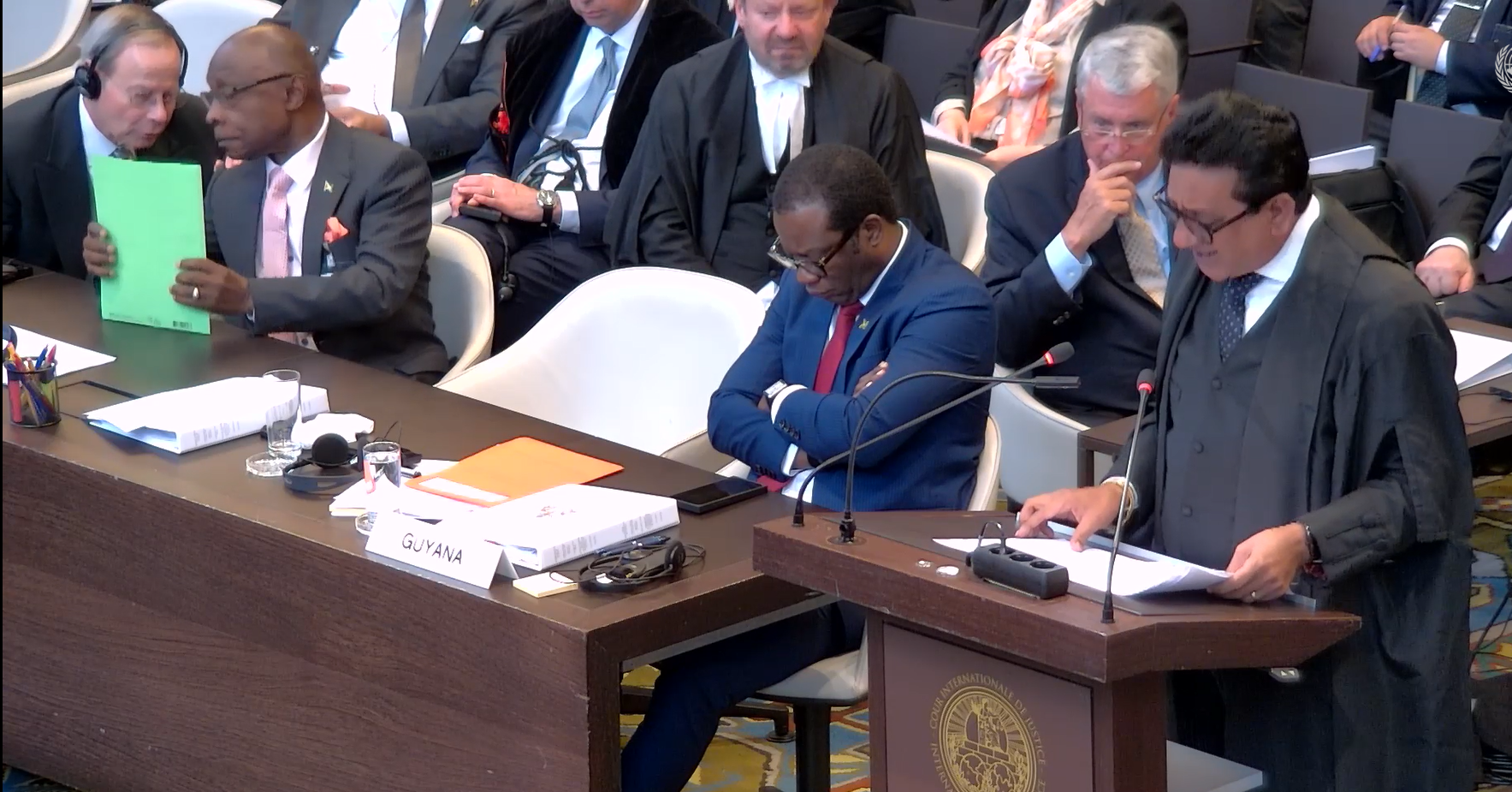
On Friday, 8 May 2026, Guyana presented its penultimate and closing oral arguments before the United Nations’ highest judicial body, the International Court of Justice (ICJ) based in The Hague, Netherlands, pushing for a definitive resolution to its decades-long territorial dispute with neighboring Venezuela.
Guyanese officials expressed cautious optimism that the ICJ will formally uphold the legal validity of the 1899 Arbitral Award, the document that originally established the full land boundary between the two South American nations. Attorney General Anil Nandlall emphasized that any vague or qualified ruling from the court would create an opening for Venezuela to perpetuate its territorial claims against large portions of Guyana’s sovereign land.
“It is essential that the court’s judgment directly, explicitly and unambiguously affirms the validity of the 1899 award in its integrity and the boundary which it established, and elucidates the ineluctable legal consequences which flow therefrom,” Nandlall told the court. “Any ambiguity or qualification in the court’s judgment will inevitably be seized upon by Venezuela as a basis for continuing to lay vast swaths of Guyana’s sovereign territory.”
Carl Greenidge, Guyana’s designated agent to the ICJ, wrapped up the country’s oral arguments by laying out a series of specific demands for the court’s final ruling. Most notably, Greenidge called on the ICJ to order Venezuela to withdraw its military forces from Ankoko Island, a territory legally recognized as part of Guyana under the 1899 award that has been occupied by Venezuelan troops since 1966.
Greenidge asked the court to issue a valid, binding judgment confirming that the boundary set out in the 1899 award and a 1905 supplementary agreement stands as the official international border between the two countries. Under this framework, he added, the court should explicitly confirm Guyana’s full sovereignty over all territory falling on its side of the border, and formally obligate Venezuela to respect that sovereignty and territorial integrity.
Citing Venezuela’s repeated failure to comply with two previous ICJ provisional orders issued on 1 December 2023 and 1 May 2025, Greenidge pressed the court to include mandatory enforcement measures in its final ruling. Beyond the withdrawal from Ankoko Island, he asked the ICJ to require Venezuela to abandon all claims of sovereignty over any Guyanese territory as defined by the 1899 award, and to refrain from any actions that violate Guyana’s sovereign rights.
Greenidge reiterated Guyana’s legal demand that Venezuela revoke all domestic measures that assert control over claimed Guyanese territory, including national laws, executive decrees, and administrative actions that purport to annex or administer land under Guyanese sovereignty. Specifically, he called for the repeal of Venezuelan legislation that purports to absorb Guyana’s Essequibo Region into Venezuelan territory and extend Venezuelan legislative, executive, and judicial jurisdiction over the area.
Greenidge also demanded that Venezuela dissolve all state entities created to exercise control over claimed Guyanese territory, most prominently the Venezuelan High Commission for the Defense of Guayana-Esequiba, along with all related executive, legislative, and administrative agencies. He added that Venezuela should be ordered to end social welfare programs and ongoing population censuses targeting the Essequibo region, as well as halt all military activities carried out to advance Venezuela’s territorial claims.
In a final demand, Greenidge stated the court should require Venezuela to stop public claims and state educational curricula that frame the 1899 Arbitral Award as invalid or fraudulent, and that portray Venezuela as having been wrongfully deprived of the Essequibo Region. Venezuela would also be required to revise all official national maps that incorrectly depict any part of Guyana’s territory as Venezuelan territory, and remove all incorrect materials from public institutions, Greenidge said.
Venezuela is scheduled to present its final oral arguments in the case next Monday, bringing the public phase of the historic proceeding to a close before the ICJ begins deliberations to issue its final binding ruling.