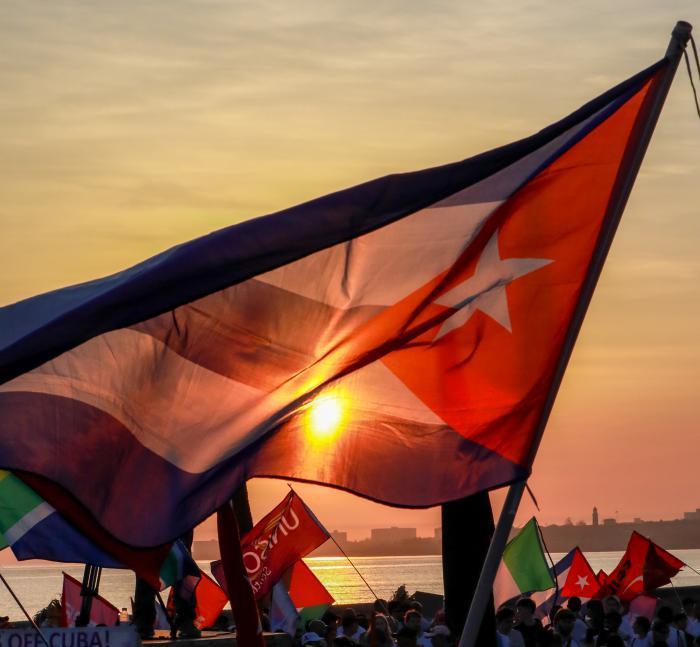
On May 1, 2026, hundreds of thousands of Cuban citizens gathered in massive, organized demonstrations across the island to voice their unified support for the country’s revolutionary government, a display of popular solidarity that directly pushes back against a years-long campaign of pressure from the United States government. According to analysis from Cuban outlet *Granma*, this open show of national unity poses a unprecedented challenge to a sitting U.S. administration that has long positioned itself as the unchallenged hegemonic power across the Western Hemisphere.
The reporting, published May 6, notes that the current U.S. policy toward Cuba is heavily shaped by hardline right-wing political interests based in Florida, with key influence exerted by high-profile figures including Senator Marco Rubio and former Inter-American Development Bank president Mauricio Claver-Carone. Cuba’s decision to openly celebrate Labor Day with a public display of grassroots backing for its sovereign system comes as Washington has spent years leveraging harsh economic sanctions to force Havana into political surrender and demobilization.
Framed by Cuban commentators as a modern David versus Goliath struggle, the Cuban people have refused to be silenced even as the U.S. has used economic pressure to create widespread hunger and hardship to force political change. In a pre-planned escalation following the demonstration, the U.S. president signed a new package of punitive sanctions designed to further subjugate Cuba, while once again openly hinting at potential military intervention to force the country into compliance.
The new U.S. policy framework relies heavily on falsehood and strategic misinformation to justify tightening the decades-long economic blockade on Cuba. The core goal of this escalating pressure, the report argues, is to force the Cuban people to abandon their hard-won independence and sovereignty, bending to the political demands of extreme opposition factions.
The entire U.S. approach to supposed talks with Cuba is described as a cynical exercise in coercion: dialogue masked as pressure, mixed with leaks, political blackmail, and non-negotiable ultimatums. What Washington frames as negotiation is in reality a trap, the analysis says: a carefully constructed plan crafted behind closed doors at the U.S. State Department by allies of anti-Castro factions based in Miami, acting on direct orders from top White House national security and diplomatic leaders. These officials take their direction from Florida’s vengeful far-right, which remains committed to restoring a corrupt, annexationist order in Havana.
The stark contrast between the two nations’ positioning on this year’s Labor Day could not be clearer: While Cuba used the occasion to reaffirm its call for peace and an end to the decades-long U.S. blockade, the U.S. responded with threats of military power and new punitive measures. The massive May 1 demonstration, which drew the equivalent of more than 6 million participants across the country, stands as a collective rebuke to what Cuba describes as a genocidal threat of foreign aggression.