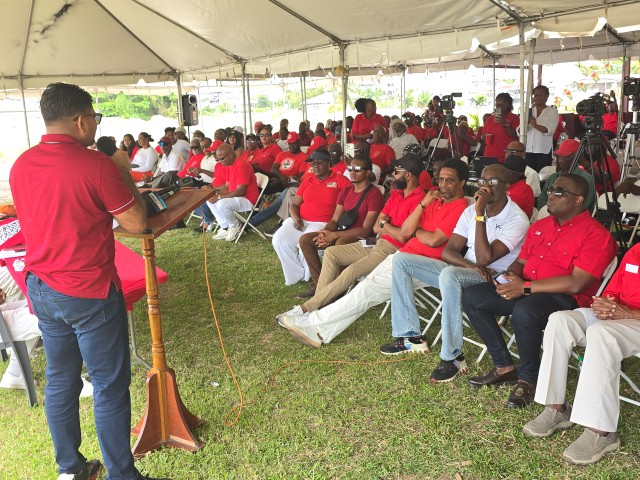
On May 1, 2026 — International Labour Day — Guyana’s main opposition figures gathered with members of the Guyana Trades Union Congress (GTUC) following a low-turnout parade to mount a coordinated call for cross-group unity aimed at unseating the incumbent People’s Progressive Party Civic (PPP-C) administration ahead of the 2030 general and regional elections.
The march, which stretched from Georgetown’s Parade Ground to Woolford Avenue, drew only 300 attendees representing affiliated GTUC unions, a far smaller crowd than organizers had anticipated. Even with the muted turnout, speakers at the subsequent post-rally meeting held at the Guyana Local Government Officers Union used harsh language to criticize the ruling government’s record on worker rights and economic policy.
GTUC President Norris Witter opened the sharp critiques, framing the PPP as a public hazard that required collective action to eliminate. “For me the PPP is a dangerous disease and, therefore, we must work together to determine what kind of dangerous medicine is required to get rid of this disease,” Witter stated, arguing that broad-based unity — rather than divisive sectarian politics — was the only path to removing the government from power.
Dr. Terrence Campbell, parliamentary leader of the main opposition bloc A Partnership for National Unity (APNU), expanded on this call, extending the demand for unity beyond opposition political parties to include trade unions and civil society groups. Campbell labeled the current administration a “wicked, evil, inhumane, despicable regime” and urged union members to back opposition-led protests on any issue — from cash grant increases to electoral reform — ahead of the 2030 vote. “When we call a protest whether it be for cash grants or a protest for a new voters list or biometrics; whether invited or uninvited, I would expect to see my union brothers standing there with us,” Campbell said.
Azruddin Mohamed, Guyana’s Opposition Leader, echoed Campbell’s calls, pressing unions to mobilize around core worker grievances that include stagnant low wages and retaliatory administrative measures, such as punitive transfers for public sector workers who oppose the ruling government. Mohamed confirmed that he had provided financial support to the Guyana Teachers Union (GTU) during its recent strike for higher salaries, and committed that all opposition parties would collaborate with organized labor to secure better compensation and working conditions for public servants.
Mohamed also took aim at the government’s recent policy priorities, questioning how the country’s nearly GY$6 trillion 2026 national budget has failed to deliver tangible improvements to working people. He pointed specifically to a May Day brunch hosted by President Irfaan Ali for nurses at State House, noting that the healthcare workers face a three-year wait to receive just GY$16,000 in promised compensation, while First Lady Arya Ali conducted an official visit to Singapore. Closing his remarks, Mohamed urged union leadership to reorganize and mobilize to deliver a much larger turnout for the 2027 May Day parade, emphasizing that collective organizing is the only way to oust what he called a “dictatorship, deceitful, treacherous government.”
The event also exposed ongoing rifts within Guyana’s broader opposition coalition. Dorwain Bess, leader of the Vigilant Political Action Committee (VPAC), publicly called on Mohamed to honor his pledge to build genuine, inclusive collaboration across all opposition factions. Bess and his former coalition partner Amanza Walton-Desir of the Forward Guyana Movement have been locked in a public dispute over parliamentary representation following last September’s general and regional elections. Veteran politician Hamilton Green, who entered Guyanese politics shortly after completing his education, noted that the opposition’s biggest immediate challenge remains convincing ordinary Guyanese to join their political struggle.