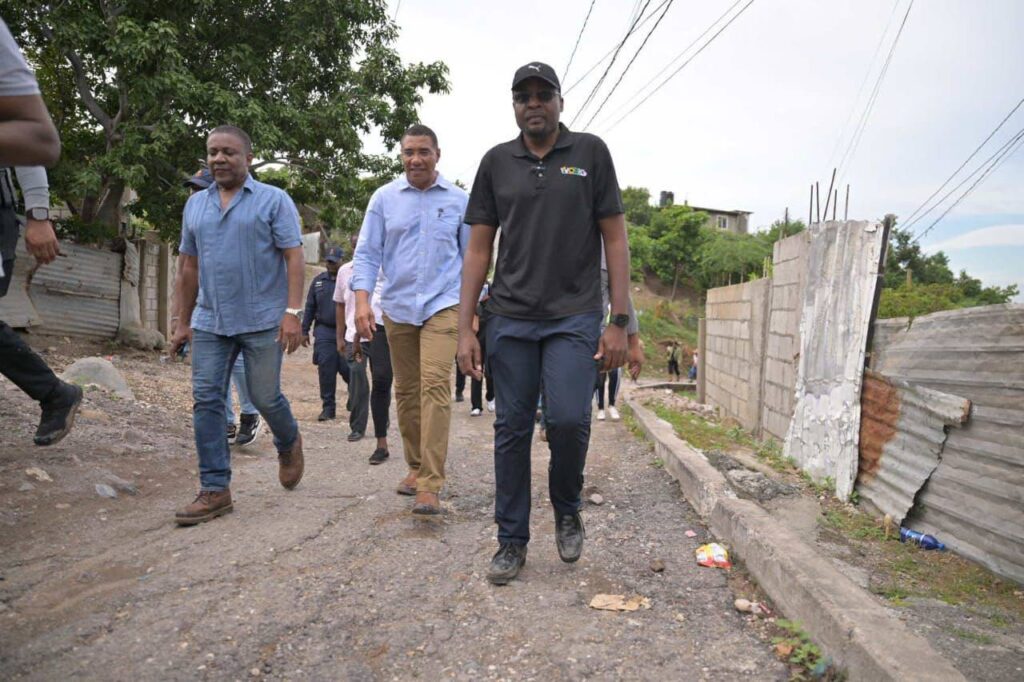
Jamaica’s Minister of Works Robert Morgan has reaffirmed the Andrew Holness-led administration’s commitment to delivering on a key electoral promise: the rehabilitation of 10 roads in every parliamentary constituency across the country, through a second phase of the flagship Shared Prosperity through Accelerated Improvement to our Road Network (SPARK) infrastructure initiative.
In an interview with the Jamaica Observer this Thursday, Morgan clarified that the first phase of the programme, SPARK 1, is scheduled to wrap up during the first quarter of the next fiscal year, making way for the launch of SPARK 2 to fulfill the original 10-roads-per-constituency commitment. “This was a core pledge in our election manifesto, and the prime minister has been unwavering in seeing this promise through. SPARK 2 was always planned to address gaps left by the first phase of works,” Morgan added.
The minister’s comments came in response to reports emerging from Wednesday’s sitting of Parliament’s Public Administration and Appropriations Committee (PAAC), where National Works Agency (NWA) CEO EG Hunter revealed that initial budget allocations for SPARK 1 would not be sufficient to complete all 10 identified roads per constituency. Hunter explained that when communities first participated in consultations to select priority road projects, no accurate cost estimates had been prepared. The number of roads that can be completed under the current budget, he noted, depends entirely on the actual cost of each selected project: if the first one or two roads in a constituency consume a large share of the allocation, fewer remaining roads can be addressed. As it stands, more than 250 of the 630 initially identified roads will not see any work under SPARK 1.
Morgan pushed back on suggestions the government was backing away from its promise, explaining that the $45-billion SPARK programme – the most ambitious infrastructure initiative Jamaica has ever undertaken – has required budget adjustments that were always anticipated. He noted that the government never claimed one single phase of works could repair every deficient road across the island in one go.
“Unforeseen circumstances have pushed up the required investment far beyond our initial estimates,” Morgan explained. “We have found far more roads that need accompanying water pipe replacement than we originally projected, and many existing road designs required far more extensive upgrades than initial costings accounted for.” He pointed to the programme’s launch site, Everest Drive in Eastern Kingston, as a case in point: the project was originally budgeted at $70 million, but ended up costing $100 million after engineers determined additional retaining walls and expanded drainage infrastructure were required to deliver a durable, long-lasting road.
Morgan emphasized that the government has made a deliberate policy choice to prioritize quality of construction over speed and volume, a shift designed to end Jamaica’s long history of short-lived road repairs. “We are not cutting corners. Our goal is to build roads that last 10 to 15 years. If we cut corners, they won’t even last five years. The old routine – just lay asphalt, and two years later you have potholes, swollen road surfaces, burst water pipes, and the National Water Commission (NWC) has to dig up the whole road again – that is going to end,” he said.
The minister added that the Holness administration has already learned critical lessons from early challenges in the SPARK programme. For example, at both Richings Avenue and Liguanea Avenue, repaired sections of road were dug up by the NWC for pipe work just four months after construction was completed – a miscoordination that has led to better inter-agency planning moving forward. “This is an unprecedented project: Jamaica has never delivered 400 road upgrades under a single programme before. This is new territory for the NWA, for lead contractor China Harbour Engineering Company, for all our subcontractors, and for the NWC. We have adjusted our processes as we go to fix these early issues,” Morgan said.
While Morgan confirmed that SPARK 2 was a core manifesto commitment and planning is already underway – with instructions issued to the NWA to begin preparation work – he noted that the programme will not necessarily launch immediately after SPARK 1 concludes in the first quarter of next year. For the current SPARK 1 phase, most constituencies will see between five and eight roads completed. Morgan used his own constituency, Clarendon North Central, as an example: only five roads will be finished in the first phase. By contrast, St James North Western, a smaller constituency represented by MP Dr Horace Chang, will see all 10 promised roads completed under SPARK 1, and most constituencies in Portmore will also see the majority of their identified roads finished in the first phase.