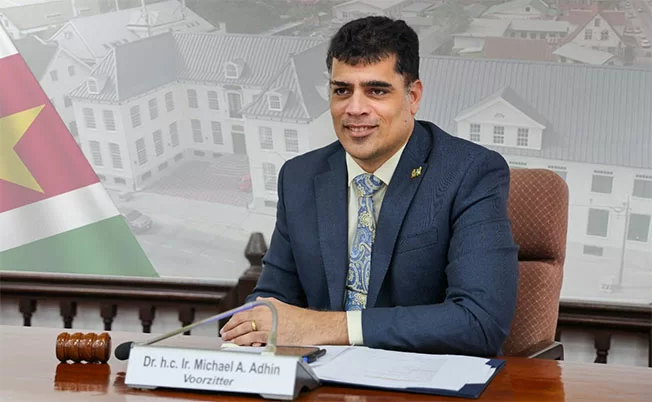
Suriname’s National Assembly Speaker Ashwin Adhin has outlined the primary factors slowing the country’s legislative process, while pushing back against criticism of the current parliament’s low output of passed laws, arguing that thorough, high-quality lawmaking serves the nation better than rushed, error-ridden legislation. In an exclusive interview with local outlet Starnieuws, Adhin identified deep political division across political factions and extended preparation requirements for bill reviews as the two leading causes of delayed legislative action.
Adhin explained that differing policy positions between parliamentary factions and frequent absences of elected members regularly force delays to the review of critical draft laws. Even within ruling coalition blocs and opposition groups, competing perspectives on sensitive pieces of legislation are common, requiring extended rounds of additional negotiations and consensus-building before bills can advance to plenary votes. While Adhin stressed that open disagreement is a natural, healthy component of democratic governance, he acknowledged that this political reality directly impacts the speed at which new laws can be enacted.
Beyond ideological divides, the speaker also highlighted persistent challenges with achieving legislative quorum. When too few assembly members are present to meet the minimum attendance requirement, scheduled sessions cannot proceed and planned votes must be pushed back to a later date. To mitigate this issue, Adhin noted he now proactively coordinates with faction leaders ahead of planned sessions to confirm attendance numbers, and will cancel scheduled meetings if it is clear quorum will not be met. “If I know in advance there will be no quorum, I will not schedule a meeting,” he said.
Adhin defended the current parliament’s legislative pace, arguing that the body should not be judged solely on the total number of bills passed, but rather on the quality and careful consideration that goes into each new law. Behind the public plenary sessions, he explained, parliamentary committees carry out intensive work to review bill content, propose amendments, and conduct rigorous legal testing to ensure legislation is sound. Rushed lawmaking, he warned, creates far larger problems down the line.
To illustrate the risks of hasty legislative action, Adhin pointed to past flawed judiciary reform laws. While the Law on the Legal Position of the Judiciary took multiple years to enact, critical provisions related to funding were not fully calculated or detailed during the drafting process. This has required major, costly corrections after the law entered into force, demonstrating the cost of cutting corners. “Better to take a little extra time and get it right, than to fix mistakes after a law has already been adopted,” Adhin said, outlining his core governing principle.
Currently, anti-money laundering and counter-terrorism financing legislation top the national assembly’s legislative agenda. Adhin emphasized these bills carry urgent priority, as Suriname must meet binding international regulatory obligations to avoid damage to the country’s financial reputation and an increased risk of being placed on an international financial blacklist. A new round of international compliance assessments is scheduled this year, but multiple required bills still need to be finalized to meet the deadline.
Over the first nine months of the current parliament’s term, 294 meetings have been scheduled, of which 264 have been held. Eighteen draft bills have been introduced for review, but only three have been passed into law to date. Adhin projected that a larger batch of bills will be finalized in the coming months, with priority given to legislation tied to Suriname’s economic, financial, and governance priorities. Over the next nine-month period, he aims to see between 30 and 35 full bills passed and enacted, a major jump from the first term’s output.
“A parliament should not rush to produce output just to hit numerical targets,” Adhin said. “It should legislate responsibly and sustainably in the interest of the people of Suriname.”
Adhin is currently out of the country for a private visit to the Netherlands, and will remain away through May 5. While in Europe, he will also meet with Surinamese diaspora community leaders and potential international investors in coordination with the Surinamese embassy in The Hague. Despite his absence, a public plenary session on the new Fire Department Law remains scheduled as planned for the day of the interview.