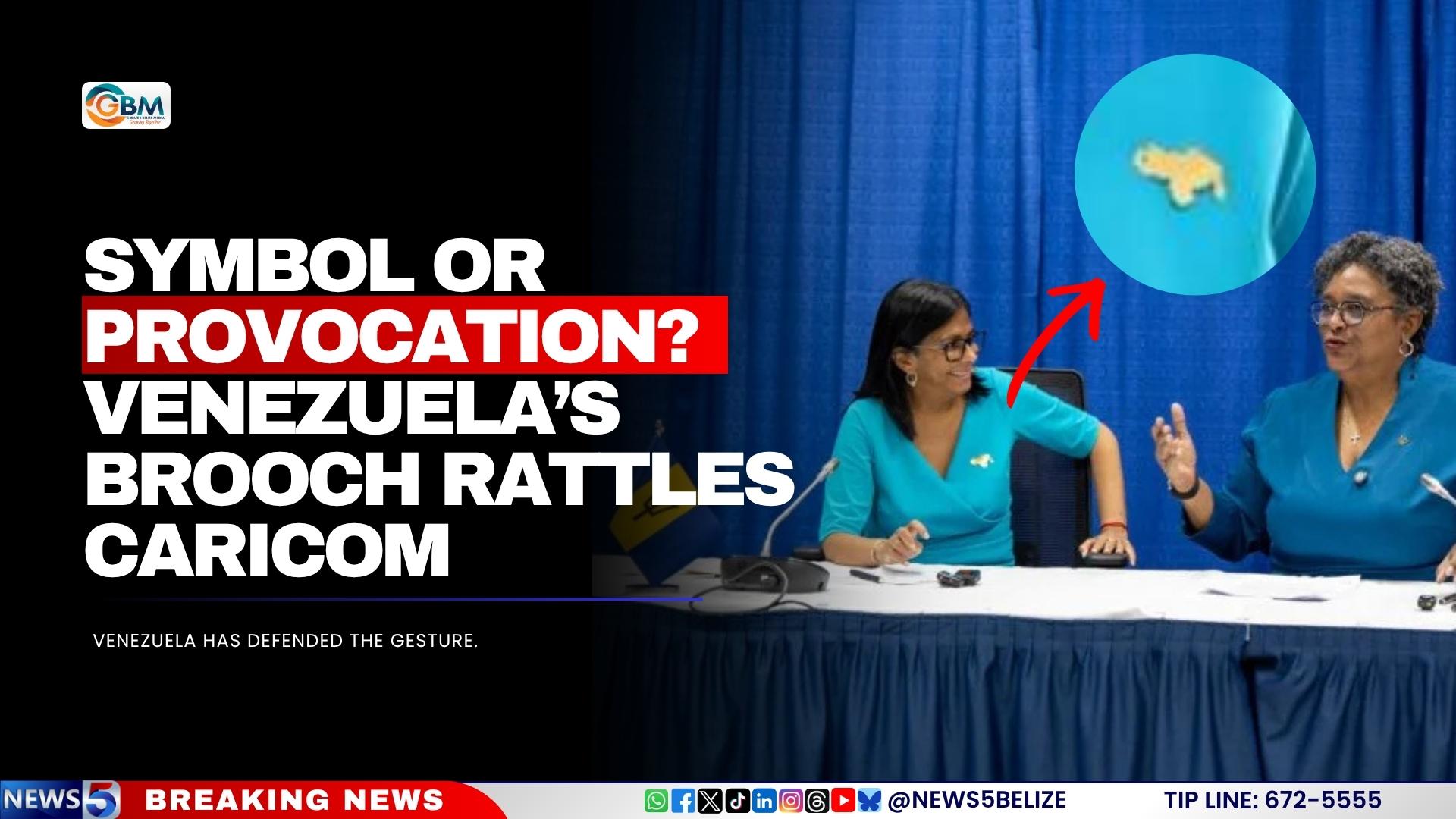
A seemingly small accessory has sparked a major diplomatic firestorm between Venezuela and Guyana, prying open a decades-old territorial dispute that has already strained regional relations and is currently under international legal review. The controversy ignited during a recent Caribbean tour by Venezuelan acting president Delcy Rodríguez, when she wore a brooch emblazoned with a map that incorporates the contested Essequibo region – territory Guyana claims as its own – directly into Venezuelan national borders.
Rodríguez displayed the brooch openly during high-level official meetings with leaders in Barbados and Grenada, two member states of the 15-nation Caribbean Community (CARICOM), earlier this month. The deliberate display drew immediate and sharp pushback from Guyanese President Irfaan Ali, who labeled the gesture a deliberate provocation meant to advance Venezuela’s long-held territorial claim through extrajudicial means.
In a formal circulated letter addressed to all CARICOM heads of government, Ali emphasized that the brooch was far more than a trivial symbolic gesture. With the decades-long border dispute already being adjudicated by the International Court of Justice (ICJ), Ali warned that actions like this could erode trust in the peaceful legal process that both sides have agreed to use to resolve the conflict.
Unapologetic, Venezuelan officials have stood firm in defending the accessory. Rodríguez herself dismissed the criticism, arguing that the brooch simply reflects Venezuela’s long-standing position that the Essequibo region is inherently part of the country’s historic national territory. Venezuelan Foreign Minister Yván Gil doubled down on this defense, framing Guyana’s outrage as nothing more than a calculated distraction from the strength of Venezuela’s underlying territorial claim.
The controversy has placed CARICOM, the key regional integration bloc that counts both Venezuela and Guyana as members, in a difficult diplomatic position. In an official public statement released after the incident, the bloc formally acknowledged Guyana’s concerns, reiterated its unwavering commitment to upholding Guyana’s sovereign rights and territorial integrity, and called on all member states to adhere to international law and refrain from any actions that could disrupt the ongoing ICJ proceedings.
The roots of the Essequibo conflict stretch back more than a century to an 1899 international arbitration ruling that granted the territory, which accounts for roughly two-thirds of Guyana’s current total land area, to the South American nation. Venezuela has refused to recognize the validity of that ruling from its inception, and tensions between the two neighbors have surged dramatically in recent years. The escalation accelerated following major commercial oil discoveries in the Essequibo region by international energy firms including ExxonMobil, turning a long-dormant border dispute into a high-stakes strategic and economic conflict.
The ICJ formally accepted the case for adjudication in 2018, and scheduled hearings have been progressing as both parties submit legal arguments and evidence to support their positions. Rodríguez’s tour of Caribbean nations was originally intended to deepen diplomatic and economic ties between Venezuela and regional CARICOM members, but the brooch incident has instead laid bare deep underlying divisions across the Caribbean on the dispute, and cast new uncertainty over the future of peaceful diplomatic relations between Caracas and Georgetown.