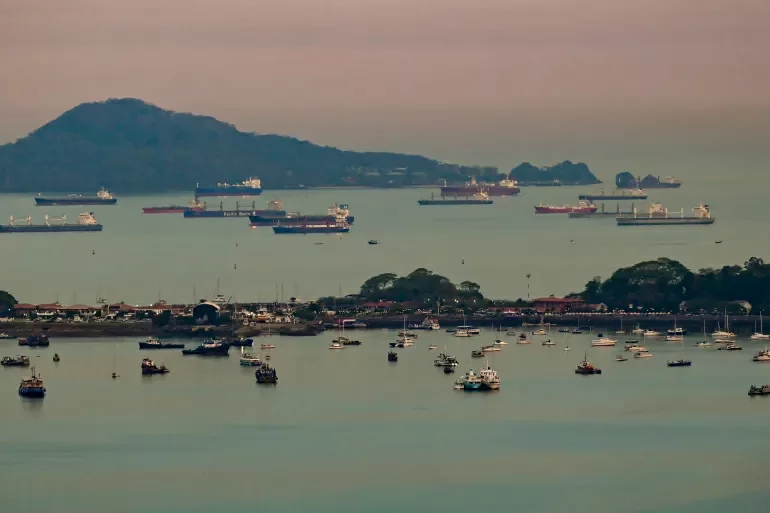
A growing geopolitical standoff over control of key Panama Canal ports has drawn in six nations, with Bolivia, Costa Rica, Guyana, Paraguay, Trinidad and Tobago, and the United States issuing a joint statement backing Panama and criticizing what they call unfair Chinese economic retaliation. The conflict traces back to a late January ruling from Panama’s Supreme Court, which voided decades-old contracts granting Hong Kong-based conglomerate CK Hutchison rights to manage the strategic Balboa and Cristobal port terminals along the canal, ruling the agreements unconstitutional.
In the joint statement released Tuesday, the six countries allege that in response to the court’s independent ruling, China has imposed targeted economic pressure on vessels flying the Panamanian flag. Data from the U.S. Federal Maritime Commission (FMC) confirms that China detained nearly 70 Panamanian-flagged ships in March alone, a volume far exceeding typical inspection levels.
“These actions, coming after the independent Panamanian Supreme Court’s decision on the Balboa and Cristobal terminals, represent a clear effort to politicize global maritime trade and violate the national sovereignty of countries in our region,” the joint statement reads. U.S. Secretary of State Marco Rubio separately emphasized Washington’s position in a post on platform X, noting that the U.S. is “deeply concerned” by Chinese pressure on Panama. “We stand in solidarity with Panama. Any attempt to undermine Panama’s sovereignty is a threat to all of us,” Rubio stated.
China has already pushed back against the criticism, accusing the U.S. of bullying and attempting to tarnish its reputation across Latin America. The Chinese government has also publicly labeled the Panamanian Supreme Court’s ruling as “absurd” and “disgraceful”.
FMC Chair Laura DiBella warned last month that China’s detention of Panamanian-flagged vessels carries significant consequences for both Panama and the United States. “These heightened inspections appear specifically designed to punish Panama following the termination of Hutchison’s port operations,” DiBella explained. She added that because a large share of U.S. container trade moves on vessels registered under the Panamanian flag, the Chinese actions could carry major commercial and strategic ripple effects for the U.S. shipping sector.
The voiding of CK Hutchison’s contracts came amid heightened global attention to the Panama Canal, driven by former U.S. President Donald Trump’s repeated threats to take control of the strategic waterway during his 2025 presidential campaign. Trump made the 80-kilometer canal a core policy priority for his second term, claiming in his January 2025 inaugural address that China controlled the canal and promising the U.S. would “take back” control.
Beyond pressure on Panamanian-flagged shipping, U.S. officials confirm China has also retaliated against global shipping giants Maersk and Mediterranean Shipping Company (MSC), the two firms awarded temporary operating contracts for the Balboa and Cristobal terminals after CK Hutchison was removed from the project. The FMC reported in March that both companies were summoned for “high-level talks” by China’s Ministry of Transport, and Chinese state-owned shipping giant COSCO has already suspended all operations at the Balboa terminal in response to the change.
CK Hutchison, through its local subsidiary Panama Ports Company, has launched an international arbitration case against the Panamanian government, seeking more than $2 billion in damages for the canceled contracts.
Analysts frame the dispute as part of a broader global trend of nations weaponizing maritime shipping for geopolitical gain. David Smith, an associate professor at the University of Sydney’s United States Studies Centre, calls the Panama Canal conflict the latest example of this shift, which has already played out in hotspots from the Strait of Hormuz to the Red Sea.
“We have always assumed the global economy runs on freely moving container ships,” Smith told Al Jazeera. “Now, we are seeing that states recognize how vulnerable maritime supply chains are. They understand they can disrupt shipping routes when it serves their political goals. It should come as no surprise if ships and global shipping more broadly become pawns in international great power politics going forward.”