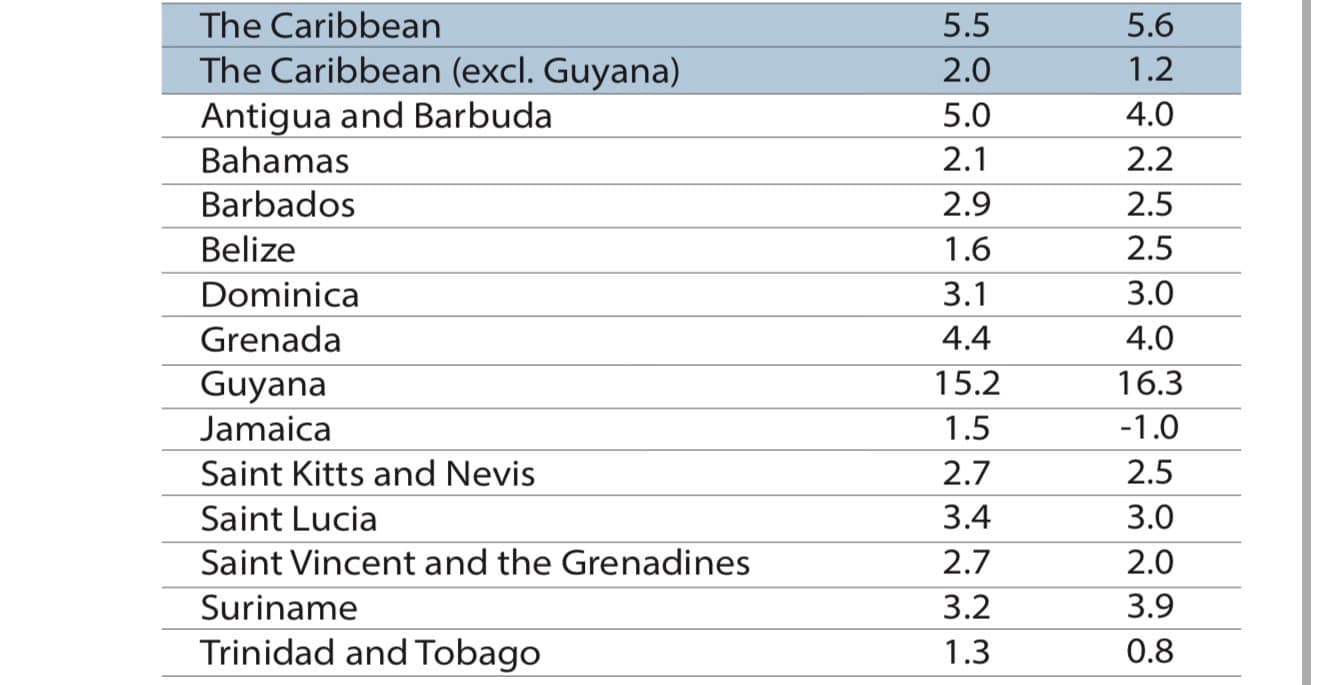
Against a backdrop of moderating economic momentum across Latin America and the Caribbean, the Economic Commission for Latin America and the Caribbean (ECLAC) has released updated projections that position Antigua and Barbuda as a standout performer in 2026, with a projected 4.0% annual economic expansion.
The latest forecast builds on an estimated 5.0% growth for the twin-island nation in 2025, highlighting the unexpected resilience of its tourism-reliant economy at a time of mounting global economic uncertainty. Unlike many of its regional peers, Antigua and Barbuda is set to maintain solid growth even as ECLAC has revised down the broader regional outlook for 2026, cutting projections to an average of just 2.2% growth across Latin America and the Caribbean amid a increasingly difficult international operating environment.
ECLAC’s analysis shows that growth will decelerate in 24 of the region’s 33 individual economies, marking a broad-based slowdown across the bloc. Antigua and Barbuda’s 4.0% projected expansion puts it nearly double the regional average, cementing its status as one of the Caribbean’s strongest-performing small island economies.
The commission attributes the region-wide slowdown to a confluence of persistent external pressures. Heightened geopolitical frictions across major global powers have created widespread market uncertainty, while stubbornly elevated inflation and tighter global financial conditions continue to constrain business and consumer activity. Persistently high oil and food prices have kept inflationary pressures stickier than many policymakers anticipated, while slowing growth in the world’s largest economies and sluggish global trade expansion have cut into external demand for regional exports. Meanwhile, major central banks have kept monetary policy comparatively tight, leaving borrowing costs restrictive for both governments and private businesses across the developing world.
The Caribbean sub-region paints an even more uneven picture, ECLAC notes. Aggregate Caribbean growth is projected to hit 5.6% in 2026, but that headline figure is skewed dramatically by the rapid oil-driven expansion of Guyana. When Guyana is removed from the calculation, underlying growth across the rest of the Caribbean falls significantly, highlighting the deep divergence in economic trajectories across Caribbean nations.
Looking beyond short-term projections, ECLAC has warned that structural challenges continue to hold back long-term prosperity across the whole region. These persistent constraints include limited potential for sustained long-term growth, widespread vulnerability to external economic and climate shocks, and soft domestic demand in multiple major economies. To counter these headwinds, the commission says that boosting productive investment, lifting labor and business productivity, and building greater economic resilience to external shocks will be critical to delivering sustained, inclusive growth in the coming years.
For Antigua and Barbuda, the 4.0% 2026 growth projection signals that the nation is on track for continued macroeconomic stability, even as global headwinds and regional slowdown trends create ongoing challenges that policymakers will need to navigate.