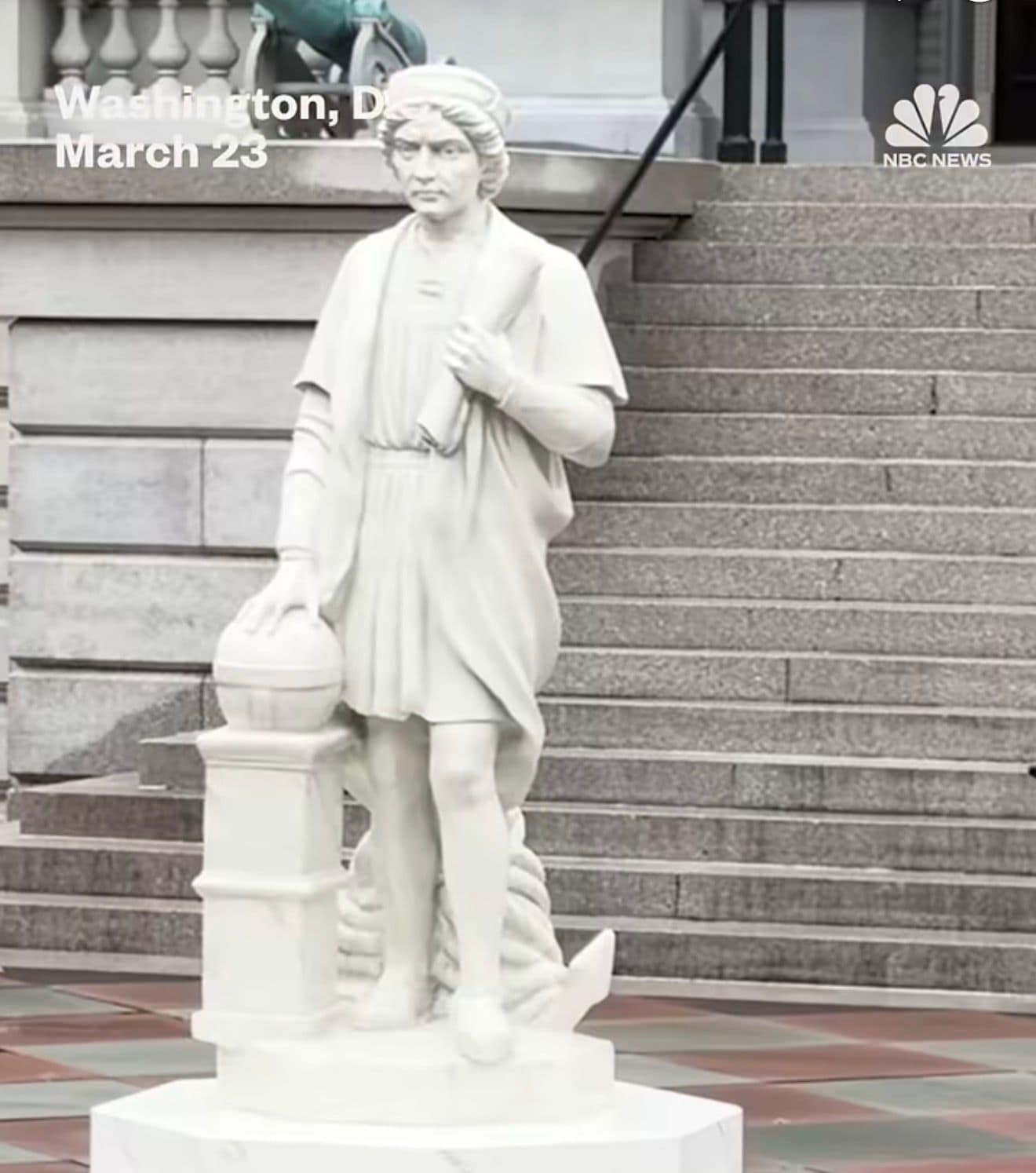
Over the weekend, a 13-foot replica statue of Christopher Columbus — cast using fragments recovered from the original monument torn down and thrown into Baltimore’s Inner Harbor during 2020’s national racial justice protests — was installed on the White House campus, outside the historic Eisenhower Executive Office Building. The placement marks the latest step in the Trump administration’s sweeping initiative to restore controversial historical monuments removed across the United States in the wake of widespread demonstrations following George Floyd’s murder.
The project was completed in partnership with the Conference of Presidents of Major Italian American Organizations, which coordinated the transfer of the replica to Washington to coincide with the United States’ upcoming 250th anniversary of independence and to celebrate Italian American cultural heritage. In a published letter to the organization, President Donald Trump lauded the group for its “incredible generosity” in bringing the monument to the nation’s capital, describing the original Baltimore statue as having been “torn down by anti-American rioters.”
White House spokesperson Davis Ingle reiterated the administration’s position in a Monday statement to CNN, affirming that “as we celebrate our Nation’s 250th anniversary of independence, the White House is proud to honor Christopher Columbus’s legendary life and legacy with a well-deserved statue on the White House grounds.” Echoing the president’s framing, Ingle added that “in this White House, Christopher Columbus is a hero, and President Trump will ensure he’s honored as such for generations to come.”
Basil Russo, president of the Conference of Presidents of Major Italian American Organizations, noted that for the more than 18 million Italian Americans living in the U.S., monuments to Columbus have long served as critical symbols of communal pride and cultural identity. “For over a century, Columbus’s legacy helped Italian immigrants navigate prejudice and hardship, serving as a source of unity and belonging as they built new lives in this country,” Russo said in the organization’s official release.
In his own remarks on the statue, Trump expanded on this framing, calling Columbus “the original American hero, a giant of Western civilization, and one of the most gallant and visionary men to ever walk the face of the earth.” He added that Columbus’ 1492 voyage “carried thousands of years of wisdom, philosophy, reason, and culture across the Atlantic into the Americas.”
The statue, which stands across from the Smithsonian’s Renwick Gallery and steps from the White House residence, is currently cordoned off by multiple rows of fencing and closed to close public viewing. Its installation comes as part of a broader nationwide reckoning over historical commemoration that unfolded after the 2020 racial justice protests, during which hundreds of controversial monuments — including hundreds of Confederate memorials and dozens of Columbus statues — were removed by local governments or pulled down by protesters.
Columbus has remained a deeply divisive figure in U.S. historical memory for centuries: while long popularized as the explorer who “discovered America,” a widely repeated myth that overlooks millennia of Indigenous habitation of the continent and earlier transatlantic contact by Norse explorers, he is widely criticized by scholars and activists for his brutal exploitation of Indigenous communities in the Caribbean and his role in opening the era of European colonization that led to the mass displacement and death of Indigenous populations across the Americas.
This installation is not the first controversial monument restoration carried out by the Trump administration in Washington, D.C. The administration has already reinstalled a statue of Confederate officer Albert Pike in the district, and has announced formal plans to return a Confederate memorial to Arlington National Cemetery in Virginia.