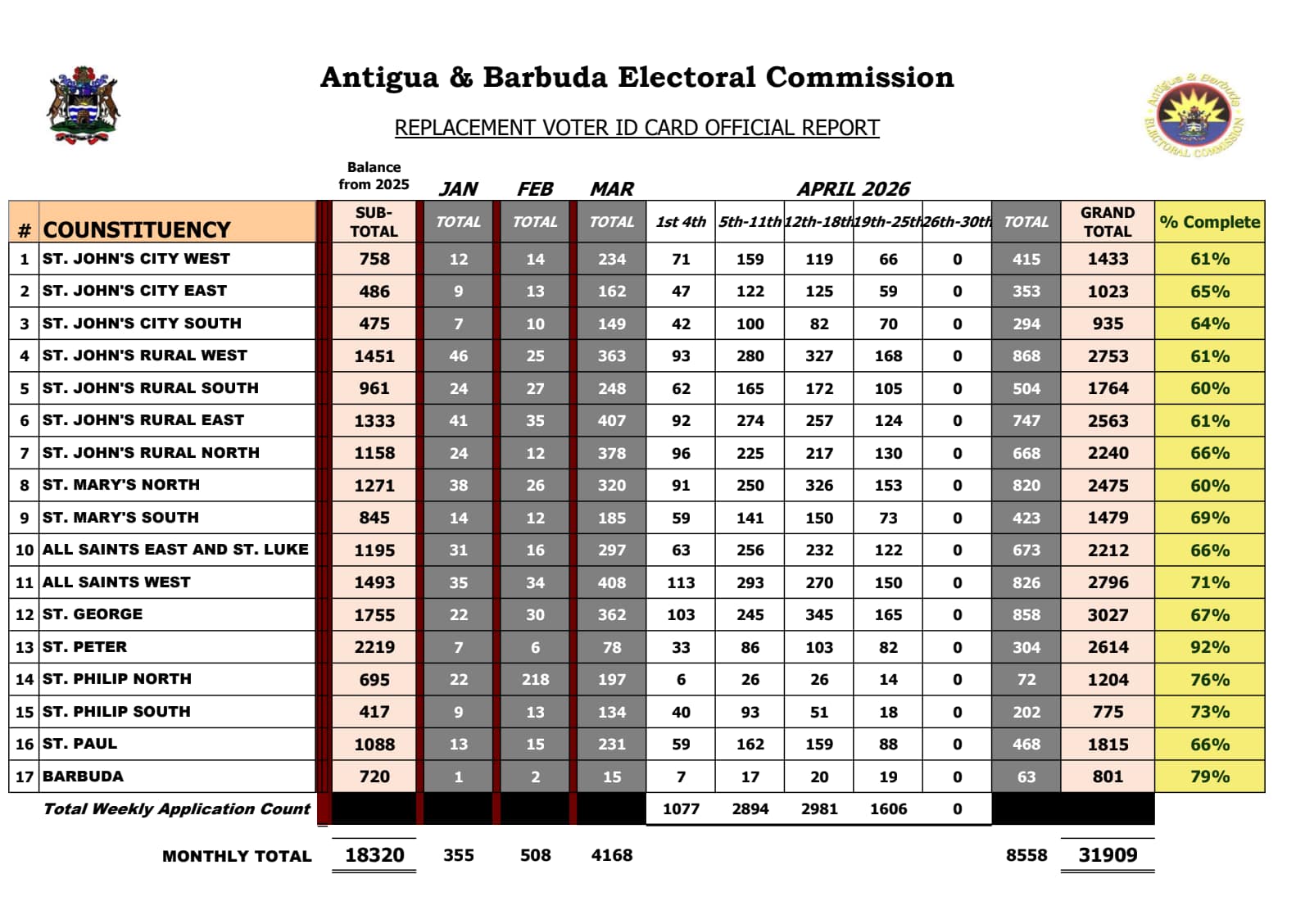
The Electoral Commission of Antigua and Barbuda has announced consistent incremental advances in its nationwide voter identification card replacement initiative, confirming that more than 31,900 applications from eligible voters have been finalized as of the April 2026 reporting period.
Breaking down the latest official statistics, the electoral body processed 8,558 replacement applications throughout the month of April, pushing the cumulative total of completed requests to 31,909. For the final full week of the month, spanning 19 to 25 April, commission teams completed work on 1,606 replacement applications, while also adding 178 entirely new voter registrations to the system.
One of the most notable trends emerging from the data is the stark gap in completion rates across the country’s 16 parliamentary constituencies. St. Peter has emerged as the clear leader in implementation, with 92 percent of all its eligible voters already submitting and receiving approval for their new ID cards. Four other constituencies have also cleared the 70 percent completion threshold: St. Philip North at 76 percent, St. Philip South at 73 percent, All Saints West at 71 percent, and Barbuda, the nation’s smallest electoral district, at 79 percent.
On the opposite end of the spectrum, multiple constituencies have yet to cross the 60 percent completion mark. St. John’s City West, St. John’s Rural West, and St. Mary’s North are all hovering just below or at the two-thirds completion target the commission has highlighted as a key benchmark. The lowest completion rates recorded in the latest data were 60 percent, shared by both St. John’s Rural South and St. Mary’s North.
Digging into the granular daily data from the 19–25 April reporting week, application processing volumes followed a predictable upward-then-downward curve, peaking early in the week before tapering off. The busiest single day was 20 April, when commission staff finalized 393 applications, followed closely by 335 completed requests on 21 April. By the final day of the reporting window, 25 April, daily processing volumes had dropped to 73 applications.
Even with this week-to-week fluctuation and the recent slowdown in processing volumes, commission officials have emphasized that voter engagement remains consistent across the vast majority of constituencies. For the 19–25 April week, St. John’s Rural West logged the highest number of processed applications at 168, followed by St. George at 165 and St. Mary’s North at 153. Barbuda, despite its small eligible voter population, recorded 19 applications during the same period, keeping its overall completion rate among the highest in the country.
With more than a third of constituencies still falling short of the 66 percent completion target, the Electoral Commission is continuing its outreach campaign to encourage all registered eligible voters to complete their ID replacement applications. Commission leaders have stressed that the initiative is a critical foundational step to maintain an accurate, transparent, and secure national electoral register ahead of upcoming general elections. To date, no official deadline for the completion of the replacement programme has been announced, but officials confirmed that targeted outreach and education efforts will be ramped up in constituencies with the lowest completion rates in the coming weeks.
Overall, the latest official data confirms that the programme is moving forward at a steady nationwide pace, though progress remains uneven across electoral districts. Electoral authorities have set a clear priority to close the performance gap between high- and low-performing constituencies over the coming weeks to get the initiative back on track ahead of future electoral events.