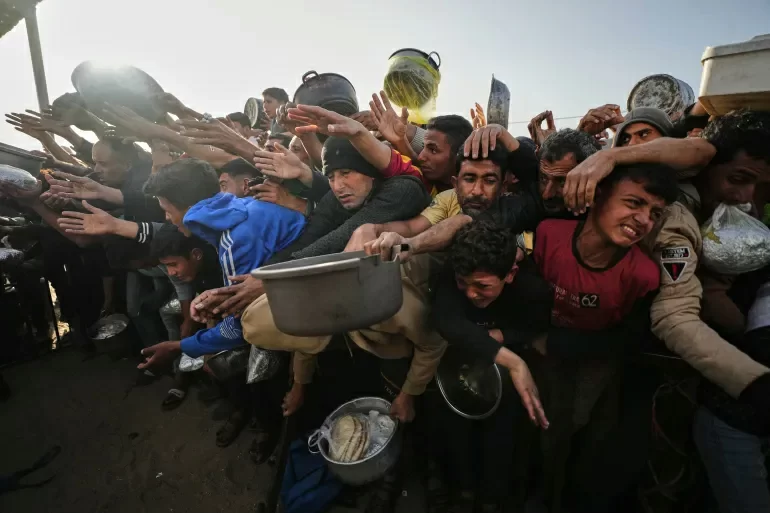
On the first day of the Islamic holy month of Ramadan, displaced Palestinian families in Khan Younis, Gaza Strip, struggled to access donated food for their daily iftar meal that breaks the fast. The scene, captured in an Associated Press photograph, underscores the devastating reality of a global food crisis that has reached new alarming heights, according to the 2026 edition of the Global Report on Food Crises (GRFC).
Published by a collaborative coalition of 18 international humanitarian and development organizations, the 2026 GRFC finds that the global count of people facing acute food insecurity remains at disturbingly high levels and continues to rise year over year. In 2025 alone, more than 266 million people across the globe experienced acute hunger, marking a small but concerning increase from 2024 figures and nearly doubling the total recorded in 2016.
The report confirms that persistent conflict and widespread violence remain the single largest driver of acute hunger worldwide, responsible for pushing nearly 150 million people into food insecurity in 2025. Alongside armed conflict, extreme climate events and destabilizing economic shocks also act as major contributing factors that exacerbate food system vulnerability across low- and middle-income nations.
In a historic and troubling milestone, 2025 marked the first time since formal global hunger monitoring began that famine was officially declared in two separate regions: parts of the Gaza Strip and Sudan. To meet the official classification of famine, at least 20 percent of households must face extreme food shortages, over 30 percent of the population must suffer from severe acute malnutrition, and hunger-related mortality must cross a critical threshold. In both regions, these grim benchmarks were surpassed in 2025.
The Gaza Strip bore the worst burden of the crisis, with 640,700 people – 32 percent of its entire population – trapped in famine conditions, the highest proportional share recorded globally. Sudan followed close behind, with 637,200 people classified as facing famine, equal to 1 percent of the country’s total population. Smaller but still severe food crises were also documented in South Sudan, Yemen, Haiti, and Mali, where vulnerable communities face persistent risk of further deterioration.
Beyond the regions officially declared to be in famine, more than 39 million people across 32 countries were categorized as being in the ’emergency’ phase of food insecurity in 2025, leaving them at sharply elevated risk of sliding into catastrophic famine conditions if current trends hold.
Compounding this growing crisis, the report reveals that international funding for humanitarian food and development assistance dropped in 2025 to levels not seen since the 2016–2017 period. This funding shortfall creates a critical barrier to addressing expanding food insecurity across the world’s most vulnerable regions.
Children and expecting or nursing women are among the most severely affected groups. An estimated 35.5 million children across 23 countries suffered from acute malnutrition in 2025, with nearly 10 million facing the most life-threatening form of severe acute malnutrition. Additionally, 9.2 million pregnant and breastfeeding women experienced severe undernutrition, putting both their own health and that of their children at long-term risk.
The report also highlights the tight link between forced displacement and food crisis. Across 46 affected countries, a total of 85.1 million people were displaced by conflict and crisis in 2025, with 62.6 million displaced internally within their home countries and another 22.5 million fleeing to other nations as refugees or asylum seekers.
Looking ahead to 2026, the GRFC warns that the global food security situation will remain critical in most high-risk regions. Escalating conflict in the Middle East is identified as a particularly significant threat, as it could disrupt global food and agricultural market systems, driving up prices and worsening access for vulnerable populations worldwide.
The report concludes with a stark warning: without a coordinated, sustainable approach that addresses the root causes of global hunger, an entire generation of children will face lifelong impacts of chronic undernutrition, and the world’s most fragile nations will bear a disproportionate share of the burden of the worsening global food crisis.