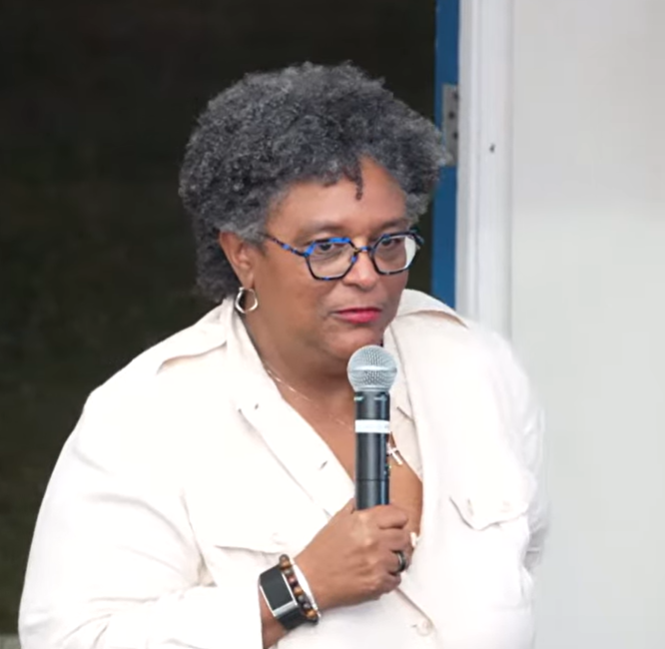
A heated debate over the future of Barbados’ state-owned Transport Board has taken center stage at a recent public policy forum, where Prime Minister Mia Mottley pushed back hard against growing speculation that her administration intends to fully privatize the public transit entity. Instead, Mottley has reframed the widely discussed restructuring effort as a worker empowerment initiative that pairs expanded employee ownership with stricter island-wide regulation to guarantee reliable service for all communities, including underserved rural areas.
The controversy reignited Wednesday during the Ideas Forum, where opposition St Peter candidate Jason Phillips of the Democratic Labour Party raised long-simmering public concerns about the government’s restructuring plans. Phillips echoed warnings first circulated late last year, when an official three-page letter from the Ministry of Transport and Works, signed by then-Permanent Secretary Jehu Wiltshire, was leaked to the public. The document confirmed that Cabinet had approved a transition to a new governing body, the Barbados Mass Transit Authority (BMTA), which would take over regulatory oversight of all public transit and hold the legal bill of sale for the Transport Board’s bus fleet. The leak triggered immediate pushback from the Congress of Trade Unions and Staff Associations of Barbados, which raised alarms about potential job insecurity and diminished service for rural residents.
At the forum, Phillips doubled down on those concerns, arguing that profit-driven private operators would inevitably abandon low-revenue rural routes — such as those serving Boscobel and Indian Ground, where ridership is often thin during early morning and late-night trips. “I can’t see a businessman wanting to take his vehicle… to deep Boscobel with three people in it,” Phillips said, calling for binding legislation to mandate that critical routes and consistent schedules be maintained regardless of profitability. He emphasized that his concern centered on reliable access, not opposition to worker ownership, stressing that the priority must be protecting vulnerable rural commuters who depend entirely on public transit.
Mottley drew a clear distinction between traditional privatization and what she calls “enfranchisement” to counter Phillips’ arguments, flatly stating: “There is no divestment of the Transport Board or privatization.” She explained that the proposed restructuring model would give Transport Board drivers and existing workers ownership stakes within the new system, rather than selling the entire entity to outside private investors. “We have said from the beginning that there is no divestment in the traditional sense. There is enfranchisement,” the prime minister said. “At the end of the day… the enfranchisement that is being entertained is to allow the drivers and the workers at the Transport Board to own.”
Under the plan, the newly created BMTA will serve as a centralized regulator overseeing all public transit services across the island, including the Transport Board’s buses, independent minibuses, and route taxis. Mottley noted that the fragmented current system lacks consistent day-to-day oversight, a gap the BMTA will fill by enforcing strict licensing requirements. Operators that fail to meet their scheduled route obligations will lose their licenses, and the authority will implement a route rotation system to ensure no operator is stuck with only unprofitable routes, while no entity can hoard high-traffic, high-revenue corridors at the expense of rural communities. “If at the end of the day you are not operating your route to the terms and conditions of the license… you are out,” Mottley said, adding that the structure guarantees equitable service for all regions.
Transport and Works Minister Kirk Humphrey reinforced Mottley’s position, dismissing any claims that outside private companies would take over the Transport Board. “There’s no company that’s coming in to own the Transport Board or none of those things you’re alluding to,” Humphrey said. He outlined that the government will retain supporting oversight while transferring bus ownership directly to workers, with the BMTA enforcing service standards to close long-standing gaps in rural transit. “The people will get a better service as opposed to less quality of service by the route that we are going,” he added.
Critics have pointed out that Mottley and other senior members of her administration previously openly described the restructuring as a divestment effort, even as they framed it as worker-focused. During prior parliamentary debates and media appearances, top officials repeatedly used the term “divestment of the Transport Board” to describe the project. Deputy Prime Minister Santia Bradshaw, who previously served as Transport and Works Minister, told Parliament that the “divestment of the Barbados Transport Board” was “a serious exercise in enfranchisement” and guaranteed that concessions for elderly residents and schoolchildren would remain in place. At a ceremony marking the handover of 35 new electric buses at Bridgetown Port, Bradshaw told reporters: “the government is moving ahead with divesting the Transport Board amid growing public opposition and establishing a new mass transit system,” adding that “when we speak of divestment, we also equally speak of the enfranchisement of the workers of Barbados and the workers of the Barbados Transport Board.”
The restructuring effort comes in response to decades of financial and operational instability at the Transport Board, which has required hundreds of millions in state subsidies to remain operational. Successive governments have called for a more sustainable funding model, while activists and opposition leaders have pushed to protect service access for low-income and rural commuters. The Mottley administration has repeatedly stated that vulnerable groups, including schoolchildren, pensioners, and low-wage essential workers, will retain their existing fare concessions and service access under the new framework. Despite the prime minister’s clarifications at the forum, Phillips maintained that the risk of profit-driven service cuts remains, and that ongoing public scrutiny will be needed to hold the government accountable to its promises.