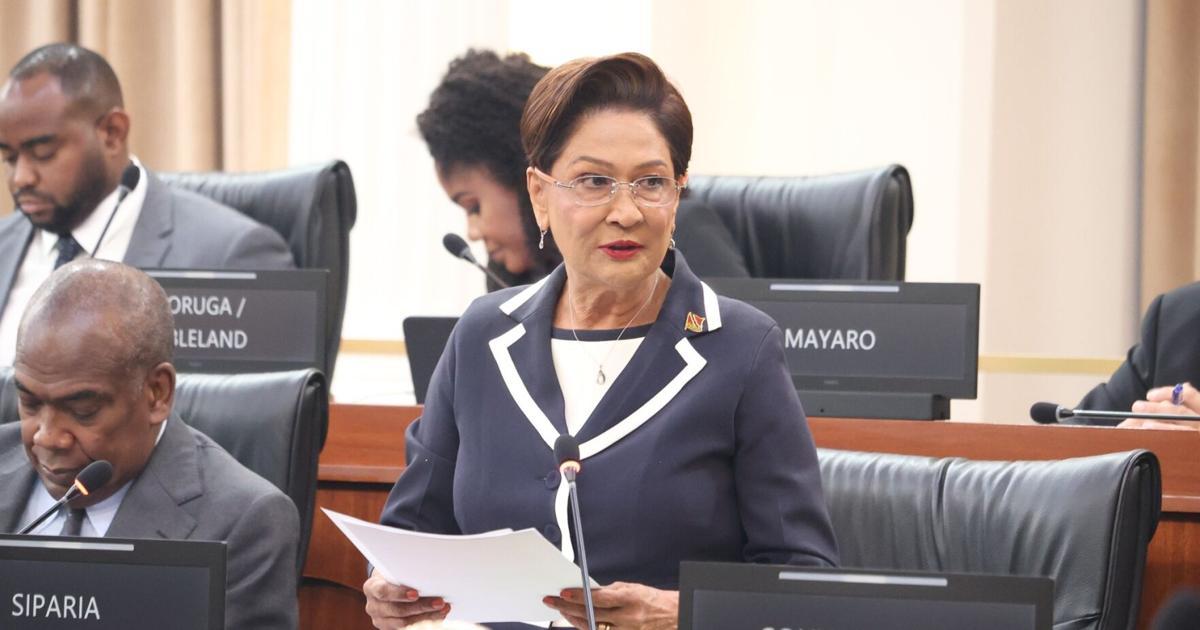
On the eve of marking one full year in office, Trinidad and Tobago Prime Minister Kamla Persad-Bissessar has confirmed that no immediate Cabinet reshuffle is planned, while offering a candid assessment of her administration’s early progress – most notably a significant drop in national crime rates. The Prime Minister made the announcement Saturday following a sod-turning ceremony for the new Hilton Garden Inn development at South Park in San Fernando, where she fielded questions from reporters on two key topics: the widely speculated restructuring of ministerial portfolios and her government’s performance ahead of its first anniversary.
When asked about the possibility of reshuffling her Cabinet ahead of the milestone, Persad-Bissessar made her position clear: “There is no reshuffle on the cards at this time.”
Turning to reflection on her administration’s first 12 months in office, the Prime Minister struck a balanced tone, acknowledging meaningful progress while emphasizing that a large volume of work remains to fulfill campaign pledges to the public. “I think we’ve done a lot. There’s still so much to do…we have many promises to keep… and I’m not shirking from that. I’m looking forward to continue to work for the people of our country,” she said.
A full comprehensive breakdown of the government’s completed projects and policy achievements over the past year will be delivered by Persad-Bissessar this weekend at a national address hosted by the United National Congress at Couva South Hall. The Prime Minister used her earlier media interaction to highlight one key early win that formed the centerpiece of her party’s election campaign: falling crime statistics.
Persad-Bissessar noted she is encouraged by consistent downward trends in criminal activity, though she stopped short of declaring victory on the issue, stressing that ongoing work is critical. “Crime was something we campaigned heavily on, and we have some achievements, (but) as I say, much more to do. Murder is down by 42%. Serious crime is down by 30%,” she told reporters. “Crime is down from 600 to whatever it was at the end of last year. And again, this year, so far, from last year to now, that too is down. So, I am very happy about that, but I’m not overjoyed, because I think there’s still much more to do.”
She also clarified a key distinction in the government’s approach, explaining that the administration has implemented what she calls an “anti-crime plan”, rather than a generic crime plan – a deliberate framing that she said rejects the idea that the status quo works for criminals. “The crime plan is in the hands of the criminals, and the anti-crime plan, as I said, state of emergency (SoE) is one part of it. It is not the be all and end all of it,” she explained.
Beyond a state of emergency, the government’s multi-pronged anti-crime strategy includes embedding police officers in primary and secondary schools, expanding the total size of the national police service through new recruitment drives, and allocating additional patrol vehicles to frontline law enforcement teams to improve response times. When asked about the long-delayed reform of national firearms legislation, Persad-Bissessar confirmed that policy development is currently ongoing in collaboration with the Law Reform Commission. She added that she has ordered comparative research into regulatory frameworks used in other Commonwealth countries to identify evidence-based models that can be adapted for local use. “Yes, we will reform it,” she confirmed.