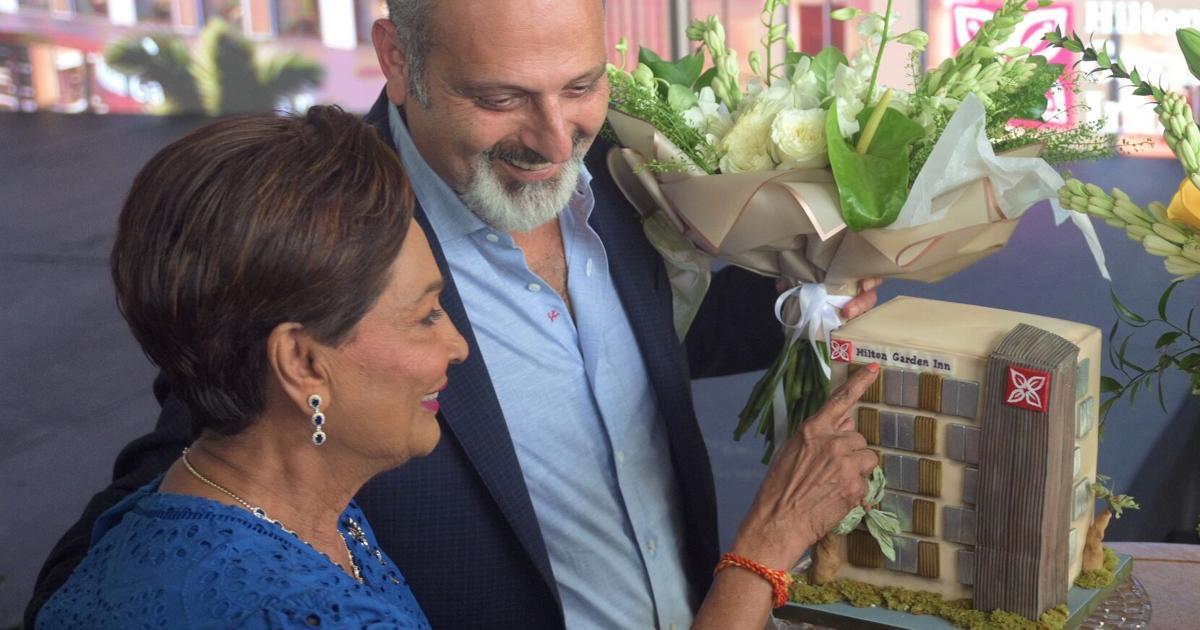
A new milestone for economic development in South Trinidad was marked yesterday, as Prime Minister Kamla Persad-Bissessar led a ceremonial sod-turning for the long-awaited $220 million Hilton Garden Inn at South Park, San Fernando. Slated for completion in 2028, the hospitality project is framed by the country’s current United National Congress (UNC) administration as more than a accommodation facility — it is positioned as a transformative long-term economic asset for the nation.
Speaking at the groundbreaking event, Persad-Bissessar announced that construction will get underway imminently, drawing a sharp contrast between the UNC’s track record of delivery and the unfulfilled promises of the previous People’s National Movement (PNM) government. She emphasized that the current administration has centered its policy agenda on tangible outcomes for citizens, moving away from the pattern of grand announcements with no follow-through that defined the prior tenure.
The Prime Minister outlined the far-reaching economic benefits the new hotel is expected to deliver. During the construction phase alone, the project is projected to generate approximately 400 on-site jobs, with 150 permanent full-time positions set to be created once the facility opens its doors. Beyond direct employment, Persad-Bissessar noted that the hotel will expand professional training opportunities for workers entering the hospitality sector, and open new supply chain doors for local farmers and small business owners across the region.
“This is exactly the kind of investment that supports my Government’s commitment to creating sustainable jobs for the population,” Persad-Bissessar told attendees.
She added that the project’s strategic placement in South Trinidad places it at the heart of a growing national infrastructure corridor surrounded by major regional hubs. Nearby landmarks include the Brian Lara Cricket Academy in Tarouba, the National Aquatic Centre, National Cycling Velodrome, Couva Children’s Hospital, Manny Ramjohn Stadium, Point Lisas Industrial Estate, the Pointe-a-Pierre refinery, and the University of the West Indies Debe campus. This central positioning, she explained, allows the hotel to drive cross-sector economic activity spanning tourism, sports, healthcare, manufacturing, higher education, and general business activity. “This, therefore, is not simply a hotel. It is an economic asset,” she said.
The Hilton Garden Inn project also serves as a flagship example of the administration’s national Revitalisation Blueprint, an economic development plan that has already drawn nearly 1,000 expressions of interest from investors, with particularly strong demand for waterfront and industrial development opportunities across the country. Persad-Bissessar framed this high level of investor interest as clear proof that the UNC government has pulled Trinidad and Tobago out of a decade of economic stagnation, and is successfully building a policy environment that enables large-scale investment to thrive. The project also fulfills a core manifesto commitment from the UNC, which ran on a platform of delivering economic transformation through job creation, increased investment, and inclusive growth.
A key focus of the Prime Minister’s remarks was the longstanding underinvestment in South Trinidad, a region she says holds enormous untapped economic potential that the current administration is prioritizing unlocking. “She said her Government was changing that” pattern of neglect.
Persad-Bissessar also used the event to critique what she called widespread mismanagement of the hospitality sector under the previous PNM administration, highlighting multiple examples of wasted public funds and uncompleted projects. She cited a pool renovation at the Port of Spain Hilton that exceeded $8.5 million in public spending, the non-operational Manta Lodge in Tobago that absorbed millions in investment without opening, public criticism of the Magdalena Grand Beach & Golf Resort in 2022, and the permanently unopened hotel component of the National Academy for the Performing Arts that never became operational.
“That is why this Government approaches projects differently,” she said. “Every dollar must deliver value, and every project must produce real outcomes for the people.”
To underscore the contrast in governance, Persad-Bissessar pointed to the UNC’s prior track record during its 2010 to 2015 administration, when it completed and opened the Magdalena Grand resort, and secured more than $334 million for the state through a successful arbitration process related to the Hyatt hotel project. She argued that the pattern of unfulfilled promises under the PNM eroded public and investor confidence, listing a half-dozen high-profile hospitality projects announced by the previous government that never moved past the announcement stage: a 2022-launched Four Points by Sheraton hotel in Piarco slated for 2024 completion that never materialized; a $70 million Maracas Bay hotel announced in 2023 that was never finished; a prior 2024 announcement for this very Hilton Garden Inn site that promised 2025 construction that never started; a $500 million Tobago Marriott project announced in 2021 that never came to fruition; and a 2017 San Fernando Hilton project announced that never broke ground.
Under the current UNC government, Persad-Bissessar said, the process is shifting: projects move from official announcement to active construction to on-schedule completion. “There is a clear difference. Under my UNC Government, we deliver. Our record is proven and unprecedented. Promises made, promises kept,” she said.