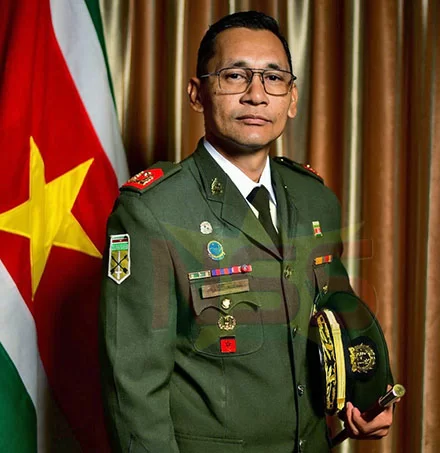
When Werner Kioe A Sen took office as commander of the Surinamese National Army in October 2022, he laid out an ambitious promise: to lift the institution to a brand new “next level”. This Friday, after almost four years at the helm, Kioe A Sen will formally transfer command to his successor, Colonel Mitchell Labadie, offering a candid, comprehensive reflection on his tenure that balances progress achieved with goals left unmet.
Looking back on his term, which focused heavily on professionalization, academic advancement, organizational reform, and targeted investment in personnel and leadership capacity, the outgoing commander highlighted key foundational gains that have strengthened the National Army. With consistent support from successive defense ministers Krishna Mathoera and Uraiqit Ramsaran, as well as collaboration from the military leadership and defense staff, Kioe A Sen’s administration built a structural foundation that will support the force for years to come.
One of the most significant milestones of his tenure was the 2023 launch of the Command and Staff Course, a specialized training program designed to prepare officers for senior political-strategic roles, alongside targeted investments in higher academic development for mid-career and senior officers. “This is a critical step forward in boosting the knowledge and innovation capacity of the entire defense sector,” Kioe A Sen noted. The non-commissioned officer corps also received a major boost through the implementation of a new staff adjutant structure, which is intended to improve internal mentorship and advisory capabilities across the force.
Despite these clear gains, Kioe A Sen openly acknowledged that not all of his initial policy ambitions were realized. In particular, progress on improving core facilities including troop infrastructure and catering has fallen short of expectations, held back by limited budget resources and broader administrative constraints that were outside the command’s direct control. Even so, the commander emphasized that he remains satisfied with the strategic direction set during his tenure, especially when it comes to long-term sustainable investments in force quality and leadership development. “The full impact of these changes will only become visible over the longer term, but the foundation is now in place,” he said.
Kioe A Sen explained that his administration deliberately prioritized broadening the service’s foundational capacity, with a focus on leadership development, personnel welfare, structural reform and process improvement – changes that he argues are essential to addressing the increasingly unpredictable nature of modern security threats. These threats span both traditional military and non-military domains. The long-running territorial dispute over the Tigri region remains a persistent priority for the force; while the issue is being addressed through diplomatic channels, Kioe A Sen noted that from a defense perspective, credible deterrence plays a key role in strengthening the country’s negotiating position, a lever whose use ultimately remains a policy decision at the political level.
Non-military threats, particularly transnational crime and environmental crime, have proven far more complex to address than initially anticipated. Kioe A Sen stressed that these challenges are deeply rooted, linked to structural weaknesses across multiple state institutions, limited operational capacity, cross-agency coordination gaps, and integrity risks. Even so, targeted operations such as Sparimakka and Ocelot have demonstrated that focused deployment can deliver tangible results, though sustained structural improvement will require broader cross-sector collaboration to achieve.
Over the past four years, the National Army has deliberately focused on strengthening its core constitutional mandates, which has translated into a significant expansion of operational activity across the country. Over the past five years, the force has conducted more than 100 deployments, ranging from patrols in gold-mining regions like Marbonsu, border presence at Marai on the eastern frontier, Operation Piranha supporting the public prosecutor’s office in cracking down on environmental crime, humanitarian relief missions as part of Gran Mati, to the destruction of illegal airstrips in Operation Ocelot. This expanded operational footprint has made the army a more visible presence across Suriname, and Kioe A Sen says this record provides a solid baseline for his successor to build on.
In pre-handover discussions with Labadie, the two leaders have reviewed the current state of the force, ongoing strategic priorities, operational capacity, and active projects. Kioe A Sen stressed that continuity in policy and implementation is essential to consolidate and expand on the progress made over the past term.
On the social welfare front, affordable, accessible housing remains one of the most pressing unaddressed issues for military personnel. “While we launched new initiatives to support service members with land acquisition for housing, these processes have not delivered the results we hoped for,” Kioe A Sen admitted. Delays stemmed from reliance on multiple external stakeholders and bureaucratic procedures, as well as broader administrative and policy constraints across government. He noted that delivering more concrete progress on housing will be a key priority for Labadie, as the issue remains central to the well-being of troops and their families.
The outgoing commander acknowledged that many troops may question whether he did enough to improve their daily conditions during his tenure, and called this a reasonable and fair question. “Given the resources and opportunities available to me, I pushed as hard as I could to deliver meaningful improvements. At the same time, I had to operate within broader constraints and conditions that were often outside my sphere of influence,” he explained. His connection to ordinary troops remains strong, forged over 28 years of service in operational units, 24 of which he spent serving alongside rank-and-file soldiers.
In October 2024, Kioe A Sen was promoted from colonel to brigadier general, the highest military rank in the Surinamese National Army. Though the command handover is imminent, he says he is not retiring, and will remain available to serve at the request of the defense minister and the president. Reflecting on his time leading the force, Kioe A Sen concluded: “I worked to deliver meaningful structural improvements to this institution, and I understand that not every desired goal can be achieved in a single term. The foundation is laid, and it is now up to the next leadership to carry this work forward.”