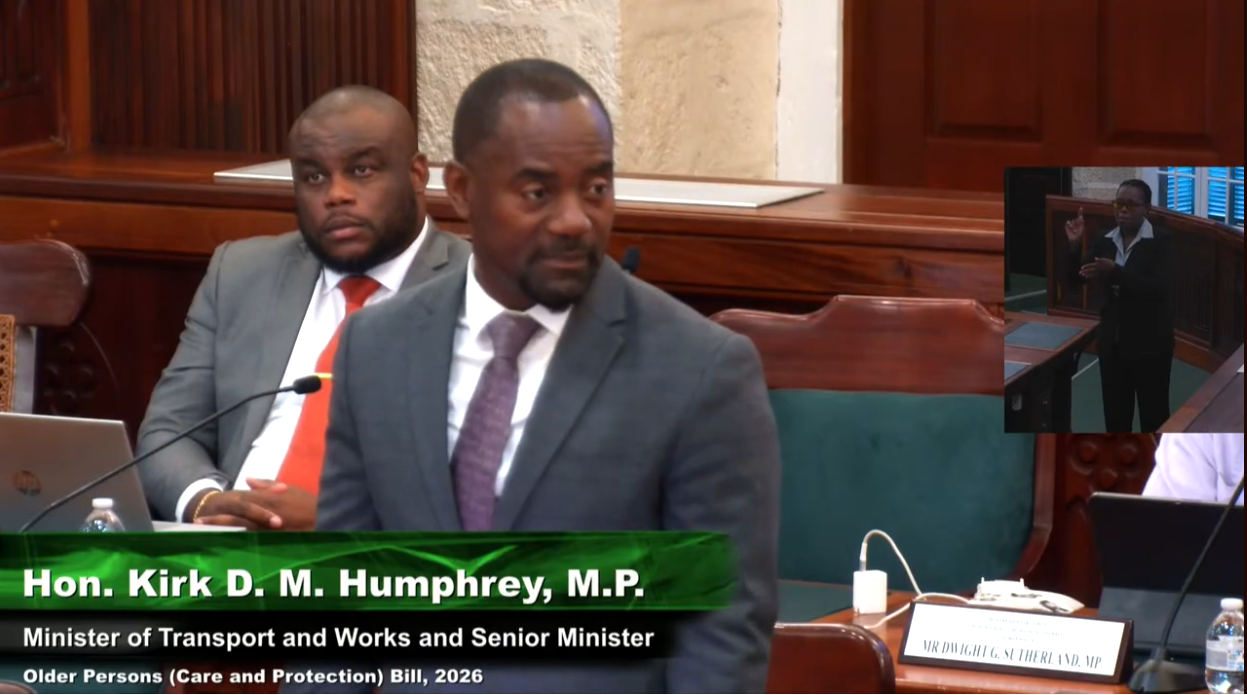
During a heated debate in Barbados’ House of Assembly on the transformative Older Persons (Care and Protection) Bill, Minister of Transport and Works Kirk Humphrey has issued an unwavering guarantee that the Mottley administration will permanently retain free bus fare for all senior citizens riding public Transport Board buses, even amid ongoing discussions of potential public-private partnerships for the island’s transport sector.
Humphrey, who draws deep personal and academic expertise in elder rights issues, framed the new legislation not as an act of charitable goodwill from the government, but as a long-overdue fundamental gesture of gratitude to the generations of Barbadians who built the modern nation. The minister used the debate to push back against persistent public rumours that privatization of transport services would eliminate the popular free fare benefit for vulnerable groups, delivering a categorical public reassurance.
“Let me make it clear. There will never be, under this administration, any time where older persons have to pay to use buses in this country. It is not the policy of the government. That free ride for older persons will continue regardless of whatever structure we settle on for delivering transport to Barbadians,” Humphrey stated emphatically. The minister extended this ironclad guarantee to all other groups that currently hold free public transport privileges, including active and serving police officers, emphasizing that government efforts to boost operational efficiency in the transport sector will never come at the expense of vulnerable and marginalized groups.
Humphrey also used the occasion to call on Barbadian society to confront a growing worrying erosion of the island’s long-held traditional culture of intergenerational community care. Invoking the classic Socratic maxim that “the unexamined life is not worth living,” he urged the nation to engage in deep introspection about how it treats its aging population. He questioned how a country once famous for its tight-knit community care systems had reached a point where so many seniors report feeling invisible, socially excluded, and neglected.
“Dignity does not expire at 65 or 67. In fact, we have a responsibility as people get to that age to put a little bit more effort in,” Humphrey argued.
Drawing on his portfolio oversight, the transport minister detailed the often-overlooked deep connection between accessible public infrastructure and broader social well-being for older Barbadians. He explained that seemingly small oversights, such as cracked sidewalks or unbuilt bus shelters, do more than just hinder mobility – they actively push seniors into social isolation. If an older person cannot wait comfortably for a bus due to a lack of shelter, they will often choose to stay home entirely, skipping critical medical appointments and cutting off visits with family and friends, eroding their independence over time.
“Getting older should not mean losing independence in these things that are so easy to be able to resolve,” he said. Humphrey challenged his own ministry to abandon outdated accessibility standards that are unfit for a 21st-century Barbados, mandating that all public walkways be fully accessible for people living with disabilities and seniors, who he noted experience mobility and safety risks such as uneven lighting very differently than younger people.
Beyond the transport policy commitments, Humphrey outlined the core protections of the new Older Persons Bill, which establishes a comprehensive national framework to combat elder neglect, abuse and financial exploitation. He highlighted the landmark creation of a confidential national register of documented elder abusers, a provision he called a personal priority, which will bar anyone with a confirmed history of abusing seniors from working in licensed elder care facilities across the island.
“This bill says that older persons are right holders and that they are not just passive recipients of government’s largesse. It recognizes physical abuse, emotional abuse, sexual abuse, neglect, abandonment, and financial abuse—including when people take your pensions or your savings. Silence can no longer be used to protect abusers in this country,” Humphrey said.
The minister closed by issuing a direct challenge to the Social Empowerment Agency and all relevant government bodies responsible for elder welfare: passing groundbreaking legislation is only the first step, and the true impact of the bill will depend on consistent, aggressive enforcement. “Protection delayed is protection denied. We have to enforce what the bill allows us to enforce. We have to put in place the systems to benefit the persons that we’re meant to protect. Use the legislation. Enforce the legislation,” he urged. Echoing a long-held global standard of national accountability, Humphrey noted that “You judge a country not by the way it treats the people who are strong… but by the way it treats its vulnerable.”