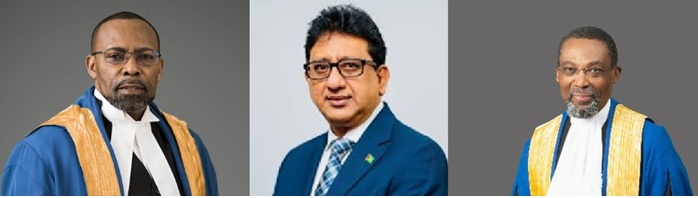
On Tuesday, April 21, 2026, the Caribbean Court of Justice (CCJ) opened a tense session focused on more than just the legal merits of an extradition appeal: judges zeroed in on controversial public statements made by Guyana’s top legal official, Attorney General Anil Nandlall, regarding two US-sanctioned and wanted Guyanese businessmen, Nazar Mohamed and Azruddin Mohamed.
The case currently before the regional court stems from the Mohameds’ appeal of an Arrest Warrant Authorization (ATP) issued last October by Guyana’s Home Affairs Minister Oneidge Walrond. The ATP authorized a local magistrate to move forward with an arrest warrant to open extradition committal proceedings for the pair, who have been sanctioned by the US Treasury Department’s Office of Foreign Assets Control over allegations of financial misconduct. All lower court proceedings have been put on hold pending the CCJ’s final ruling, which has not yet been scheduled.
During Tuesday’s hearing, the issue of Nandlall’s public commentary took center stage after the Mohameds’ legal team argued that the attorney general’s repeated public statements created a taint of bias that undermines the fairness of the entire extradition process.
CCJ President Winston Anderson acknowledged that all legal professionals, including government lawyers, hold a protected right to free speech. Still, he emphasized that out-of-court statements that risk eroding public trust in judicial processes or compromising the fairness of ongoing proceedings have no place in a functional democracy. “Statements which are made outside of these proceedings and which could have the effect of undermining the fairness of the proceedings, or which could undermine public confidence in the administration of justice, should be avoided,” Anderson stated, adding that he expected legal representatives to adhere to professional guidelines and that the court would prefer not to address the issue again.
Anderson went on to press Nandlall, noting that while serious allegations against the Mohameds are already on the public record, there was no clear reason for the government’s chief legal advisor to issue public pronouncements on the ongoing case. The court highlighted that the “elephant in the room” is the Mohameds’ core claim: that Nandlall’s public comments revealed a predetermined bias against them in any extradition request, a claim that Minister Walrond – who received legal advice from Nandlall before issuing the ATP – did not refute from her position in the courtroom.
Justice Chile Eboe-Osuji expanded on the court’s concerns, clarifying that the issue is not whether the Attorney General has the authority to make formal decisions in the case, but whether his public comments – which included criminal accusations against the applicants, ongoing public commentary on the extradition process, and implied criticism of Principal Magistrate Judy Latchman who is assigned to the committal proceedings – have irreparably biased the process. Eboe-Osuji posed a sharp question to Nandlall: “Is there something to be said that it is part of the job of the AG to bring the population back to say, look, respect the process, let the process take its course rather than making comments that might add to that negative public view on the matter?”
Judge Arif Bulkan also pushed back on Nandlall’s attempts to frame the controversy as a product of political rivalry, pointing out that the attorney general had failed to directly address the court’s core question about his comments on the extradition case and its expected outcome. Nandlall pushed back against the judges’ questioning, denying he had ever commented on the projected outcome of the proceedings. He argued his public remarks focused instead on public concerns over the length of the ongoing committal process and referenced already public information: the US sanctions against the Mohameds that had been widely reported by international outlets including Reuters.
Nandlall further defended his comments by noting many of the remarks were made during the 2025 Guyanese general and regional election campaign, a period when public debate over political and policy issues is heightened. “This is his rap sheet; this is what we have to speak about,” he told the court, adding that he had not made any improper statements. He argued that any perceived missteps stem from incorrect quotation, and that his comments were framed appropriately with respect for the judicial system, and any use of his remarks against him is politically motivated. “The comments that were made were in their proper context. They may have been disputed and used for political purposes, but they were not improper statements,” he said.
The Mohameds’ legal team has argued that Minister Walrond’s decision to authorize the arrest warrant is fatally biased because she acted on advice from Nandlall, who has repeatedly publicly condemned the pair and commented on their multiple ongoing court cases at every level of the Guyanese judicial system, from the magistrates’ court to the Court of Appeal. They also point out that Walrond herself publicly spoke out against the Mohameds during the 2025 election campaign.
In closing the court’s questioning on the issue, President Anderson noted that the panel of judges was actively questioning whether Nandlall’s comments aligned with the standards of best practice needed to strengthen democratic governance and the rule of law in Guyana. Nandlall reiterated that his role was limited to providing legal advice to the Home Affairs Minister, who retained full authority to make the final decision on the ATP.