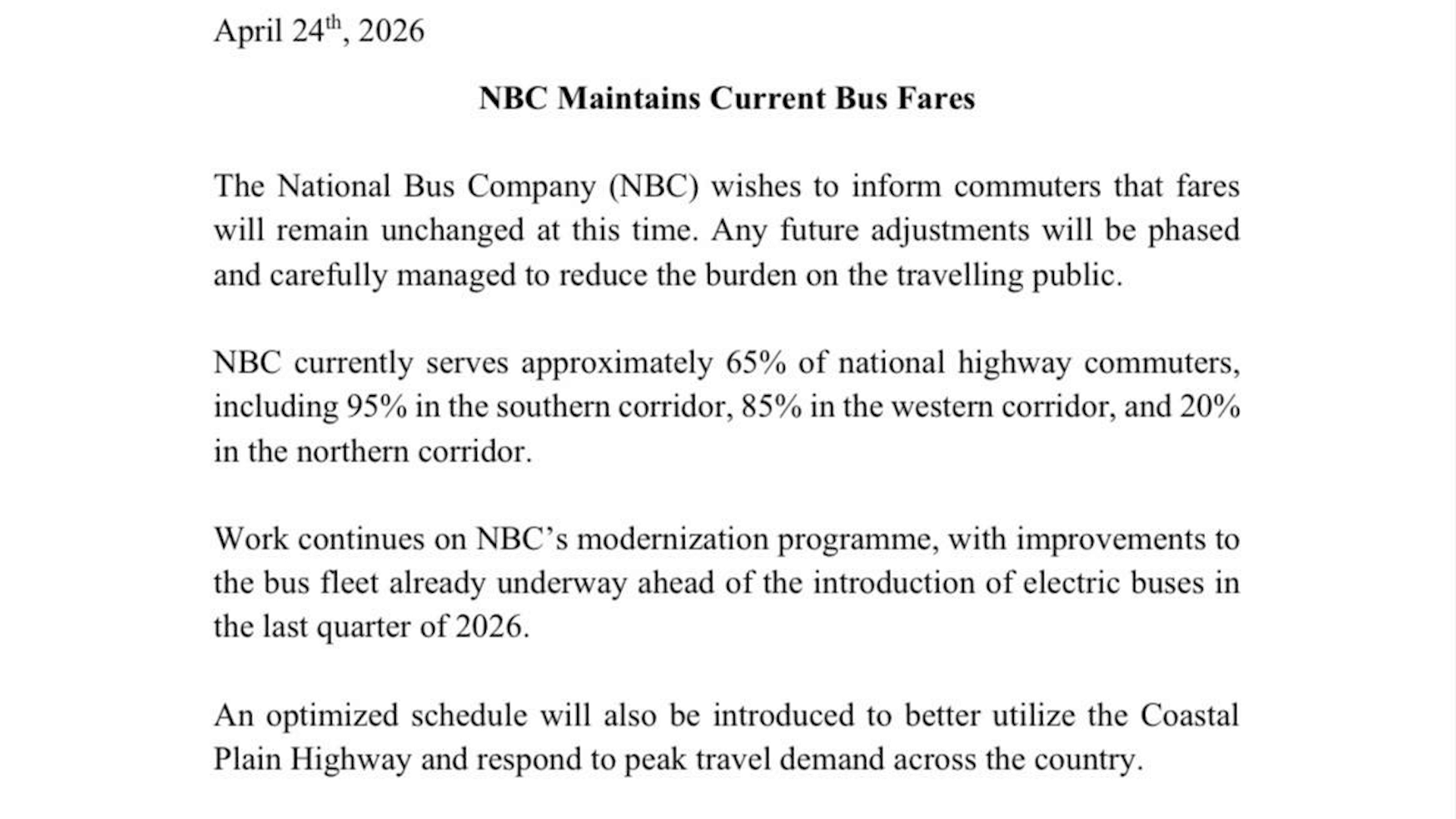
In a much-anticipated announcement that has brought relief to tens of thousands of daily commuters across Belize, the National Bus Company (NBC) confirmed on April 24, 2026 that it will hold current ticket rates steady for the immediate future, even as other regional operators have moved forward with approved fare increases. This decision comes at a time when widespread speculation about rising bus fares has left daily commuters, particularly those in the country’s busy southern corridor, bracing for added monthly travel costs.
As the dominant provider of intercity highway bus service across Belize, NBC carries approximately 65% of all national highway commuters, serving between 8,000 and 12,000 passengers daily depending on the day of the week. Its market share is especially pronounced in the critical southern route, which runs from Punta Gorda through Independence, Dangriga, and Belmopan before reaching Belize City, with upcoming routing adjustments along the coastal road expected to cut travel time for passengers. In this corridor, NBC controls 95% of the commuter market, meaning nearly all travelers along the high-traffic route will avoid the recently approved fare hikes that had been set to take effect. The company also holds an 85% market share on the western corridor connecting Belize City to Belmopan, San Ignacio, and the western border at Benque Viejo del Carmen. Its smallest footprint is in the northern corridor leading to Orange Walk, Corozal, and the northern border, where it only serves 20% of commuters, with most northern service provided by private operators affiliated with the Belize Bus Association (BBA).
Belize’s Transport Minister Dr. Louis Zabaneh confirmed that the formal NBC press release, published this afternoon, explicitly notes that the rate freeze is not a permanent policy. The company has retained the right to revisit pricing if global and domestic fuel prices continue their upward trajectory. Dr. Zabaneh praised NBC’s decision, framing the temporary rate hold as a responsible step to prioritize the needs of commuters who rely on public transit for daily travel to work, school, and essential services.
When asked whether commuters could expect rate reductions if fuel prices decline in the future, Dr. Zabaneh acknowledged that standard economic dynamics make downward price adjustments far less common than increases, a phenomenon widely referred to as sticky prices. He added that long-term fare stability for NBC will not come from fluctuating fuel markets, but from the company’s planned transition to a brand-new fleet of electric buses. Operating an electric bus costs only 25% of the operating cost of a traditional diesel bus when measuring energy expenses, he explained, meaning the shift to electric technology will create permanent long-term cost savings that can be passed on to commuters. For private operators that have already implemented fare increases to offset rising fuel costs, Dr. Zabaneh noted that operators have little remaining capital to invest in upgrading outdated fleets, but he agreed fully with widespread public expectations that improved service and newer vehicles should accompany any future price increases.
The decision to freeze fares has sparked immediate pushback from the Belize Bus Association, the industry group representing the country’s 14 private bus operators that mostly serve the northern corridor. In a statement released just before this evening’s news broadcast, the BBA pushed back against public narratives surrounding the recent fare hikes, placing blame for the industry-wide price adjustments squarely on NBC and the government agencies that regulate the sector.
The BBA argues that NBC operates under direct control of the Ministry of Transport, creating an inherent conflict of interest that skews both fare policy decisions and public messaging around the recent increases. The association claims that NBC has long charged the highest fares in the Belizean bus industry, while private BBA operators maintained lower rates for years, absorbing rising fuel and maintenance costs out of pocket to avoid passing burdens onto commuters. According to the BBA, the recent fare adjustment for its members was not an arbitrary price hike, but a forced alignment with NBC’s existing higher price structure after the government rejected repeated requests for fuel tax relief and operating subsidies.
The association further alleges that government officials are attempting to deflect public anger over higher fares by positioning NBC as a responsible, commuter-friendly alternative, while allowing private operators to bear the brunt of public criticism—even as commuters across the country face higher travel costs overall. The BBA emphasizes that it remains the largest provider of bus service in the northern corridor, and that the Belizean public deserves full transparency about the policy decisions that led to the current fare landscape.