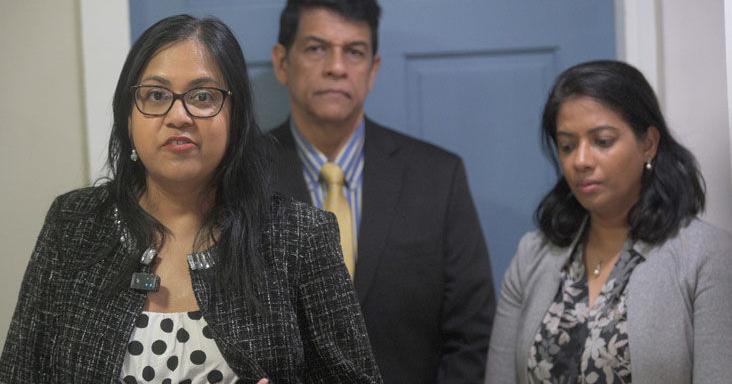
Over the 14-year period spanning 2010 to 2024, Trinidad and Tobago’s police service recorded more than 33,400 formal reports of domestic violence, alongside 443 domestic-related murders and murder-suicides, according to newly released official statistics. The alarming figures were presented during a San Fernando press conference yesterday by Saira Lakhan, head of the Assembly of Southern Lawyers, an event organized by local attorney Prakash Ramadhar. Lakhan emphasized that the data, compiled from police records by the Central Statistical Office, confirms that intimate partner and family violence is not an isolated crisis, but a deeply ingrained, persistent pattern of harm across the island nation.
Breaking down the reported cases, Lakhan noted that the vast majority — 17,189 incidents — involved physical assault by beating, making this the most common form of reported domestic violence by a significant margin. Over 2,400 reports were registered for breaches of court-issued protection orders, while additional data shared with local outlet *Trinidad Express* after the conference revealed threats of harm were the second most prevalent offense, with 8,935 recorded reports. A total of 877 sexual abuse cases were also reported over the period, with officials highlighting a particularly concerning upward trend in these incidents in recent years.
Lakhan pointed to deep-rooted cultural normalization as a core driver of the crisis, arguing that abusive behavior within romantic relationships is often downplayed and accepted long before it escalates to criminal harm. “In Trinidad and Tobago, too much bad conduct in relationships is normalized long before it becomes criminal. It is laughed off. It is minimised. It is wrapped in jokes, lyrics, bravado, and the dangerous idea that infidelity, domination, verbal abuse, jealousy, and control are just part of how relationships work,” she said.
Calling for a two-pronged approach of stronger enforcement and expanded early prevention, Lakhan backed existing government plans to integrate domestic violence education into school programming, but urged far more robust action. “Prevention has to start much earlier. The ministry itself has said it is strengthening partnerships with schools and advancing education and sensitisation programmes. I agree with that approach, but we need much more of it. Whether it sits under social studies, values education, family life education, or another curriculum area, children must be taught from young about respect, boundaries, honesty, accountability, and healthy relationships,” she stated.
The press conference was organized by Ramadhar, who is currently representing a woman who was taken into police custody following the fatal shooting of local businessman Steve Ghany at his Vistabella home earlier this month. The woman was released days before the conference after the Director of Public Prosecutions recommended continued investigation pending formal charges. According to initial police accounts, the shooting followed a confrontation in which Ghany allegedly drew a firearm and fired at the woman. Ramadhar declined to comment on the specific details of the case, noting that the client needs time to heal with the support of her family.
Ramadhar used the platform to issue a nationwide call for public reckoning with domestic violence, pushing for greater empathy and support for survivors. He stressed that the crisis is widely misunderstood by the general public: harm extends far beyond physical violence, often encompassing coercive control that is emotional, financial and psychological in nature. He pushed back against the common question of why victims do not simply leave abusive relationships, explaining that survivors face a range of crippling barriers, from fear for their own safety and that of their children to economic dependence that leaves them unable to afford housing, food or legal representation.
Domestic violence, Ramadhar added, does not only harm the immediate victim; its impacts ripple outward to affect children, extended families, workplaces and entire communities, leaving long-term intergenerational damage that makes public understanding and support critical. “When survivors come forward, they should be met with support rather than judgment. Simplifying their experiences into questions of ‘why they didn’t leave’ risks overlooking the real dangers and constraints that you may have faced,” he said. “At the same time, it is important to uphold respect for the rule of law. Each situation must be assessed on its own facts within the framework of the legal system which seeks to balance individual rights, accountability and justice.”
In a heartfelt plea directed at the nation’s young men, Ramadhar — a father of a daughter — acknowledged that while people of all genders can be victims of domestic violence, his experience as a man compels him to address the issue directly. He pushed back against outdated cultural ideals of toxic machismo that frame masculinity as brute force and emotional indifference, arguing that true manhood centers on care, protection and support for partners. “What is a real man? Some believe in the machismo of the old that a man is supposed to be this brutish, strong and ignorant…and not caring about emotions and feelings. Real men love, real men protect, real men care, real men produce, real men support. It’s not about how you look, it is about how you conduct yourselves,” he said.
Drawing on his decades of experience working on murder trials, Ramadhar noted that many perpetrators of violent crime, including domestic violence, are themselves survivors of childhood violence and abandonment. “Many of the young fellas charged for murder grew up in an environment — I wouldn’t even call them ‘homes’ — of violence, of non-love, non-care. Most of them end up growing up with grandparents, parents nowhere to be found, no nurturing. If there is no love and embrace in what we classically known as a home, the homes are in the gangs. What we are dealing with here today transcends just domestic violence in that way because a person coming from an environment, a baby growing up in that, this is what they know,” he explained.