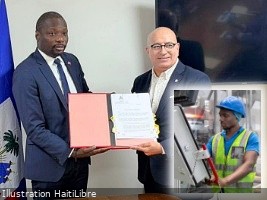
In a landmark move for Haiti’s ongoing economic revitalization efforts, government officials formalized a deal on April 15, 2026, to host a new manufacturing facility from global packaging leader ALPLA Group at the CODEVI Industrial Development Company free trade zone in Ouanaminthe, a city in Haiti’s northeastern region.
The project brings more than $10.2 million in foreign direct investment to the Caribbean nation, marking a major vote of confidence in Haiti’s recent policy overhauls designed to improve its domestic business environment. For policymakers, the investment is not just a capital injection—it is tangible proof that economic reform efforts are starting to pay off with international stakeholders.
The new local entity, ALPLA HAITI S.A., operates as a subsidiary of Austria-based ALPLA Group, a 30-year industry giant that maintains production and distribution operations across more than 45 countries worldwide. ALPLA specializes in producing high-quality bottles, caps, injection-molded components and cutting-edge sustainable packaging solutions for a wide range of consumer and industrial sectors. This new Haitian facility aligns with the group’s broader global expansion strategy, which prioritizes eco-friendly operations, sustainable supply chain management and increased use of recycled raw materials in production processes.
Beyond manufacturing output, the project is expected to deliver long-term social and economic benefits to local communities. Industrial facilities of this scale typically create hundreds of direct jobs across production, logistics, facility maintenance and administrative roles, and will facilitate the transfer of advanced technical skills to local workers. This talent development is projected to strengthen Haiti’s overall human capital and boost the nation’s competitiveness in regional industrial and export markets.
Haiti’s Minister of Commerce and Industry, James Monazard, emphasized the Haitian government’s strategic focus on unlocking growth in the country’s northern corridor, particularly the Northeast region. He reaffirmed the executive branch’s continued commitment to removing barriers for international and domestic investors, outlining ongoing policy efforts including administrative process simplification, updates to strengthen the national investment legal framework, targeted financial incentives and on-the-ground support for incoming businesses operating in the country’s free trade zones.