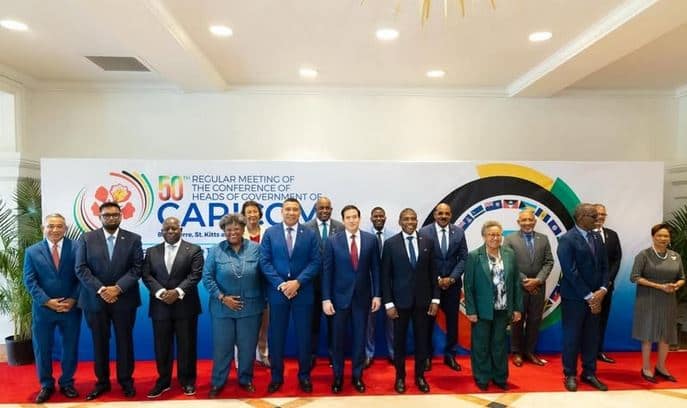
The Caribbean Community (CARICOM) finds itself navigating one of the most challenging periods in its institutional history, as long-simmering regional tensions amplified by shifting global geopolitics push the 15-nation bloc to its breaking point. When St. Kitts and Nevis assumed the rotating six-month chairmanship of CARICOM’s supreme governing body, the Conference of Heads of Government, this past January, it inherited a bloc fractured by deepening divides over core foreign policy principles at a time of unprecedented global upheaval.
Under the terms of CARICOM’s founding constituent treaty, the Conference of Heads of Government holds ultimate decision-making authority over the bloc’s agenda, with the rotating chair tasked with advancing collective regional priorities for their term in office. For Prime Minister Terrance Drew, who leads St. Kitts and Nevis and serves as the current chair, the weight of regional fragmentation has shaped every dimension of his leadership from day one. The bloc is currently split along sharp lines over divergent responses to the so-called “Trump Corollary” to the Monroe Doctrine, a high-stakes U.S. foreign policy framework that has created a months-long diplomatic impasse within CARICOM.
This schism comes as the entire global international order undergoes a seismic transformation — a shift not seen on this scale since the collapse of the Soviet Union and the end of the Cold War, which erased the bipolar global system and paved the way for the decades-long unipolar era that is now drawing to a close. For small developing states that make up CARICOM, this global realignment has created acute pressure to align with competing great power blocs, straining the collective diplomatic coherence the bloc has spent decades building.
The majority of CARICOM member states have approached the Trump Corollary with deep suspicion and caution, anchoring their positions in the bloc’s long-standing foundational principles: commitment to multilateral dialogue, respect for sovereign international cooperation, and independence in foreign policy decision-making for small states. But a smaller faction of members has broken ranks to offer unapologetic, full-throated support for the U.S. framework.
The most high-profile split came in response to the recent escalation of tensions between the U.S.-Israeli alliance and Iran, which only recently settled into a fragile, uncertain ceasefire after weeks of spiraling direct conflict. Trinidad and Tobago drew widespread controversy across the region when it openly aligned with Washington’s position on the conflict, while neighboring Barbados took an early, contrasting stance, publicly calling for all parties to exercise restraint as Middle East tensions reached a boiling point. For Drew and his chairmanship, bridging this deepening foreign policy divide and restoring CARICOM’s collective diplomatic voice will be the defining test of his term, as the bloc grapples with whether it can maintain unity amid a rapidly changing global order.
This report was originally published by the Jamaica Gleaner on April 16, 2026.