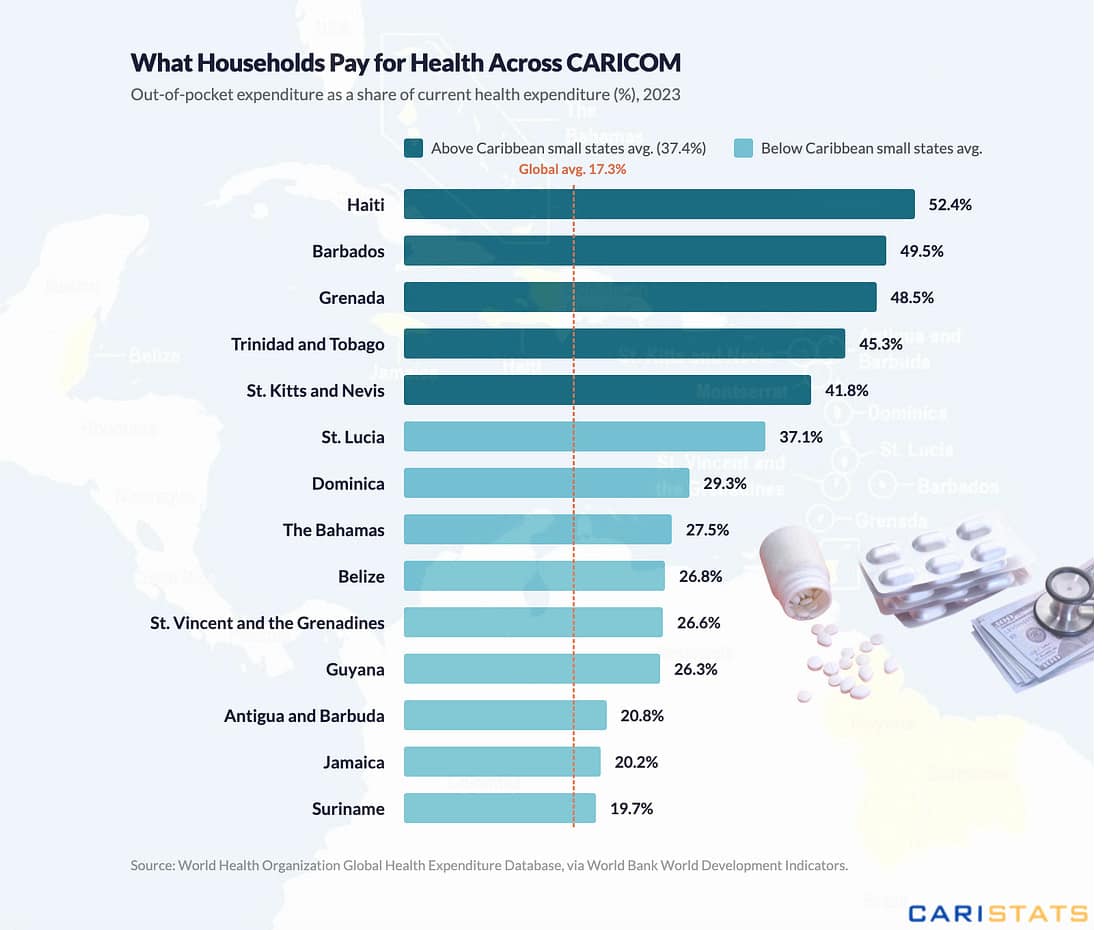
New regional health expenditure data compiled by the Caribbean Community (CARICOM) statistical agency CARISTATS has revealed that households in Antigua and Barbuda shoulder a lower direct healthcare cost burden than nearly all other Caribbean nations, though their out-of-pocket (OOP) spending still outpaces the global average.
Out-of-pocket spending refers to direct payments by patients for medical services not covered by public health plans or private insurance schemes. Per CARISTATS’ analysis, which draws data from the World Health Organization’s Global Health Expenditure Database and was published through the World Bank, OOP spending makes up 20.8% of Antigua and Barbuda’s total annual national health expenditure. This rank positions the dual-island nation among the Caribbean countries with the smallest household cost burdens for healthcare, while the figure still sits 3.5 percentage points higher than the current global average of 17.3%.
The broader CARICOM region tells a starker story: household OOP burdens are far heavier across most member states, with the majority recording OOP spending that makes up more than 25% of total national health expenditure. This widespread trend highlights systemic gaps in regional insurance coverage and a widespread reliance on private healthcare providers that pass costs directly to patients.
Haiti tops the list of nations with the highest OOP shares, with households covering 52.4% of all national healthcare costs through direct out-of-pocket payments. Barbados ranks second at 49.5%, followed closely by Grenada at 48.5%. Analysts have noted that Barbados’ high figure is particularly notable, given the country’s classification as a high-income economy with a formal universal public health system. The elevated share suggests that even with universal public coverage, many Barbadian patients still opt for or rely on private care and pay for services directly out of pocket.
Antigua and Barbuda’s comparatively low OOP share aligns it with other regional low-burden performers: Jamaica records a 20.2% OOP share, while Suriname sits even closer to the global benchmark at 19.7%.
A key takeaway from the aggregated data challenges common assumptions about healthcare financing: the structure and funding model of a country’s healthcare system plays a far larger role in shaping household out-of-pocket burdens than national income levels alone.
Researchers emphasized that the findings underscore persistent systemic challenges across the entire Caribbean region. Limited health insurance coverage and uneven access to consistent, affordable public health services continue to shift a disproportionate share of healthcare costs onto individual patients — a problem that persists even in countries that outperform their regional peers on this metric.