A weeks-long political controversy has fractured the 15-member Caribbean Community (CARICOM), pitting regional power Trinidad and Tobago against the bloc’s leadership and Secretary-General Dr. Carla Barnett over her controversial second-term reappointment, with demands for transparency and a high-profile call for Barnett’s resignation escalating tensions. The dispute first ignited on March 26, 2026, when CARICOM Chairman and St. Kitts and Nevis Prime Minister Dr. Terrance Drew announced that a required majority of CARICOM Heads of Government had approved extending Barnett’s tenure starting in August 2026. But the conflict has since pivoted to a heated dispute over conflicting accounts of whether Barnett barred foreign ministers from attending the closed-door February 26, 2026 heads of government retreat where the reappointment was finalized.
Trinidad and Tobago Prime Minister Kamla Persad-Bissessar added a new twist to the saga this Wednesday, calling out Chairman Drew’s official statement for deliberately omitting the allegation that Barnett blocked the Caribbean nation’s foreign minister from attending the retreat. Persad-Bissessar publicly shared a screenshot of a February 25, 2026 WhatsApp message from Barnett that read: “Chairman PM Drew has indicated that today will be a Heads only retreat. Notwithstanding any indication otherwise, he would like it to remain Heads only. He apologises for any inconvenience.” Barnett directed attending foreign ministers to remain for a separate Community Council meeting to advance preliminary work on agenda items that would later be sent to heads for final approval.
In an April 9, 2026 letter to Chairman Drew, Trinidad and Tobago’s Foreign and CARICOM Affairs Minister Sean Sobers, who led his country’s delegation in the absence of Prime Minister Persad-Bissessar, wrote that he interpreted the message as an uninvitation to the heads-only retreat. Sobers added that Trinidad and Tobago’s CARICOM director contacted CARICOM Chef de Cabinet Janice Miller, who confirmed the authenticity of Barnett’s WhatsApp instruction. He also noted that Community Council Chairman Dr. Denzil, St. Kitts and Nevis’ foreign minister, had explicitly told the council the February 26 event was restricted to sitting heads of government.
A senior anonymous CARICOM official pushed back on this account to Demerara Waves Online News, denying that Sobers was ever disinvited. The official clarified that when a head of government cannot attend a retreat, the serving foreign minister serves as head of delegation — not a head of government — and argued that a seasoned lawyer and foreign minister like Sobers should have understood the regional bloc’s standard diplomatic protocols. The official accused Sobers of intentionally misleading the public to fuel controversy.
In an April 12, 2024 statement, Chairman Drew released evidence of a second unpublicized WhatsApp message sent by Barnett to him at 10:55 p.m. on February 25, hours after the first message. That message read: “Chairman. TT Foreign Minister Sobers called me to ask if he should come to retreat in the absence of his PM. I indicated that other Heads who have left may be represented by their FMs. He also indicated he gets seasick, so he’s not looking forward to the boat ride. So we may not have TT represented tomorrow.” The CARICOM source explained that both messages must be read together: the first restriction only applied to foreign ministers whose heads of government were already in attendance at the retreat.
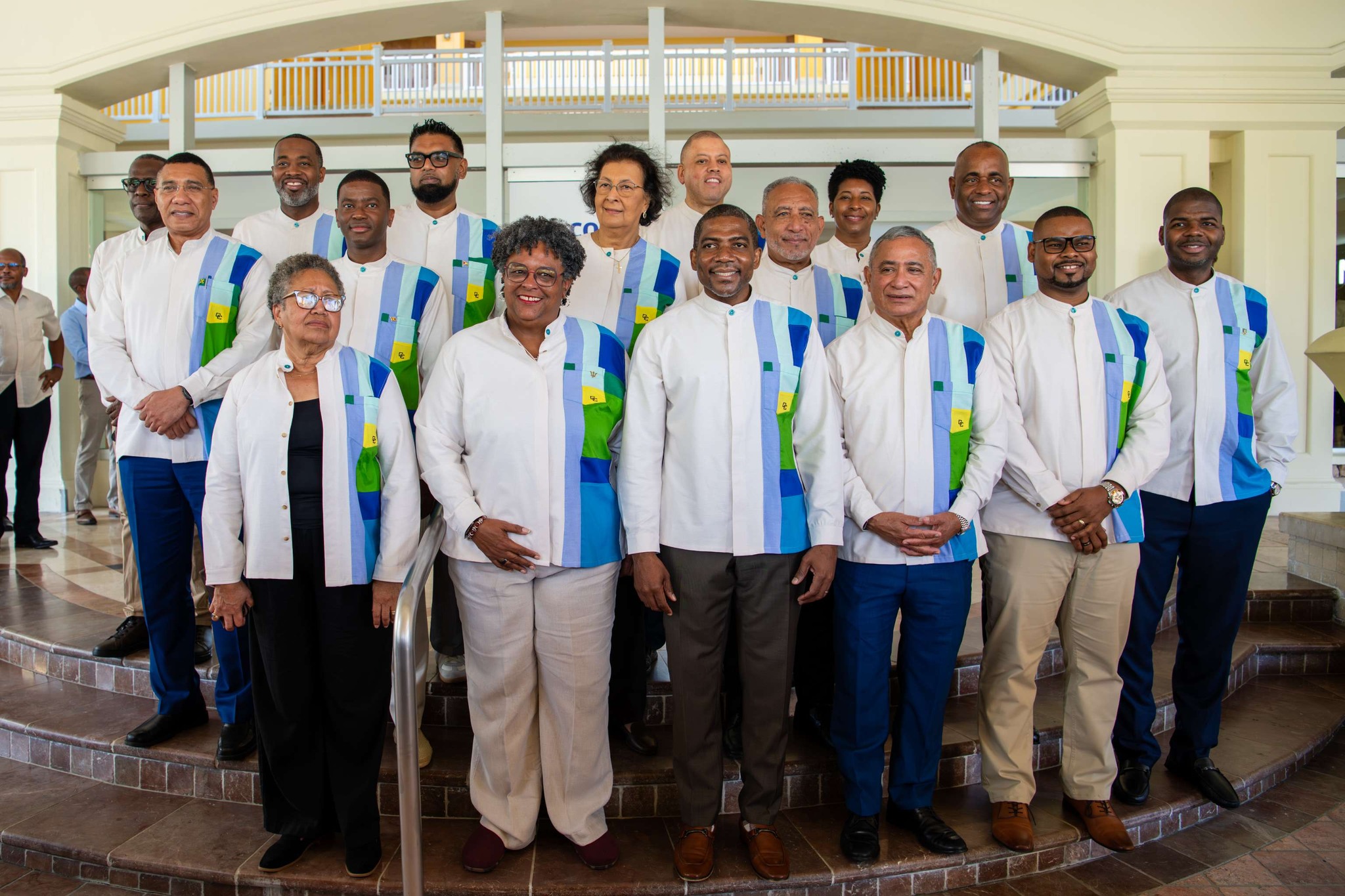
CARICOM’s official photo release from the retreat shows 10 heads of government from full independent CARICOM member states in attendance, alongside non-voting representatives from British dependent associate member territories. Full members Antigua and Barbuda, The Bahamas, Haiti, Montserrat, and Trinidad and Tobago were absent from the official gathering.
Persad-Bissessar has demanded full documentary evidence from Chairman Drew to confirm the legitimacy of Barnett’s reappointment, including meeting agendas, full attendee lists, official minutes from the February 26 retreat, all performance appraisals for the incumbent secretary-general, all formal communications calling for secretary-general nominee submissions, proof that all member states and their authorized representatives received proper invitations, clarification of why the heads-only restriction was omitted from the March 2, 2026 summary of confirmed decisions, and official documentation proving the reappointment vote was properly circulated by the chairman or the CARICOM Secretariat.
“Surely there must be timestamped minutes, performance appraisals etc. Even village councils and sports clubs document their meetings far less an organization over half a century old,” Persad-Bissessar said, adding that she has yet to receive any of the requested materials.
Trinidad and Tobago has taken drastic action over the stalled transparency request: both Persad-Bissessar and Sobers have refused to participate in future CARICOM meetings until the documents are released, and the nation boycotted a recent virtual CARICOM summit last week. A senior CARICOM source has argued that the dispute should be resolved during an in-person summit, not via back-and-forth correspondence, a position Trinidad and Tobago has rejected.
Drew has defended the reappointment process, noting that the decision was taken under the retreat’s “financing and governance of the community” agenda item, in full compliance with Article 24 of the Revised Treaty of Chaguaramas. He also said that prior to the public announcement, officials attempted to contact all absent heads to share the outcome, but multiple attempts to reach Persad-Bissessar via email and phone failed. Ultimately, Chairman Drew spoke directly to Sobers about the decision, though he has not shared details of that private discussion.
Persad-Bissessar has lashed out at what she calls a culture of cronyism at the CARICOM Secretariat, accusing officials of hiring political allies, party affiliates, and family members of regional politicians to maintain an “old boys club order.” She vowed to continue public pressure for accountability until the full truth is revealed and institutional reforms are implemented. “Therefore this matter will continue to be ruthlessly and relentlessly publicly escalated and prosecuted until persons are held accountable for their odious actions and proper reforms are made to the organization to ensure fairness, accountability, effective management and non interference in the domestic politics of CARICOM members,” she said Wednesday.
The growing rift has led to outside calls for Barnett to step down. Earlier this week, Antigua and Barbuda’s veteran ambassador to the United States and Organization of American States, Sir Ronald Sanders, publicly urged the secretary-general to resign on principle to avoid derailing Caribbean regional integration. Speaking to state-owned ABS Television, Sanders argued: “If I were the Secretary General of CARICOM and I’m being quite serious here and this had occurred I would have resigned and I would have resigned because I would have said I must not stand in the way of Caribbean integration and the movement forward. It is clear that one senior government and Prime Minister is not in favour of Barnett’s appointment and as a result she should consider stepping down. Why am I still there? Because it is clear that I will never enjoy her support and why therefore would I put myself in a situation in which I am now the cause of the rift. If I were Carla Barnett, I would resign now on principle because [Persad-Bissessar] will not attend the meeting if Carla Barnett is at that meeting, neither will her foreign minister.”