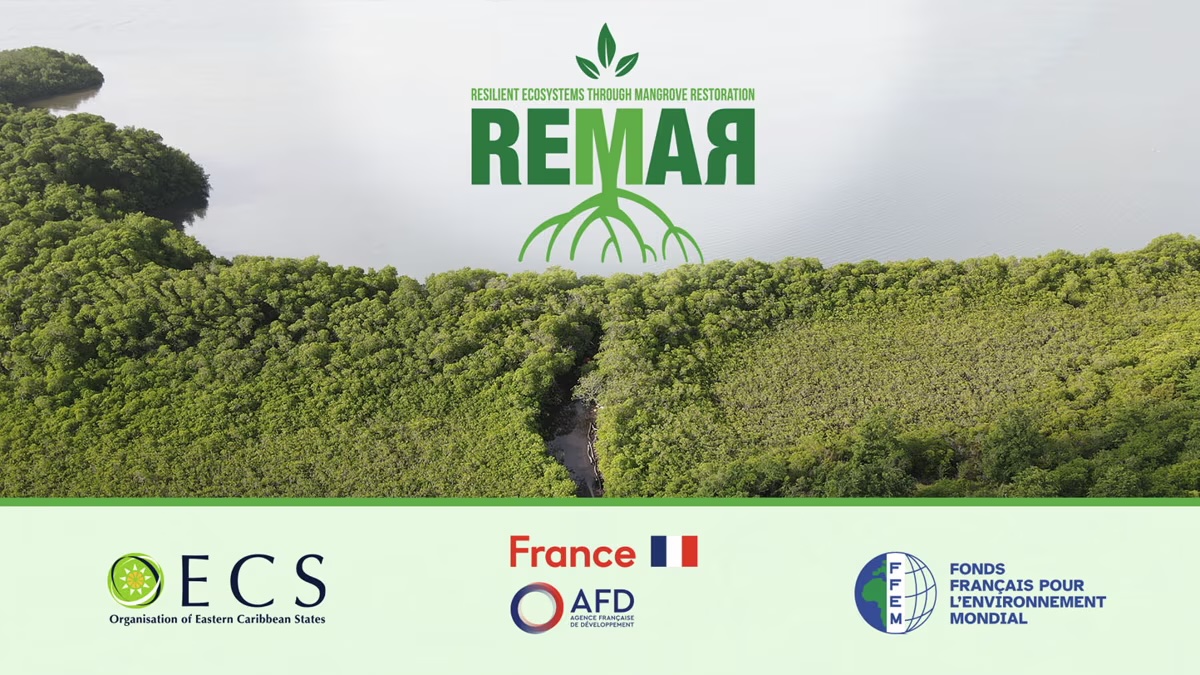
On April 11, 2026, the Organisation of Eastern Caribbean States (OECS) Commission held an official virtual launch ceremony for the groundbreaking Resilient Ecosystems through Mangrove Restoration (REMAR) Project, in close partnership with France’s Agence Française de Développement (AFD) and the French Facility for Global Environment (FFEM).
This five-year regional initiative carries a total investment of €5.5 million, marking one of the most significant recent commitments to advancing climate resilience, biodiversity protection, and inclusive sustainable livelihoods across the Eastern Caribbean. Over its implementation period, the project will deliver targeted support for mangrove restoration and long-term collaborative ecosystem management across five participating OECS territories: Grenada, St Lucia, St Vincent and the Grenadines, Martinique, and Guadeloupe.
Mangrove forests rank among the most ecologically and economically valuable coastal ecosystems in the entire Caribbean region. These unique coastal habitats deliver a wide range of critical ecosystem services: they shield shorelines from destructive erosion and dangerous storm surges, provide essential breeding and feeding grounds that underpin local commercial and artisanal fisheries, support a wide array of unique native biodiversity, filter pollutants to improve coastal water quality, and sequester far larger volumes of atmospheric carbon than most terrestrial forest ecosystems, making them a powerful natural tool for climate change mitigation.
Despite their outsized importance, Caribbean mangrove habitats have faced growing, cumulative threats in recent decades. Unsustainable coastal development, pollution, rising sea levels and intensifying storm activity driven by climate change, recurring hurricane damage, severe flooding events, and the rapidly growing crisis of large-scale sargassum inundations have all degraded vast swathes of mangrove habitat across the region.
Speaking during the project’s official launch, OECS Director General Dr. Didacus Jules framed REMAR as far more than an environmental intervention, calling it a strategic investment in regional communities, natural resources, and cross-border cooperation. “Protecting and restoring mangroves is not simply an environmental choice; it is a development imperative,” Jules noted. “REMAR is one such model. A model that brings together regional cooperation, local ownership, and strategic partnerships. A model that allows us to learn, adapt, and scale. And a model that positions the OECS not only as a beneficiary of support, but as a driver of solutions.”
Jules added that the new initiative aligns perfectly with the OECS’s core vision of lifting quality of life for all people across the region through collective action and equitable, impact-focused development cooperation.
Domenico Ditaranto, Deputy Head of Mission for the Embassy of France to the Eastern Caribbean States, Barbados, and the OECS, reaffirmed France’s longstanding commitment to sustainable development and collaborative regional action in the Caribbean. “REMAR is a very iconic project because it embodies regional cooperation that is highly relevant for the Caribbean,” Ditaranto said. “It shows the commitment of France and the value of working together to respond to shared challenges.”
Quentin Lajus, representing the Agence Française de Développement, also delivered remarks at the ceremony, highlighting the urgent need for coordinated cross-border action to address shared regional threats ranging from biodiversity loss and climate change to increasing coastal vulnerability. “The challenges that are shared by the region’s states and territories go beyond national borders and require joint, coordinated responses,” Lajus explained. “This is why our partnership with the OECS is so important and why REMAR is such a meaningful initiative.”
The REMAR Project is structured around three core strategic pillars that guide its work across all participating territories. First, it supports community-led restoration efforts at sites where mangrove habitats have been heavily degraded. Second, it works to expand scientific understanding of Caribbean mangrove ecosystems and establish open regional data-sharing protocols. Third, it focuses on strengthening institutional capacity for long-term ecosystem management and conservation across local, national, and regional levels.
At the regional level, the OECS Commission will lead overall implementation coordination, facilitate cross-territory knowledge exchange, and support the development of a new regional network focused on mangroves and swamp forest conservation. At the local level, site managers and community stakeholders will lead all restoration planning and on-the-ground work, with activities tailored to the specific ecological conditions and socio-economic needs of each territory.
Over the long term, project leaders expect REMAR to deliver far-reaching benefits across environmental, social, and economic domains. These outcomes include healthier, more resilient coastal ecosystems, expanded and more stable livelihoods for coastal communities dependent on mangrove resources, stronger local stewardship of natural resources, and more coordinated regional policy frameworks for mangrove protection.
Through the REMAR initiative, the OECS Commission and its partner organizations are reaffirming their shared commitment to building a more resilient, interconnected, and sustainable Eastern Caribbean, centered on nature-based climate solutions and strengthened by regional collective action.