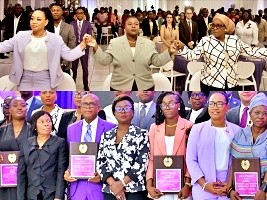
On April 10, 2026, Haiti’s Ministry on the Status and Rights of Women (MCFDF) hosted a day of reflection and national commemoration at Port-au-Prince’s Montana Hotel to mark both the National Day of the Haitian Women’s Movement and the 40th anniversary of the transformative April 3, 1986 women’s rights march. Billed under the theme “40 Years of Battle for Respect for Women’s Rights: Where We Are From, Where We Are, Where We Want to Go with Women’s Demands,” the gathering brought together a cross-section of senior government officials, election authority leaders, veteran feminist activists, senior United Nations representatives, and global institutional partners to examine decades of progress and map the path forward for gender equity in the Caribbean nation.
Attendees included cabinet members Stéphanie Smith of the Ministry of Tourism, Rayina Forbin of the Ministry of Foreign Affairs, and James Monazard of the Ministry of Commerce, alongside Provisional Electoral Council (CEP) leadership: CEP President Jacques Desrosiers and women’s sector representative Yves Marie Edouard. Former high-ranking officials also joined the conversation, including Marjorie Michel, a former health minister, and Sofia Loréus, who led MCFDF from 2021 to 2024. The United Nations system was represented by Samir Anouti, the UN Population Fund (UNFPA) resident representative to Haiti, and Eric Voli Bi, the national representative for UNESCO.
Kicking off the official proceedings, Marie Frantz Joachim, executive director of the leading women’s advocacy group Haitian Women’s Solidarity (SOFA), anchored the day in historical context, reminding attendees that the 1986 march endures as one of the most powerful symbols of Haitian women’s democratic awakening. Former minister Michel echoed this recognition of the march’s legacy, while drawing attention to a persistent gap in equity: women remain severely underrepresented in nearly all national decision-making bodies across government and politics.
Over the course of the day, institutional and international partners called for tangible, accelerated action to turn formal equality commitments into lived reality. UNFPA reaffirmed its commitment to advancing sexual and reproductive health and upholding the inherent dignity of girls and young women across Haiti. Commerce Minister James Monazard outlined ongoing government support for women-led business ventures through the national Women’s Entrepreneurship Support Project (PAEF), while Tourism Minister Stéphanie Smith highlighted the irreplaceable role women play in Haiti’s tourism sector, from driving economic growth to stewarding the country’s cultural heritage. She framed expanded women’s entrepreneurship as a critical lever to build long-term resilience for Haiti’s tourism industry.
In her closing address to attendees, MCFDF Minister Pedrica Saint Jean delivered a frank, unflinching assessment of where Haiti stands on gender equality four decades after the 1986 march. She acknowledged significant hard-won progress, pointing to the adoption of the 2014–2030 National Gender Equality Policy, the mandated 30% quota for women’s representation in public office, and the country’s ratification of the Belém do Pará Convention, the landmark international treaty to prevent, punish, and eliminate all forms of violence against women. Even with these gains, Saint Jean emphasized that deep gaps remain, and urgency is required to address ongoing systemic barriers. To that end, she announced a series of bold new government initiatives to advance equity, including the upcoming launch of four new regional Women’s Centers across four Haitian departments: West, Central, Artibonite, and Grand’Anse; targeted socio-economic integration programs designed to expand women’s financial independence; and a nationwide public outreach campaign to build broader support for the national gender equality policy.
The commemorative day included moving tributes to the pioneers of Haiti’s feminist movement, with honorary plaques presented to iconic activists who have led the fight for women’s rights across decades. Moderated by journalists Ediana Pierre Louis and Evelyne Bien-Aimé, two panel discussions fostered dynamic, intergenerational dialogue between veteran movement leaders like Joachim and emerging next-generation advocates including Pascales Solages and the collective Nègès Mawon, alongside MCFDF technical staff.
Closing out the event, Minister Saint Jean reaffirmed her ministry’s unwavering commitment to building a truly inclusive Haiti. Forty years after thousands of Haitian women took to the streets to demand equal rights and democratic representation, the core message of the movement remains unchanged: the fight for gender equality is far from over, and advocates will continue organizing until equal rights are a daily reality for all Haitian women, not just a stated demand.