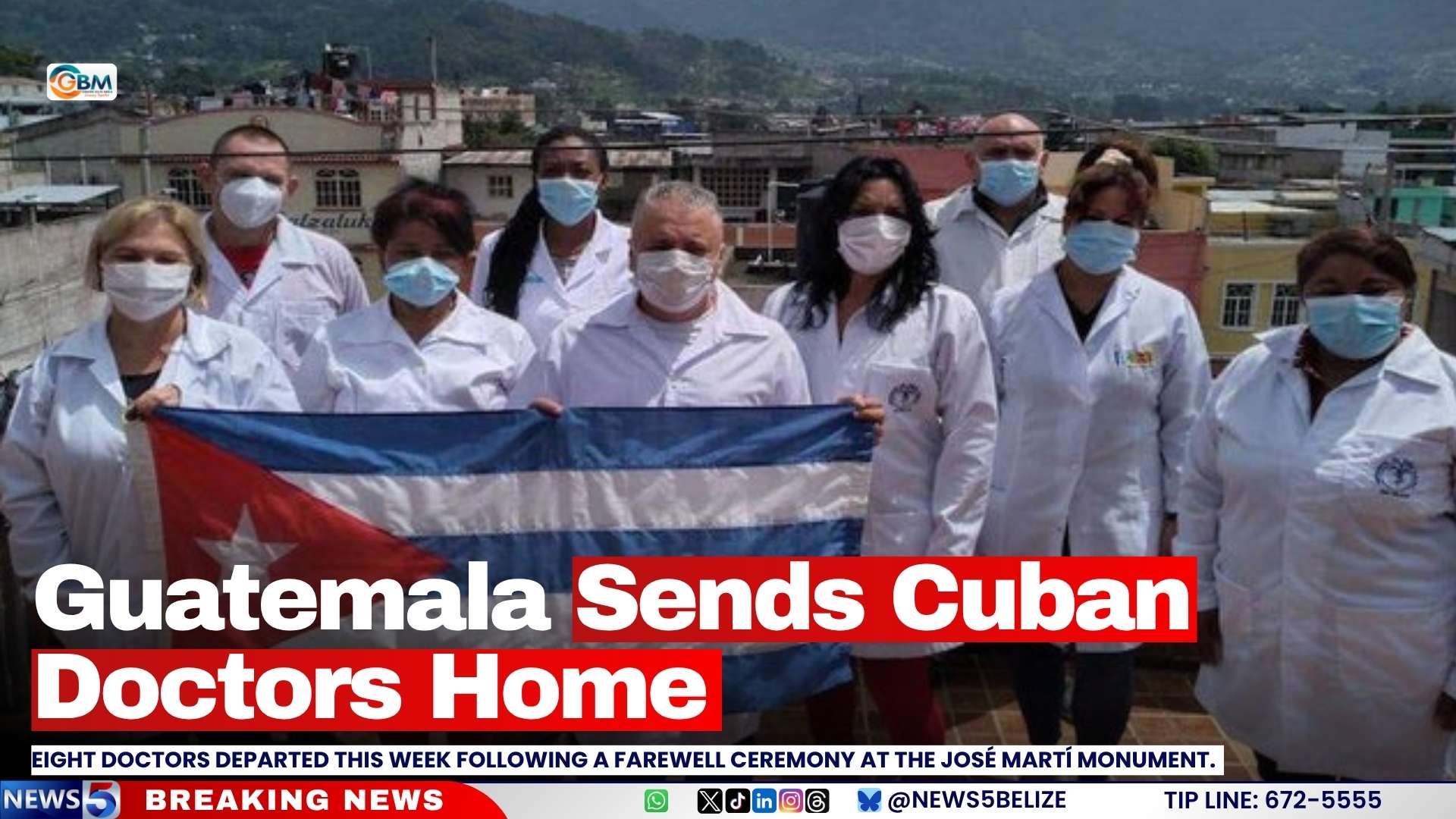
On April 4, 2026, Guatemala has launched the first phase of withdrawal for a decades-old Cuban medical collaboration program, marking the latest development in a growing regional trend of terminating medical partnerships with Havana that has been spurred by United States pressure.
The first cohort of eight Cuban medical professionals departed Guatemala this week after an official farewell ceremony held at the José Martí monument in the capital. In total, 93 members of the long-standing Cuban medical brigade are scheduled to complete their exit from the country by the end of April, with the remaining 319 brigade members set to leave in a second wave scheduled for August.
The Cuban medical mission first established a presence in Guatemala in 1998, growing over 28 years to include 412 total public health collaborators, 333 of whom were licensed practicing doctors. These medical workers were integrated fully into Guatemala’s national public health network, with nearly half deployed to some of the country’s most underserved remote regions. Departments including Quiché, Petén, and Alta Verapaz – which have long struggled with limited access to basic healthcare for rural and Indigenous communities – relied heavily on the Cuban medical personnel to fill critical gaps in service.
A key detail of the withdrawal has sparked questions about compliance with the bilateral agreement between Guatemala and Cuba. Guatemala’s Ministry of Health has confirmed that the Guatemalan government will not cover the cost of the medical workers’ return flights, a financial obligation explicitly outlined in the original 1998 cooperation agreement. According to reporting from independent Cuban news outlet CiberCuba, the Cuban embassy in Guatemala ultimately stepped in to coordinate funding for the tickets, securing financial support from Guatemalan private business owners to cover the travel costs.
Guatemala’s decision to end the program is not an isolated policy shift. It is part of a broader wave of withdrawals across Latin America and the Caribbean that can be traced directly to pressure from the U.S. government. In 2025, the U.S. State Department implemented visa restrictions on government officials across the region connected to Cuban medical missions, basing the punitive measure on unsubstantiated claims that the programs amount to forced labor schemes. Since those restrictions went into effect, three other countries – Honduras, Jamaica, and Guyana – have already terminated their own bilateral medical cooperation agreements with Cuba, leading to the withdrawal of hundreds of additional Cuban doctors from the region.
The regional shift has left the future of the Cuban medical program in neighboring Belize hanging in the balance. Prime Minister John Briceño confirmed recently that the Belizean government is currently holding “delicate negotiations” to determine the future of the program, which has supplied critical medical staff to Belize’s under-resourced public health system for many years.