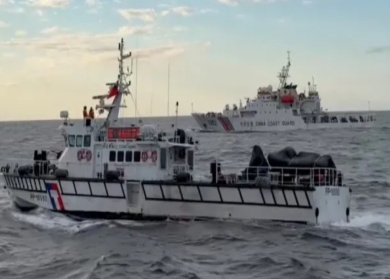
The Federation of St. Kitts and Nevis has issued a formal statement expressing deep apprehension regarding recent military exercises conducted by China’s People’s Liberation Army (PLA) in the Taiwan Strait. The Caribbean nation’s government, led by Prime Minister Terrance Drew, characterized these drills as activities that ‘heighten tensions and risk undermining peace, stability, and prosperity’ in the strategically vital region.
Emphasizing its commitment to international law and peaceful conflict resolution, the Basseterre administration highlighted the Taiwan Strait’s critical role as a global trade corridor whose stability represents a matter of international concern. The statement specifically called upon all involved parties to uphold their responsibilities under the United Nations Charter while reaffirming the nation’s dedication to collaborating with international partners to safeguard global peace and development.
This diplomatic position emerges from St. Kitts and Nevis’ unique status as one of the few Caribbean Community (CARICOM) members maintaining formal diplomatic relations with Taiwan, which China considers a breakaway province subject to its ‘One China’ principle.
The situation coincides with Taiwanese President William Lai Ching-te’s reaffirmation of his administration’s commitment to ‘resolutely defend national sovereignty and strengthen national defence.’ President Lai has proposed a substantial US$40 billion military spending increase, though this initiative currently faces legislative hurdles due to opposition party control in Taiwan’s parliament.
Concurrently, the United States has urged China to exercise restraint and avoid actions that escalate regional tensions. State Department spokesman Tommy Pigott articulated Washington’s position supporting ‘peace and stability across the Taiwan Strait’ while opposing ‘unilateral changes to the status quo, including by force or coercion.’
China’s recent military operations included missile launches and deployments of aircraft and naval vessels simulating an encirclement of Taiwan. While such drills have become increasingly routine, analysts note that Beijing’s demonstrated willingness to curtail autonomy in regions like Hong Kong has intensified speculation about potential military intervention to compel Taiwan’s compliance with Chinese objectives.