标签: Suriname

苏里南

  • Plannen gepresenteerd voor STEM-campus in Diitabiki

    Plannen gepresenteerd voor STEM-campus in Diitabiki

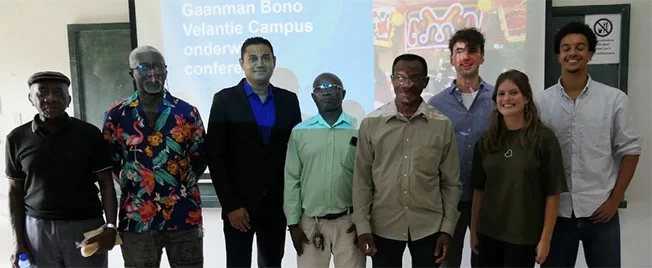
    PARAMARIBO – Ambitious plans for the Gaanman Bono Velantie Campus in Diitabiki, deep within Suriname’s Tapanahony region, were unveiled during an educational conference at the NATIN complex. The visionary initiative, championed by Indigenous leader Gaanman Bono Velantie, aims to dramatically improve educational access for both youth and adults in the nation’s remote interior territories.

    The pioneering campus will house the School for Technology, Entrepreneurship and Management (STEM Diitabiki), delivering practical, skills-based education specifically designed to foster sustainable economic development and entrepreneurial growth within the region. The curriculum will focus on equipping students with immediately applicable technical and business capabilities.

    Notably, the project design emerged from a collaborative effort. Students from the renowned Delft University of Technology in the Netherlands partnered with local institutions NATIN and AMTO to develop the initial concept. Their proposal was informed by comprehensive field research conducted in Diitabiki, combined with prior studies on sustainable construction practices and innovative water management systems tailored to the unique rainforest environment.

    A Surinamese engineering firm has been tasked with the subsequent technical elaboration, ensuring all final plans rigorously comply with national building codes and regulations. The campus infrastructure is slated to include modern workshops and a dedicated business incubator, creating a direct pipeline from education to practical application and stimulating local enterprise.

    To oversee realization and long-term management, the Stichting Gaanman Bono Velantie Campus foundation has been established. A specially appointed working group will provide supervisory governance. The initial operational phase anticipates accommodating approximately 100 students, with a targeted launch of educational activities by October 2026.
  • Gerenoveerde OS II Livorno feestelijk in gebruik genomen

    Gerenoveerde OS II Livorno feestelijk in gebruik genomen

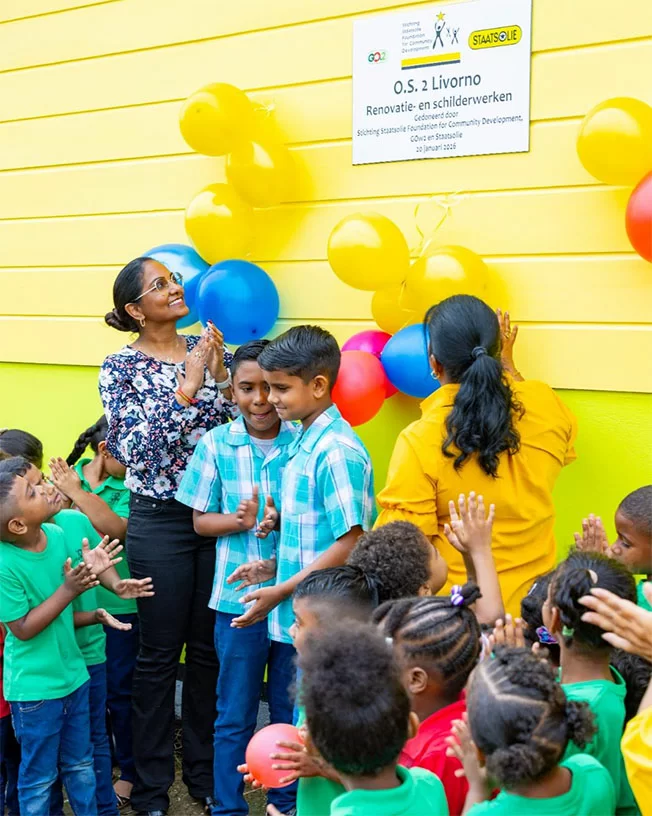
    The OS II Livorno school located on Pandit Paltan Tewarieweg has been officially reopened following an extensive renovation project completed with support from the Staatsolie Foundation in collaboration with GOw2. This educational institution has undergone a remarkable transformation that addresses both aesthetic and structural concerns.

    The comprehensive refurbishment included complete classroom upgrades featuring new ceilings, wall panels, and modernized blackboards, all complemented by fresh paint throughout the facility. The school environment has been redesigned with child-friendly elements to create a more engaging learning atmosphere. Crucially, the project resolved persistent issues with woodlice and wood-boring insects that had compromised the building’s integrity, ensuring both safety and comfort for students and faculty.

    School administration and teaching staff have expressed profound appreciation for the renovations, noting that the improvements contribute significantly to a more pleasant and motivating educational environment. The transformation goes beyond cosmetic changes, addressing fundamental infrastructure issues that had hindered the learning experience.

    The Staatsolie Foundation emphasized that this initiative aligns with its long-term commitment to supporting educational institutions throughout Suriname. This project represents part of their broader strategic investment in national development through educational infrastructure improvement. By enhancing physical learning environments, the foundation aims to create sustainable educational opportunities that will benefit Surinamese communities for years to come.

    The successful completion of the OS II Livorno renovation demonstrates how public-private partnerships can effectively address educational infrastructure needs while creating environments conducive to academic excellence and student development.

  • Europese leiders roepen op tot eenheid in Davos na Trumps dreiging met tarieven

    Europese leiders roepen op tot eenheid in Davos na Trumps dreiging met tarieven

    European leaders demonstrated remarkable solidarity at the World Economic Forum in Davos, Switzerland, as they coordinated a firm response to former U.S. President Donald Trump’s controversial pursuit of acquiring Greenland. The gathering revealed a continent determined to present a unified stance against what they perceive as provocative American actions.

    French President Emmanuel Macron articulated Europe’s position with notable clarity, asserting that the European Union must not yield to ‘the law of the strongest.’ He characterized as ‘crazy’ the mere consideration of deploying the EU’s anti-coercion instrument against the United States. ‘We seek greater growth and stability, but we prefer respect over intimidation,’ Macron declared during the forum’s proceedings.

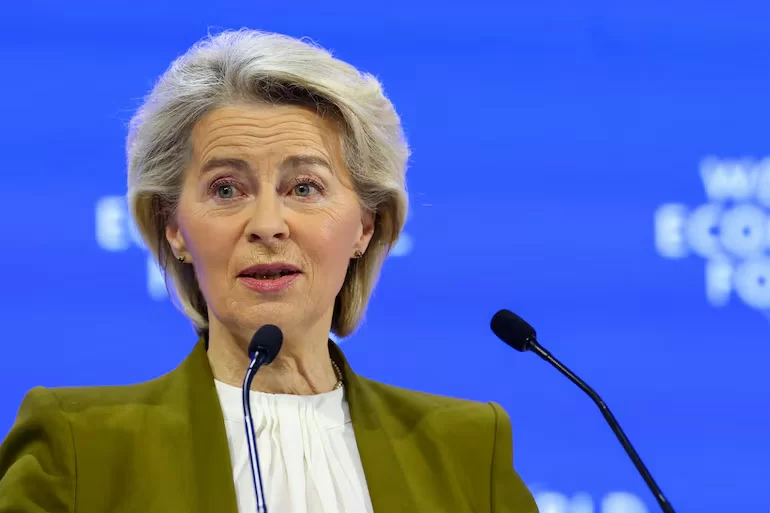
    European Commission President Ursula von der Leyen emphasized the imperative for Europe to adapt to rapid global transformations, advocating for the construction of a ‘new, independent Europe’ capable of navigating contemporary geopolitical challenges. Her address highlighted the strategic repositioning of European foreign policy in response to shifting international dynamics.

    Belgian Prime Minister Bart De Wever framed the situation as a critical juncture for the European project, issuing a stark warning: ‘We must tell Donald Trump: you are crossing red lines here. We stand strong together, or we stand divided.’ This sentiment was echoed by Swedish Deputy Prime Minister Ebba Busch, who cautioned that appeasing Trump’s ego would prove ineffective, urging maintenance of sharp trade measures including potential retaliatory actions.

    The diplomatic tensions escalated following Trump’s Saturday announcement of tariffs targeting European nations opposing his Greenland acquisition plans. This move triggered substantial protests across Denmark, with thousands expressing their disapproval through public demonstrations.

    United Nations Secretary-General António Guterres joined other global leaders in advocating for maximum restraint to prevent further escalation and potential loss of life. Meanwhile, Ukrainian President Volodymyr Zelenskyy expressed conditional willingness to participate in security guarantee discussions and reconstruction plans, provided the United States offers concrete commitments. He simultaneously called for increased pressure on Russia following recent severe attacks on Ukrainian territory.

    The Davos meeting effectively mirrored the complex tensions and challenges characterizing contemporary international politics, with European nations and their partners seeking equilibrium between cooperation and defending their interests against unpredictable American policy decisions.

  • Bezoek CCJ onderstreept rol Suriname binnen Caribische rechtsorde

    Bezoek CCJ onderstreept rol Suriname binnen Caribische rechtsorde

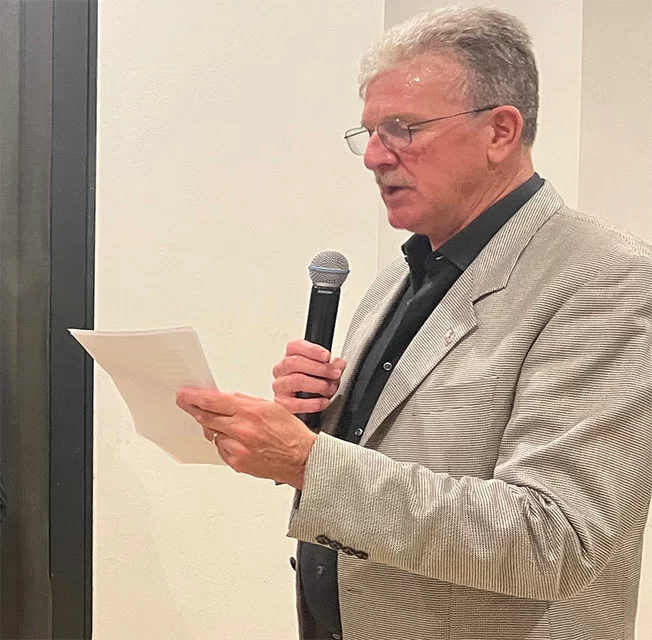
    A high-level delegation from the Caribbean Court of Justice (CCJ), led by President Winston Anderson, has commenced an official visit to Suriname at the invitation of the country’s Court of Justice President Iwan Rasoelbaks. The delegation, which includes Justice Peter Jamadar, the Registrar, and Chief Marshal, aims to enhance judicial cooperation between regional institutions and national legal systems.

    This strategic engagement aligns with the CCJ’s 2025-2032 Strategic Plan, which prioritizes improving access to justice, strengthening regional legal collaboration, promoting transparency, and building public confidence in judicial institutions. During their stay, the delegation will engage with members of Suriname’s judiciary, the Bar Association, parliamentarians, and other key stakeholders.

    A highlight of the visit will be the delegation’s participation in the Congress on Modernization of the Judiciary on January 22, where they will elaborate on the CCJ’s role, operational methodologies, effectiveness, institutional framework, and jurisdictional authorities.

    The current mission builds upon previous collaborative initiatives between the CCJ and Suriname. In November 2025, the Court concluded a multi-year training program on Referral Procedures in partnership with Suriname’s Bar Association. This comprehensive two-year awareness campaign, partially funded by the European Union, focused on educating legal professionals and business communities about the obligation of national judges to refer questions regarding the interpretation and application of the Revised Treaty of Chaguaramas to the CCJ in its original jurisdiction.

    As part of this ongoing cooperation, President Anderson previously presented the CCJ Original Jurisdiction Rules 2024 and accompanying Referral Manual—now translated into Dutch—to Suriname’s former Minister of Justice & Police. The CCJ anticipates constructive dialogues with Surinamese partners and aims through this visit to foster greater understanding of the Court’s role in advancing rule of law, regional integration, and legal excellence throughout the Caribbean region.

  • Scheidende VS ambassadeur Faucher: ‘Dit is geen afscheid’

    Scheidende VS ambassadeur Faucher: ‘Dit is geen afscheid’

    After completing his diplomatic assignment in Suriname, U.S. Ambassador Robert Faucher emphasized that his departure marks not an ending but the beginning of a new chapter in his four-decade relationship with the nation. During his farewell reception, the ambassador reflected on his transformative tenure while affirming his permanent personal connection to the country.

    Ambassador Faucher characterized his recent three-year term as one of the most significant phases of his diplomatic career, highlighting a period of remarkable recovery and advancement following the challenges of the global pandemic. Under his leadership, bilateral cooperation between Suriname and the United States intensified substantially across multiple sectors including energy development, educational exchange, and commercial engagement. This enhanced partnership manifested through historic business delegations and strengthened academic networks between the two nations.

    The ambassador’s personal journey with Suriname began in 1986, with subsequent visits in 2002 leading to his ambassadorial appointment. Throughout his service, he witnessed the country’s evolution into a confident nation with global perspectives. His extensive travels across all districts—from urban Paramaribo to the remote Sipaliwini region, including visits to Kwamalasamutu and the culturally significant Werehpai area—deepened his appreciation for Suriname’s natural wonders, cultural diversity, and national resilience.

    A cornerstone of Faucher’s diplomatic mission involved highlighting the shared historical narrative between the United States and Suriname. Notable achievements included the installation of the first American Battle Monuments Commission memorial in South America, commemorations of NASA rocket launches in Coronie, and the publication of “Common Past, Shared Future” documenting fifty historical connections between the nations. Most recently, a monument in Commewijne honored 35 American military personnel and diplomats who perished in the 1943 Matapica aircraft tragedy.

    The ambassador described the current bilateral relationship as the strongest in history—characterized by practical cooperation, mutual respect, and future-oriented vision grounded in shared sovereignty and developmental values. Concluding with an optimistic outlook, Faucher expressed confidence that “the best chapters in U.S.-Suriname relations remain ahead of us,” promising to return not as a diplomat but as a permanent friend of the nation.

  • VP Rusland in Davos: Suriname kiest bewust voor duurzaam toerisme

    VP Rusland in Davos: Suriname kiest bewust voor duurzaam toerisme

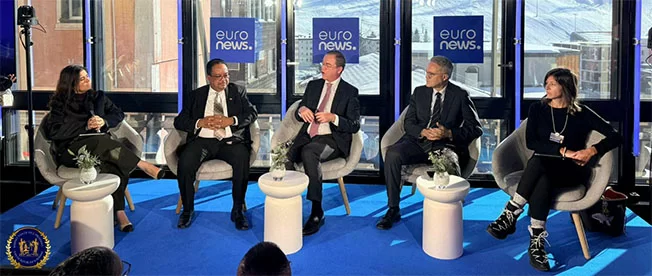
    Suriname has declared its intention to build economic development around sustainable tourism rather than petroleum revenues, according to Vice President Gregory Rusland’s address at the World Tourism Forum in Davos, Switzerland on January 20, 2026. Speaking during a panel discussion, the vice president positioned ecotourism as a strategic pillar for national development while inviting international investment and collaboration.

    Rusland presented Suriname as a distinctive destination characterized by 93% pristine rainforest, preserved indigenous and tribal communities, and remarkable religious coexistence exemplified by a synagogue and mosque standing peacefully side by side. ‘Though our population numbers merely 600,000, our nation possesses exceptional offerings,’ Rusland stated, highlighting that Suriname ranks among only three carbon-negative countries worldwide.

    The vice president cautioned against mass tourism, advocating instead for high-quality, low-volume tourism where visitors pay premium rates for authentic experiences centered on nature, tranquility, and ecological preservation. ‘Maintaining our current status is crucial,’ he emphasized, underscoring the need to protect the country’s environmental and cultural assets.

    Panel participants broadly agreed that sustainable tourism represents a shared responsibility among governments, businesses, travelers, and local communities. Preservation of natural and cultural heritage for future generations emerged as a central theme, particularly as younger demographics grow increasingly critical of environmental degradation and legacy impacts.

    Rusland challenged the perception of sustainable tourism as costly, arguing that it generates reciprocal value when travelers contribute positively to destinations they visit. In his concluding remarks, he reinforced Suriname’s commitment to avoiding oil dependency and emphasized the essential role of public-private partnerships with active local community involvement. ‘The Surinamese government will support everything necessary to further develop sustainable tourism,’ Rusland affirmed, identifying inclusion as a key component in this strategic direction.

  • Chikungunya-uitbraak bevestigd in Suriname: volksgezondheidsautoriteiten waarschuwen bevolking

    Chikungunya-uitbraak bevestigd in Suriname: volksgezondheidsautoriteiten waarschuwen bevolking

    Suriname’s Ministry of Health, Welfare, and Labor has officially confirmed an outbreak of chikungunya virus within the country, marking a significant public health development. Laboratory analyses conducted by both the Central Laboratory of the Bureau of Public Health and the Academic Hospital Paramaribo have identified eight confirmed cases of the mosquito-borne illness.

    What makes this outbreak particularly noteworthy is that none of the infected individuals had recently traveled abroad, indicating local transmission within Suriname. This pattern suggests established mosquito-borne viral circulation in the community.

    Chikungunya, a viral infection transmitted primarily by Aedes mosquitoes—the same vectors responsible for dengue, zika, and yellow fever—manifests with symptoms including sudden high fever, severe joint pain and swelling, headaches, fatigue, and occasionally skin rashes. The virus is not directly transmitted between humans but spreads when mosquitoes bite infected individuals and then transfer the virus to others.

    Health authorities have initiated comprehensive epidemiological investigations, including contact tracing, enhanced laboratory testing, and strengthened surveillance systems to contain further spread. The ministry emphasized that while serious complications are rare, joint pain can persist for weeks or even months following infection. Elderly individuals, young children, pregnant women, and those with chronic health conditions face elevated risks of complications.

    Medical guidance recommends against using aspirin or ibuprofen for symptom management, instead advising paracetamol for pain and fever relief, adequate hydration, rest, and seeking medical attention if symptoms worsen.

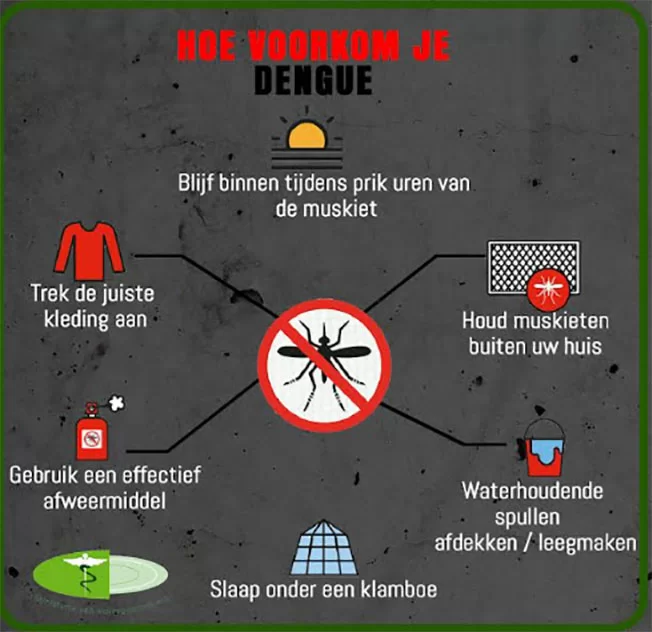
    The ministry has committed to providing timely, accurate, and transparent updates as new information emerges. Simultaneously, they urge citizens to actively participate in mosquito control efforts by eliminating breeding sites—particularly standing water in containers, tires, flower pots, and buckets—while also recommending protective clothing and insect repellents as essential preventive measures.

  • Noodtoestand Guatemala, tien politieagenten vermoord

    Noodtoestand Guatemala, tien politieagenten vermoord

    Guatemala has plunged into a state of emergency following a devastating wave of coordinated gang violence that left ten police officers dead and forced the government to implement drastic security measures. The crisis began with simultaneous prison riots across three correctional facilities on Saturday, where members of the notorious Barrio 18 gang took dozens of guards hostage.

    The violence escalated dramatically on Sunday when gang forces launched retaliatory attacks against police units throughout Guatemala City. This aggressive response came after security forces successfully regained control of a prison housing influential gang leader Aldo ‘El Lobo’ Duppie, who is serving cumulative sentences totaling approximately 2,000 years.

    On Monday, Guatemala’s parliament nearly unanimously approved a 30-day state of emergency that had already been activated by President Bernardo Arevalo. The emergency measures significantly expand police powers, allowing warrantless arrests of suspected gang members, restricting freedom of movement, and prohibiting public demonstrations. Authorities can now also implement vehicle checkpoints and search restrictions in designated areas.

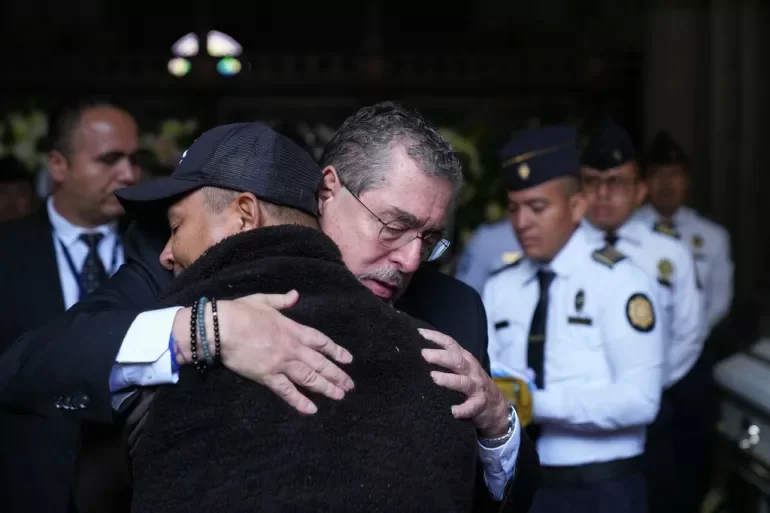
    President Arevalo presided over a solemn ceremony at the Interior Ministry to honor the fallen officers, presenting flags to grieving families. ‘It pains me today to hand each of these families this flag,’ Arevalo stated, ‘a symbol of the nation that will not forget the sacrifice and dedication of its police officers who fell in the exercise of their duty.’

    The Barrio 18 gang, which operates alongside the rival MS-13 in Central American drug trafficking networks, reportedly initiated the violence to demand improved privileges for incarcerated members and leaders. This incident continues a pattern of prison unrest that began in mid-2025, including a major October escape where 20 Barrio 18 leaders fled custody—only six were recaptured, while one was killed.

    Notably, gang leader El Lobo maintains family connections to Sandra Torres, President Arevalo’s primary opponent in the 2023 elections, adding political dimensions to the security crisis. Guatemala City remains under heightened security as the government attempts to restore order amidst widespread fear and outrage.

  • Diaspora  wil uitvoering wettelijke verplichtingen na 50 jaar onafhankelijkheid

    Diaspora wil uitvoering wettelijke verplichtingen na 50 jaar onafhankelijkheid

    An internationally composed coalition of Surinamese diaspora representatives has issued a formal demand for the Surinamese government to finally implement constitutional obligations outlined in the 1975 Transfer Agreement. In an open letter addressed to President Jennifer Simons, the group asserts that the continued absence of a comprehensive national diaspora policy has become indefensible.

    The letter specifically references Article 5, Section 2 of the Transfer Agreement, which legally obligates the Surinamese state to provide equal treatment, access, and residency rights to persons of Surinamese descent regardless of their country of residence or nationality. Despite marking fifty years of independence, this constitutional commitment remains unfulfilled through coherent policy implementation, representing what the diaspora terms a persistent failure to execute state legal agreements.

    While acknowledging the existing PSA policy as a useful preliminary measure, the diaspora characterizes it as fundamentally insufficient due to its lack of an integrated, interministerial, and structural framework. The current approach suffers from institutional fragmentation, inadequate coordination, and insufficient legal certainty for diaspora members, primarily due to the absence of a designated policy authority.

    The coalition advocates for the immediate establishment of a Directorate for Diaspora Policy under the Ministry of Foreign Affairs, International Business, and International Cooperation. This proposed directorate would be led by an appointed director with explicit mandate to develop cohesive policies addressing access rights, nationality provisions, settlement procedures, labor regulations, and developmental engagement opportunities.

    Emphasizing that they are requesting compliance rather than special favors, the diaspora warns that further delay in implementing these obligations would constitute legal, administrative, and social irresponsibility. The group has made the full text of their open letter publicly available for download.

  • Jeugd aan de grens onder druk: Suriname en Frankrijk zoeken samenwerking via sport en preventie

    Jeugd aan de grens onder druk: Suriname en Frankrijk zoeken samenwerking via sport en preventie

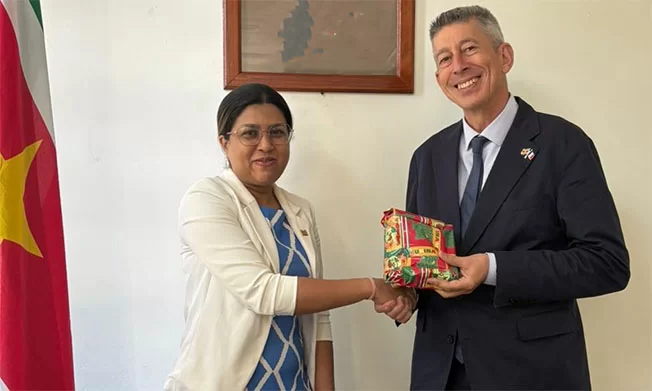
    In a significant bilateral meeting, Suriname’s Minister of Youth Development and Sport Lalinie Gopal and French Ambassador Nicolas de Lacoste have identified sports as a strategic tool to address mounting youth challenges in the border regions shared by Suriname and French Guiana.

    The high-level discussion centered on the Marowijne River border between Suriname’s Marowijne district and France’s Saint-Laurent-du-Maroni territory, where interconnected social issues transcend national boundaries. Ambassador de Lacoste emphasized the urgency of understanding Suriname’s policy priorities given the transnational nature of youth problems in these border communities.

    French officials highlighted severe challenges plaguing French Guiana’s youth, including mental health crises and alarmingly high suicide rates among young people. Both nations recognize organized sports as a powerful mechanism to provide structure, purpose, and future perspectives for vulnerable youth populations.

    The dialogue explored existing and prospective sporting initiatives, including the Inter-Guiana Games, Olympic events, and regional tournaments. France has committed to facilitating participation by providing free visas for sporting and cultural activities, effectively removing financial barriers for Surinamese athletes.

    Minister Gopal outlined Suriname’s infrastructural limitations in sports facilities and policy implementation. She referenced ongoing discussions with the Surinamese Olympic Committee and international partnerships, including India’s donation for upgrading sports infrastructure in Nickerie. The minister stressed the critical gap in school sports programs due to insufficient structural integration within education systems and a shortage of qualified sports instructors.

    Youth development challenges received substantial attention, with particular focus on persistent issues like teenage pregnancies and school dropout rates in border communities. Suriname is collaborating with UNICEF and UNFPA on prevention programs that engage not only girls but also parents and fathers.

    Ambassador de Lacoste expressed France’s willingness to expand cooperation into prevention strategies, sports training, and knowledge exchange. He noted that sports facilities in French Guiana benefit from management by locally elected officials, which enhances accountability and targeted investment.

    Both parties agreed to explore formalizing their collaboration through a memorandum of understanding, potentially establishing concrete agreements addressing youth development, sports, education, and shared cross-border challenges.