标签: Suriname

苏里南

  • Na felle discussies nieuw amendement over organisatie OM

    Na felle discussies nieuw amendement over organisatie OM

    In a significant legislative development, four members of Suriname’s National Assembly (DNA) have submitted a substantive amendment to the Judicial Status Act, proposing two major reforms to the country’s judicial system. The proposal, filed on Friday afternoon by assembly members Steven Reyme (A20), Xiaobao Zheng (PL), Ronny Asabina (BEP), and Rabin Parmessar (NDP), seeks to recalibrate both retirement protocols and administrative structures within the Public Prosecutor’s Office (OM).

    The central amendment aims to reverse the current retirement age for members of the Public Prosecutor’s Office, including the Attorney General, from 70 back to 65 years. According to explanatory notes accompanying the proposal, this adjustment seeks to reharmonize pension regulations across the magistracy, addressing inconsistencies that have emerged within judicial retirement policies.

    Concurrently, the amendment proposes transforming the prosecutorial leadership model from a single Attorney General system to a collective Board of Prosecutors General. This new governance structure would consist of one Attorney General as chairperson complemented by two to four Advocates General. Proponents argue that this collegiate approach would enhance institutional balance, strengthen internal controls, and ensure greater continuity in prosecution policies.

    The proposed reforms emerge against the backdrop of intensive debates within legal and political circles regarding the organizational framework and leadership dynamics of the Public Prosecutor’s Office. The amendment also introduces fixed-term appointments for the Attorney General position, proposing a five-year term renewable once, replacing the previous lifetime appointment system.

    The National Progressive Party (NPS), while supporting the amendment, was unable to formally endorse the proposal due to time constraints affecting representative Jerrel Pawiroredjo. Meanwhile, the opposition Progressive Reform Party (VHP) has expressed reservations about the current amendment and is expected to present alternative proposals during Monday’s parliamentary session, where the amendments will undergo thorough public deliberation.

    These proposed changes represent part of broader institutional reforms aimed at strengthening Suriname’s judicial apparatus by reducing dependence on individual officials and creating more robust systems of checks and balances within the nation’s law enforcement infrastructure.

  • Nieuwe lichting ambassadeurs moet internationale positie Suriname versterken

    Nieuwe lichting ambassadeurs moet internationale positie Suriname versterken

    In a significant diplomatic ceremony held at the Presidential Palace on Friday, President Jennifer Simons officially sworn in nine new ambassadors who will represent Suriname across multiple nations and international organizations. The event marks the commencement of a fresh phase in Suriname’s foreign diplomatic appointments aimed at strengthening bilateral cooperation and advancing national interests globally.

    Among the newly appointed ambassadors are Vanessa Tsin-Jie Li (Beijing, China), Pearl Aprasong-Paulus (Paris, France), Genia Lank-Corinde (Havana, Cuba), Marciano Armaketo (Brussels, Belgium), Ike Antonius (Brasília, Brazil), Hanisha Jairam (New Delhi, India), and Georgette Elias (Caracas, Venezuela). Additionally, Marlon Mohamed-Hoesein assumes the role of Ambassador to Washington D.C. and will serve as Permanent Representative to the Organization of American States (OAS), while Michel Kerpens is designated as Suriname’s representative to the United Nations in New York.

    President Simons emphasized the critical importance of professional and results-oriented diplomacy during her address. She urged the ambassadors to actively promote Suriname’s interests in international cooperation, trade, investment, and development. The head of state outlined clear expectations for the new envoys to deepen diplomatic and political relations with host countries while simultaneously contributing to investment attraction and economic diversification efforts.

    The president further highlighted the ambassadors’ role in cultural and societal representation, stating, “You are expected to keep Suriname’s potential and the ideals of our nation in mind throughout your duties.” She called for an assertive, outcome-driven approach underpinned by open communication and close collaboration with both Surinamese and foreign partners.

    Ambassador Ike Antonius, speaking on behalf of the newly appointed diplomats, expressed gratitude and acknowledged the weight of their responsibilities. “We accept this appointment not merely as a position, but as a mission to represent our country with dignity and professionalism,” he stated.

    The ceremony was attended by Vice President Gregory Rusland and Minister of Foreign Affairs, International Trade, and Cooperation Melvin Bouva, reflecting the government’s unified support for these strategic diplomatic assignments.

  • Indiase schepen krijgen doorgang na Iraans vertrek uit India

    Indiase schepen krijgen doorgang na Iraans vertrek uit India

    In a significant development highlighting regional tensions, an Iranian-chartered aircraft departed southern India Friday evening carrying both naval personnel from a docked Iranian warship and stranded Iranian tourists. This follows Sri Lanka’s earlier repatriation of 84 deceased Iranian sailors killed in a US attack on an Iranian naval vessel near the island’s coast, with survivors also returned through Colombo’s coordination according to Reuters sources.

    The events unfold against the backdrop of escalating US-Israel hostilities against Iran that have severely disrupted shipping through the strategically critical Strait of Hormuz. This maritime corridor remains vital for global energy supplies, accounting for approximately 40% of India’s crude oil imports. After days of uncertainty, Tehran confirmed Friday that Indian vessels would receive safe passage through the strait, providing New Delhi substantial relief in averting a broader energy crisis.

    The Iranian naval vessel IRIS Dena was struck by a US submarine torpedo on March 4 while returning from maritime exercises in India. Two accompanying ships from the same exercises sought refuge—IRIS Lavan in India and IRIS Booshehr in Sri Lanka.

    An Indian official reported the chartered flight first landed in Kochi, southern India, after departing Sri Lanka where the deceased sailors’ remains had been held. A Sri Lankan court had earlier ordered the bodies, preserved in a morgue in the southern port town of Galle, to be transferred to the Iranian embassy.

    Regional Implications and Diplomatic Developments
    The repatriation operations underscore the expanding regional consequences of the Iran conflict, which has critically disrupted maritime transit through the Hormuz Strait. India has maintained intensive communications with Iranian officials to guarantee safe passage for Indian-flagged or India-bound vessels.

    In recent days, several Indian ships have successfully transited the strait—an achievement touted by Prime Minister Narendra Modi’s party as a diplomatic victory, widely promoted on social media ahead of crucial state elections.

    Iranian Ambassador to India Mohammad Fathali confirmed the safe passage arrangement while emphasizing bilateral relations: “We believe Iran and India are friends. We share common interests and a common destiny. As Iran’s ambassador to India, I affirm that the Indian government will support us across various domains following the war.”

  • Explosies bij al-Quds-dag in Teheran, één dode

    Explosies bij al-Quds-dag in Teheran, één dode

    A series of explosions struck central Tehran during the annual Quds Day demonstrations, resulting in one confirmed fatality and escalating tensions in the ongoing military confrontation between Iran and the US-Israel alliance now entering its fourteenth day.

    The blast occurred Friday afternoon at Ferdowsi Square where thousands had gathered for the international day of solidarity with Palestine. While the exact cause remains undetermined, the explosion came shortly after Israeli officials had warned of potential airstrikes in the area.

    Iran’s state-run Press TV reported one woman killed by shrapnel from what they described as a US-Israeli aerial attack, though no further casualty details were provided. According to Iranian health authorities, the cumulative toll since February 28 stands at 1,444 fatalities and 18,551 injured from American and Israeli military operations.

    Despite security concerns, state media reported continued large turnout for Quds Day commemorations across multiple Iranian cities. Participants carried Iranian flags and images of Palestinian fighters while chanting “Death to Israel” and “Death to America” during the marches.

    The demonstrations were attended by senior Iranian officials including President Masoud Pezeshkian and National Security Council Secretary Ali Larijani, who asserted that Israel’s bombing campaign reflected “fear” and criticized US President Donald Trump for underestimating Iranian resolve.

    The global implications of the conflict continued to intensify with Iran’s newly appointed Supreme Leader announcing the permanent closure of the Strait of Hormuz to international shipping. This strategic waterway, which typically handles approximately 20% of global oil exports, has become the focal point of escalating regional tensions.

    The maritime blockade has created massive congestion with dozens of oil tankers stranded in lengthy queues, severely disrupting global energy supplies and driving crude prices to approximately $105 per barrel—a significant increase over recent months. This price surge has triggered fuel rationing measures in neighboring Gulf states including Oman, UAE, and Kuwait as governments attempt to manage limited supplies and prevent social unrest.

    The economic impact extends throughout Asia and beyond, affecting all nations dependent on Hormuz transit routes. Supply chain disruptions are now affecting both transportation networks and industrial operations, increasing economic pressure across the region.

  • LVV onderzoekt kansen voor pluimveehouderij in Asidonhopo en omgeving

    LVV onderzoekt kansen voor pluimveehouderij in Asidonhopo en omgeving

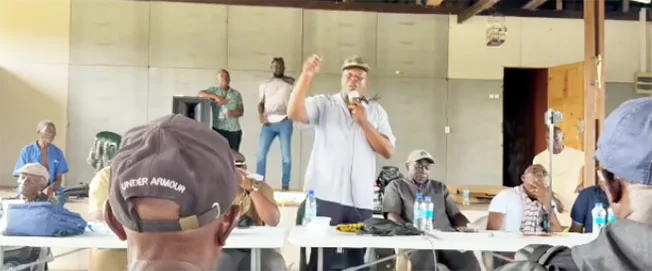
    In a significant move to enhance food security in remote communities, officials from the Directorate of Livestock at Suriname’s Ministry of Agriculture, Animal Husbandry, and Fisheries (LVV) recently conducted an exploratory visit to Asidonhopo village and surrounding communities in the Upper Suriname region. The visit, initiated at the invitation of Granman (Paramount Chief) Albert Aboikoni, marks the beginning of a sustainable poultry development project designed to strengthen local protein supplies.

    The primary objective of the reconnaissance mission was to assess regional conditions and conduct an initial inventory of available feed crops suitable for poultry farming. Additionally, the delegation evaluated opportunities for poultry husbandry training programs and scaling up local poultry production systems. These initiatives aim to empower indigenous communities through improved access to protein-rich food sources.

    Granman Aboikoni had formally requested Minister Mike Noersalim’s intervention through the LVV ministry to establish a comprehensive sustainable poultry farming program. The traditional leader emphasized that such developmental projects are crucial for ensuring long-term food security in the region.

    During consultations, Aboikoni advocated for an integrated approach to agricultural development around Asidonhopo, stressing that coordinated development of crop cultivation, livestock rearing, and aquaculture would create a more resilient and sustainable food production ecosystem. He highlighted the importance of multi-sectoral agricultural initiatives rather than isolated sector-specific interventions.

    The logistical arrangements for the orientation visit demonstrated community commitment: Granman Aboikoni provided his personal boat for delegate transportation, the LVV ministry covered fuel expenses, and additional costs were borne by the Cooperative Association Saamaka WOSU, which the Granman chairs.

    The Ministry of LVV will now analyze findings from this preliminary assessment to determine appropriate support mechanisms and develop strategies for implementing sustainable poultry farming operations throughout the Upper Suriname territory.

  • Sri Lanka repatrieert stoffelijke resten 84 Iraanse matrozen van Amerikaanse aanval

    Sri Lanka repatrieert stoffelijke resten 84 Iraanse matrozen van Amerikaanse aanval

    Sri Lanka has initiated the repatriation process for the remains of 84 Iranian naval personnel who perished when their frigate was torpedoed by a US submarine in international waters. The incident occurred on March 4th near Sri Lanka’s coastline, approximately nine days prior to the announcement.

    Foreign Ministry spokesperson Thushara Rodrigo confirmed to AFP that the transfer would be conducted via a chartered aircraft dispatched by Iran. The Iranian embassy subsequently verified these arrangements, according to Reuters.

    The sinking of IRIS Dena represents a significant geographical expansion of Middle Eastern conflict into the Indian Ocean, drawing widespread condemnation as a blatant violation of international maritime law.

    Meanwhile, 32 surviving sailors rescued by the Sri Lankan navy remain on the island nation. Rodrigo noted that while the International Committee of the Red Cross (ICRC) has been consulted regarding wounded personnel, the organization is not involved in the repatriation process.

    In a related development, a second Iranian warship, IRIS Bushehr, entered Sri Lankan territorial waters one day after the sinking. Colombo is currently providing safe harbor for the vessel and its 219 crew members.

    Sri Lankan officials confirm no discussions have yet occurred regarding the repatriation of either the Bushehr’s crew or the surviving Dena sailors, though all personnel will be treated according to Colombo’s treaty obligations.

    Of the 32 hospitalized survivors, 22 have been discharged and are currently housed at a southern air force base, separated from the Bushehr crew. Sri Lanka now hosts 251 Iranian sailors total.

    The Bushehr remains under Sri Lankan naval custody while engineers attempt repairs on one of its reportedly disabled engines.

    A third Iranian vessel has found safe harbor at Kochi port in southern India, with its 183 crew members receiving humanitarian protection from New Delhi. Both South Asian nations cite humanitarian concerns as their primary motivation, fearing additional American attacks against Iranian naval assets.

  • VS en bondgenoten botsen met Rusland en China bij VN over Iraans nucleair programma

    VS en bondgenoten botsen met Rusland en China bij VN over Iraans nucleair programma

    The United Nations Security Council witnessed a sharp diplomatic confrontation on Thursday as the United States and its Western allies clashed with Russia and China regarding Iran’s nuclear program. The heated exchange occurred during a meeting chaired by the U.S., which currently holds the Security Council presidency for March.

    The session turned contentious when Russia and China attempted to block discussions concerning the so-called 1737 Committee, the UN body responsible for monitoring and enforcing sanctions against Iran. Their effort was defeated by a vote of 11-2, with two abstentions, allowing the proceedings to continue.

    U.S. Ambassador Mike Waltz accused Moscow and Beijing of protecting their ally Tehran by obstructing the sanctions committee’s work. He called for all UN member states to maintain weapons embargoes against Iran, prohibit missile technology trade, and freeze relevant financial assets. Waltz emphasized that these measures specifically target concerns regarding Iran’s nuclear, missile, and conventional weapons programs, along with its alleged support for terrorism.

    The American diplomat asserted that Russia and China are preventing a functional sanctions committee to preserve their defense cooperation with Iran, which he claimed has been repeatedly prohibited. He referenced a recent International Atomic Energy Agency (IAEA) report confirming that Iran, as the only non-nuclear weapons state, has enriched uranium to 60% purity while denying access to these stockpiles.

    Russian Ambassador Vassily Nebenzia countered that the U.S. and its allies were promoting ‘hysteria’ about alleged Iranian nuclear weapons plans that have never been confirmed by the IAEA. He characterized American military actions targeting Iran as attempts to escalate tensions throughout the Middle East and beyond.

    China’s representative Fu Cong labeled Washington ‘the instigator’ of the nuclear crisis and criticized the use of military force during negotiations, which he stated rendered diplomacy meaningless.

    Iranian Ambassador Amir Saeid Iravani maintained that his country’s nuclear program has always been peaceful and that Iran does not recognize any sanctions.

    The discussion referenced President Donald Trump’s previous justification for military action, claiming that Iran would have developed nuclear weapons within two weeks had the U.S. not bombed three nuclear facilities in June. However, intelligence agencies have disputed this assertion.

    Britain and France supported reinstating sanctions, arguing that Iran’s lack of accountability regarding its nuclear activities warrants such measures. France warned that the IAEA can no longer guarantee the peaceful nature of Iran’s program and noted that Tehran has accumulated sufficient nuclear material for ten weapons.

  • Bureaucratie en falend toezicht brengen Surinaamse landbouwexport bijna tot stilstand

    Bureaucratie en falend toezicht brengen Surinaamse landbouwexport bijna tot stilstand

    Suriname’s agricultural export sector faces an existential crisis as systemic deficiencies trigger a catastrophic decline in international shipments. Official data reveals a staggering collapse from 65 tons of monthly vegetable exports in 2018 to merely 15 tons currently, while active exporters dwindled from 13 to just 7 companies.

    The crisis stems from multiple structural failures. The European Union’s 2019 ban on bitter melon (sopropo) exports—despite six years of advance warning—eliminated 40% of Suriname’s export revenue. Unlike Mexico and Santo Domingo which successfully regained market access, Suriname remains excluded from key markets.

    Ram Soeknandan, President of the Vegetable Exporters Association (VEAPS), condemns the policy inertia: “While political parties universally promise agricultural support, once elected they neglect practical collaboration with scientific institutions.” He notes the bitter irony that while commercial sopropo exports remain prohibited, individuals freely ship the vegetable via postal services to relatives abroad.

    Seasoned exporter Bhiesnoe Gopal of Gopex NV identifies rampant corruption in production chains as crippling legitimate businesses. Unscrupulous exporters ship products without proper cultivation documentation, while the National Plant Protection Organization (NPPO) turns a blind eye. This malpractice contaminates legitimate shipments when mixed with illicit produce.

    Critical staffing shortages plague inspection services, creating arbitrary enforcement that undermines process reliability. Although packing house and Vito inspections function adequately, bureaucratic rigidity at Zanderij customs requires perfect alignment between shipment manifests and actual cargo—a practical impossibility that causes extensive delays.

    Logistical failures compound these issues. Despite ISO 9001 certification, Surinam Air Cargo (SAC) lacks adequate cold chain infrastructure. Produce frequently sits exposed after weighing due to workers’ reluctance to transport it 500 meters to refrigeration units. Flight schedules exacerbate the problem—cargo must arrive by 11 AM for flights departing hours later.

    Packaging regulations create additional obstacles. Surpost packaging triggers frequent scanner alarms at customs, causing two-day delays that render perishables unsalable. Financial protections remain virtually nonexistent—with no local representatives of transport companies, insurance claims become impossible to process, forcing exporters like Gopal to prefer KLM for its marginally better reliability.

    The Federation of Surinamese Agrarians (FSA) warns of complete institutional collapse, citing the paralysis of the National Food Safety Institute and demanding autonomous professional institutions free from political interference. Without immediate structural reforms, Suriname’s agricultural export sector faces irreversible decline and permanent market exclusion.

  • Column: WIPA plaatst politici boven de wet

    Column: WIPA plaatst politici boven de wet

    Suriname’s Attorney General has formally requested the National Assembly to initiate criminal proceedings against three former government ministers, exposing fundamental flaws in the country’s legal framework for prosecuting political officials. The targeted individuals include former Finance Minister Gillmore Hoefdraad, ex-Public Works Minister Riad Nurmohamed, and former Interior Minister Bronto Somohardjo.

    The requests have ignited a constitutional debate surrounding the Law on Charging and Prosecuting Political Office Holders (WIPA), which mandates parliamentary approval before judiciary proceedings can commence against sitting or former government officials. This unique legislation effectively grants politicians veto power over criminal investigations that would proceed automatically in standard judicial systems.

    Legal analysts note that WIPA fundamentally alters the separation of powers by requiring political consensus before the justice system can exercise its authority. Rather than evaluating evidence sufficiency—a responsibility that properly belongs to prosecutors and judges—parliamentarians must determine whether prosecution might “disrupt the political system” or “undermine social tranquility.”

    The case of former Minister Hoefdraad demonstrates the law’s susceptibility to political manipulation. An initial prosecution request was rejected in 2020 when his party held legislative majority, only to be approved after electoral changes produced a new governing coalition. Notably, Hoefdraad has since been convicted by the Court of Justice, yet his attorney recently petitioned parliament to retroactively invalidate the prosecution authorization.

    One of the currently targeted officials, Somohardjo, has publicly welcomed prosecution, asserting confidence that no evidence exists against him. While seemingly principled, his stance highlights the systemic problem: elected officials rather than judicial authorities determine investigatory permissions.

    The law’s theoretical justification—protecting high-ranking officials from politically motivated prosecutions—has produced the opposite effect in practice. By injecting political considerations into judicial processes, WIPA has created precisely the politicized justice system that rule-of-law principles seek to prevent.

    Legal experts argue that the legislation establishes a two-tier justice system where prosecution depends on electoral outcomes and coalition dynamics rather than legal merit. This framework contradicts fundamental democratic principles requiring equality before the law and independent judiciary proceedings free from political interference.

  • EBS-bond uit scherpe kritiek op toelage van SRD 40.000 voor managers

    EBS-bond uit scherpe kritiek op toelage van SRD 40.000 voor managers

    A significant labor dispute has erupted at Surinamese state-owned energy company EBS after revelations of a controversial proposal to grant managers substantial monthly allowances. The Organization of Workers in the Energy Sector (OWOS) has launched vehement protests against a memorandum suggesting monthly supplements of SRD 40,000 (approximately $40,000) for senior managers who have reached their maximum salary scale.

    The conflict centers on a December memorandum allegedly approved solely by General Director Leo Brunswijk without full executive board consultation. According to OWOS President Marciano Hellings, the document was recently discovered and appears to circumvent standard approval processes. The proposed policy aims to retain experienced management personnel and recognize their contributions through additional compensation beyond base salaries and existing benefits.

    Hellings has characterized the proposal as “unprecedented and unacceptable,” particularly highlighting the stark contrast with ordinary employees’ compensation struggles. Many rank-and-file workers have reportedly waited years for salary structure improvements, with some denied modest SRD 1,500 raises due to purported financial constraints.

    The union leader questions the financial logic behind simultaneously claiming inability to fund small employee raises while allocating substantial resources for management bonuses. Hellings suggests this creates a perception of preferential treatment for a small corporate elite while most staff contend with relatively low wages.

    OWOS has formally requested that both EBS management and the Board of Commissioners investigate the proposal’s origins and financial implications. The union contends this incident reflects broader systemic issues, including allegations of strategically placing highly compensated individuals in key positions.

    The controversy has generated significant unrest among union members, with Hellings reporting being “inundated with questions from angry employees” demanding explanations for the astronomical management allowances amid general staff austerity. The union is now appealing to the state-owned enterprise’s shareholder for intervention and transparency regarding EBS compensation policies.