标签: Suriname

苏里南

  • Column: Werk aan de winkel

    Column: Werk aan de winkel

    Suriname’s national football team has undergone a dramatic transformation in recent years, revealing a concerning trend about the country’s player development system. The squad now consists predominantly of professional players who received their training abroad, marking a significant departure from previous selection practices.

    Initially, selectors made concerted efforts to include players from the local league, but gradually the representation of domestically-trained athletes diminished. For a considerable period, only Robinhood club players maintained spots on the national team roster. Eventually, even these field players were phased out, leaving only the goalkeeper as the sole representative of Suriname’s domestic development system.

    This evolution starkly demonstrates that footballers trained within Suriname’s current system are failing to meet international standards. While this realization is painful, it represents an honest assessment that demands immediate attention from all stakeholders in Surinamese football.

    Recognizing the problem marks a crucial starting point for addressing the undesirable situation. The entire approach to football in Suriname requires thorough evaluation, with courage to identify specific weaknesses. Solution-oriented models must be developed to comprehensively improve the quality of football in its broadest sense.

    The overwhelming public turnout at national team training sessions indicates that football enthusiasts desperately crave qualitative improvement of the sport. These open training sessions attract significantly more spectators than competitive league matches, prompting critical reflection.

    The introduction of a professional league was once believed to be the ultimate solution, but reality has proven otherwise. While establishing professional competition was necessary, it alone cannot make Surinamese football attractive. The massive attendance at official national team matches—despite high ticket prices—demonstrates public willingness to pay for quality football entertainment.

    A proposed football congress could provide the platform to not only identify problems but also develop concrete solutions for elevating the quality of the game. This gathering must generate strategies to professionalize all aspects of football, including transforming clubs into corporate entities with proper management structures.

    Football must cease to be viewed as a part-time activity compatible with full-time employment. Serious professional positions need creation, and marketing strategies require significant enhancement to make football competitive with other entertainment options and financially viable. Creating a broad forum where all stakeholders can contribute to improving Surinamese football remains essential—and there is substantial work ahead.

  • Politie ziet criminaliteit dalen met 25%, maar kondigt hardere aanpak aan

    Politie ziet criminaliteit dalen met 25%, maar kondigt hardere aanpak aan

    Suriname’s police force has reported a significant 25% reduction in overall criminal activity, including suicide cases, according to Acting Police Commissioner Melvin Pinas. Despite this positive trend, Commissioner Pinas cautioned against premature celebration, emphasizing that the Suriname Police Force (KPS) will intensify security operations during the upcoming holiday season.

    During a press conference at police headquarters on Duisburglaan, Pinas and his staff addressed the current security situation, quarterly performance results, and new technological measures being implemented to enhance public safety. The commissioner issued a stern warning to criminal elements, stating that offenders should anticipate a substantially strengthened law enforcement response.

    “Criminals will not have an easy time. I advise them to seek alternative employment!” Pinas declared, highlighting the police force’s detailed understanding of repeat offenders’ operational patterns. He noted that perpetrators frequently escape to hinterland areas or cross into French territory after committing crimes, remaining dormant before returning to urban centers.

    Rishi Akkal, Director of Policy Preparation and Management, elaborated on technological enhancements revolutionizing police work. The Safe City camera network now employs advanced recognition capabilities for facial identification, vehicle tracking, and license plate recognition. The police force will soon deploy surveillance drones to enhance pursuit capabilities against criminal elements.

    Human Resources Manager Maureen Palmtak joined officials in outlining the comprehensive security strategy, which combines traditional policing methods with cutting-edge technology to create a more robust public safety infrastructure during the festive period and beyond.

  • Nieuwe training moet citrusproductie in Saramacca versterken

    Nieuwe training moet citrusproductie in Saramacca versterken

    The Ministry of Agriculture, Animal Husbandry and Fisheries (LVV) has successfully concluded an intensive four-day “Citrus Cultivation Technique” training program in Saramacca, designed to enhance expertise among agricultural extension workers and citrus growers. This comprehensive capacity-building initiative combined theoretical instruction, practical field application, and participant presentations to strengthen competencies throughout the citrus value chain.

    During the initial two days, participants received detailed theoretical training covering crop management techniques, fertilization methods, and identification and control of diseases and pests. The third day featured hands-on field implementation where attendees applied their newly acquired knowledge in real-world conditions. The program concluded with participant presentations and a formal certificate ceremony recognizing the graduates’ accomplishments.

    This training forms part of the broader “Strengthening of Citrus Production” project funded by the Inter-American Development Bank (IDB) and coordinated by LVV’s Directorate of Agricultural Research, Marketing and Processing. The project aims to sustainably increase citrus production while promoting professional development within the sector. Previous interventions under this initiative have included establishing compost facilities and providing specialized training to citrus nurseries.

    Soesila Udit-Ramautar, Head of Fruit Tree Research and IDB Citrus Project Team Leader, emphasized the strategic importance of ongoing investment in citrus cultivation: “Citrus represents the most widely planted fruit variety in Suriname and remains exceptionally suitable for courtyard cultivation practices.”

    Participants responded enthusiastically to the training program. Citrus grower Rolia Sewbarath-Misser noted: “The knowledge gained has significantly expanded my understanding, enabling me to implement improvements throughout my plantation operations.”

    To provide continued support, LVV has developed and distributed digital informational brochures and instructional videos covering pruning techniques, transplantation methods, and pest management strategies. The ministry emphasizes that continuous knowledge enhancement and technical information sharing remain critical priorities for advancing Suriname’s agricultural sector development.

  • Taskforce voor productieve arbeid en kansen kwetsbare groepen vergroten

    Taskforce voor productieve arbeid en kansen kwetsbare groepen vergroten

    Surinamese President Jennifer Simons has officially inaugurated the specialized task force ‘From Poverty to Welfare Through Productive Labor’ on December 10th. This high-level working group has been mandated to develop practical, targeted programs designed to help citizens acquire vocational skills and sustainably escape poverty cycles.

    The initiative comes at a critical time when numerous families across Suriname continue to face significant financial and social vulnerabilities. Chairperson Donaghy Malone emphasized that the task force’s mission directly aligns with the government’s broader social policy framework, which prioritizes sustainable poverty reduction, protection of vulnerable populations, and enhanced development opportunities for those living below the poverty line, school dropouts, and youth in challenging circumstances.

    The comprehensive approach addresses both individual development pathways and community-wide improvement strategies. The task force comprises representatives from multiple key ministries including Education, Science and Culture; Youth Development and Sports; Economic Affairs, Entrepreneurship and Technological Innovation; alongside the Foundation for Labor Mobilization & Development and the Foundation for Productive Work Units—all organizations with demonstrated expertise in workforce mobilization and vocational training.

    According to the Suriname Communication Service, the task force will initially conduct thorough field assessments to identify target populations. Malone noted the particular challenge in reaching these groups: ‘You won’t simply find the target population on streets or in schools. We must actively seek them out, precisely because they often don’t automatically access available services.’ The working group, potentially accompanied by President Simons herself, will conduct neighborhood visits to directly assess community needs.

    The program structure includes intensive training periods ranging from four to six months, with possible extensions up to one year. Significant emphasis will be placed on post-training support, including job placement guidance, entrepreneurship assistance, and pathways for participants to return to formal education systems. The task force will provide periodic progress reports to President Simons to enable timely policy adjustments throughout the implementation process.

  • Diváli krijgt wereldwijde erkenning: sinds vandaag op UNESCO-lijst

    Diváli krijgt wereldwijde erkenning: sinds vandaag op UNESCO-lijst

    In a landmark decision during its 20th intergovernmental committee meeting in New Delhi (December 8-13, 2025), UNESCO has officially inscribed Deepavali (Diwali) on its Representative List of the Intangible Cultural Heritage of Humanity. The announcement was formally communicated by Indian Ambassador Subhash Gupta in Paramaribo, marking a significant global recognition for the festival of lights.

    Ambassador Gupta emphasized that UNESCO’s designation confirms Deepavali as a living tradition that continues to uplift hearts and minds worldwide. He characterized the festival not merely as an Indian celebration but as an integral component of Surinamese culture, representing enduring historical bonds and shared heritage between Suriname and India. Both nations, he noted, deeply connect with the festival’s universal themes: hope over despair, knowledge over ignorance, and light over darkness.

    Radjen Baldew, Chairman of the Hindu Media Organization (OHM), expressed elation at this international acknowledgment, describing it as an honor recognizing Deepavali as tangible cultural heritage not only for Sanátan Dharmis (Hindus) but for the entire global community. He extended congratulations to all who uphold the religious and spiritual values embodied by the festival.

    Indian Prime Minister Narendra Modi reinforced the significance through his social media platform, stating: “For us, Deepavali is intrinsically linked to our culture and values. It represents the very soul of our civilization, embodying enlightenment and justice.” He predicted this UNESCO recognition would further amplify the festival’s global popularity.

    Ambassador Gupta highlighted Suriname’s particular connection to Deepavali, noting the Indian embassy’s consistent participation in local celebrations through prayers, cultural performances, and community gatherings. He referenced the lighting of the world’s largest diya (lamp) using ghee at Independence Square as a symbol of this engagement. Gupta further praised Suriname’s official recognition of Deepavali as a national holiday, demonstrating the country’s commitment to inclusivity and appreciation for its Indian-descended population.

    Globally, Indian diplomatic missions are celebrating this achievement with various events. In Suriname, the embassy is collaborating with the Swami Vivekananda Indian Cultural Center for an evening celebration at the Arya Diwaker Hall, open to all attendees from 6:30 PM. Ambassador Gupta concluded with a hopeful message: “May the light of Deepavali shine brightly and guide us toward growth and peace.”

  • Agrarisch bedrijf Defensie krijgt impuls met nieuwe investeringen

    Agrarisch bedrijf Defensie krijgt impuls met nieuwe investeringen

    In a significant move to bolster national food security and military self-sufficiency, Defense Minister Uraiqit Ramsaran personally oversaw the delivery of substantial agricultural resources to the Von Freyburg Defense Agricultural Enterprise in Saramacca on Tuesday. The deployment included fertilizers, operational equipment, and other essential supplies exactly one month after the minister’s initial inspection visit.

    The delivery fulfills Ramsaran’s previous commitment to modernize the defense agricultural sector. The occasion was marked symbolically by the planting of inaugural almond trees, initiating a comprehensive development project integrating recreation, education, and community engagement.

    ‘These represent not merely symbolic gestures but concrete investments toward establishing a modern, autonomous, and efficient agricultural center within our Defense infrastructure,’ Minister Ramsaran declared. ‘Today we advance further toward complete self-sufficiency—not as aspirational concept but as achievable objective through targeted actions and collective effort.’

    The minister outlined a vision for Von Freyburg to evolve into a multifunctional facility where both military personnel and civilians can learn, recreate, and take pride in developmental achievements. In collaboration with the Ministry of Agriculture, Livestock and Fisheries, greenhouse installations are scheduled for imminent implementation to facilitate modern, efficient cultivation methodologies.

    Ramsaran emphasized the triple focus on enhanced production output, superior quality standards, and increased operational independence. ‘Our objectives extend beyond agricultural production alone. We are creating an environment where recreation, education, and community development converge, thereby progressively building a stronger Defense institution,’ he concluded.

  • China en Latijns-Amerika: nieuwe samenwerking en duidelijke grenzen

    China en Latijns-Amerika: nieuwe samenwerking en duidelijke grenzen

    China has formally released its third comprehensive policy document outlining strategic engagement with Latin America and the Caribbean, emphasizing mutual cooperation in defending international justice and preserving the historical legacy of World War II victories. Vice Foreign Minister Cai Wei presented the framework on Wednesday, asserting that no external force can reverse the established course of history.

    The policy document establishes Taiwan matters as fundamental to China’s core interests, describing them as an absolute boundary that must not be crossed. It reaffirms China’s endorsement of the Latin American and Caribbean region as a Zone of Peace and supports nuclear non-proliferation efforts. The framework advocates for peaceful resolution of international disputes while explicitly rejecting external interference in regional affairs—an indirect reference to perceived U.S. involvement in Venezuela.

    This document continues the trajectory established by previous policy papers issued in November 2008 and November 2016, which significantly strengthened Sino-Latin American relations. President Xi Jinping has personally prioritized these ties, having visited the region six times while introducing innovative cooperation concepts and developmental initiatives.

    Current economic integration is substantial: 24 regional nations have joined China’s Belt and Road Initiative, with China standing as the second-largest trading partner for the region overall and the primary partner for nations including Brazil and Peru. As influential Global South actors, China and Latin American countries are collaborating to reform international governance systems and address pressing global challenges such as climate change.

    The new policy framework emerges amid unprecedented global transformations and emerging regional conflicts that introduce external uncertainties into China-Latin America relations. It outlines cooperative plans across forty domains including trade, investment, financial cooperation, scientific innovation, and climate response, serving as a strategic roadmap for a new era of partnership.

    China commits to supporting regional nations in pursuing independent development paths, emphasizing that these relationships are mutually beneficial, free from geopolitical manipulation, and not targeted against third parties. The document simultaneously rejects coercive diplomatic practices where nations impose their viewpoints pressure regional countries to take sides in international disputes.

  • Raadslieden in Pikin Saron zaak: Recht moet boven emoties staan

    Raadslieden in Pikin Saron zaak: Recht moet boven emoties staan

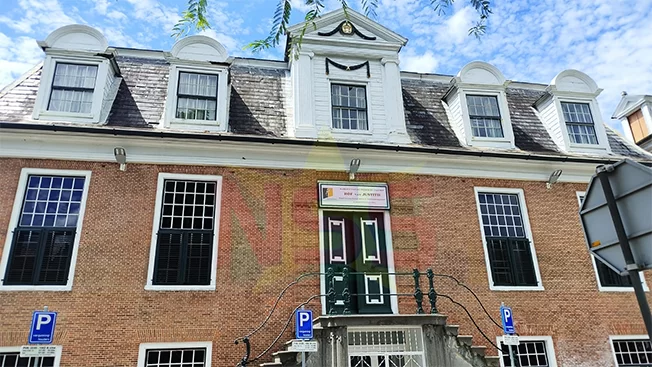
    In a significant judicial development, the Court of Justice of Suriname on December 9th suspended the pretrial detention of five Indigenous men from Pikin Saron, a decision their legal representatives describe as both legally necessary and constitutionally inevitable. Defense attorneys Pamela Karg, Murwin Dubois, and Milton Castelen successfully argued for their clients’ provisional release through a motivated petition filed October 21st, after previous requests had been denied.

    The case has emerged as one of Suriname’s most discussed criminal proceedings, stemming from a fatal incident during escalating tensions between Indigenous residents and outsiders allegedly entering their territory without community authorization. The defendants maintain they acted within a conflict situation arising from ongoing infringements on their residential and usage rights.

    Public prosecutors had vehemently opposed release, citing serious criminal allegations and potential societal concerns. However, the defense team successfully countered that pretrial detention under Surinamese law constitutes an extreme measure rather than punishment, only justifiable when specific risks exist—none of which applied to these defendants who had never attempted escape, witness tampering, or investigation obstruction.

    Human rights organizations have criticized the criminal prosecution as inseparable from underlying land rights struggles, considering the pretrial detention disproportionately applied. The defense highlighted broader context including substantial public support for the men, organizational capacity of Indigenous movements, and internationally recognized Indigenous rights.

    This ruling enables the five men to await their appeal in freedom, aligning with fundamental rule of law principles. The attorneys view the decision as transcending individual case outcomes—it represents a corrective within Suriname’s criminal justice system regarding practices conflicting with international obligations, particularly concerning pretrial detention application, procedural risk assessment, and treaty compliance.

    The defense specifically references Article 106 of Suriname’s Constitution, which prohibits application of national laws contradicting binding international treaties. Castelen expressed the collective position: ‘The Court’s decision confirms that legal provisions conflicting with treaty law cannot be blindly applied anymore.’

    This suspension of detention sends a principled signal that criminal justice measures must be based on legal norms applicable to all defendants rather than emotions, societal pressure, or traditional practices.

  • Geen begrotingsbehandeling in december: regering werkt aan aangepaste cijfers voor 2026

    Geen begrotingsbehandeling in december: regering werkt aan aangepaste cijfers voor 2026

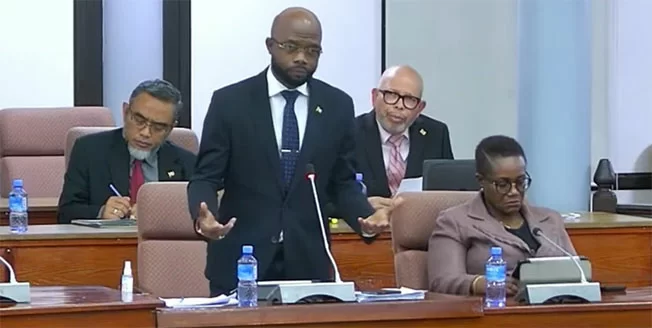
    Suriname’s National Assembly has officially postponed deliberations on the 2026 national budget following critical consultations between Finance Minister Adelien Wijnerman and parliamentary committees. The joint session of the Permanent Committee for Finance and Planning and the State Expenditure Committee concluded that December consideration would be impossible due to ongoing fiscal recalibrations.

    Minister Wijnerman revealed that recently completed tax agency reforms have uncovered systemic irregularities and administrative backlogs within revenue collection systems. These findings necessitate significant revisions to projected tax income estimates, compelling comprehensive budget adjustments. The minister has already consulted with President Jennifer Simons regarding substantive reallocations primarily affecting education, agriculture, and tourism sectors.

    The restructuring focuses exclusively on project financing reconfigurations while maintaining unchanged allocations for goods and services. International organization contributions and the national debt management strategy will also undergo substantial revisions. Parliamentary committee chairs emphasized that both the amended budget proposal and modified debt plan must be formally submitted before legislative proceedings can commence.

    Notable attendees included Committee Chair Rabin Parmessar alongside members Asis Gajadien, Rossellie Cotino, Jennifer Vreedzaam, Ronny Asabina, Jeffrey Lau, Kishan Ramsukul, and Steve Reyme. Observers Stanley Betterson, Xiaobao Zheng, and Tashana Lösche monitored the proceedings that determined Suriname’s budgetary timeline shift into the new year.

  • Fernandes steunt kwetsbare baby’s met forse bijdrage aan Diakonessenhuis

    Fernandes steunt kwetsbare baby’s met forse bijdrage aan Diakonessenhuis

    In a significant boost to Suriname’s healthcare infrastructure, the Fernandes Social Foundation has contributed a generous €250,000 donation for the complete renovation of the neonatal intensive care unit at Diakonessen Hospital. The ceremonial handover took place at the Presidential Cabinet on December 10th, with Health Minister André Misiekaba formally accepting the contribution in the presence of President Jennifer Simons.

    This philanthropic initiative originated from Fernandes’ request during Suriname’s 50th anniversary of independence (Srefidensi), where the company sought Ministry-identified community projects requiring support. Among six healthcare projects proposed by the Health Ministry, the neonatal unit’s renovation was prioritized as most critical. The department has been temporarily closed despite growing demands for specialized post-natal care for vulnerable newborns.

    Minister Misiekaba characterized the donation as “a crucial contribution to healthcare,” emphasizing its direct impact on medical services for critically ill infants. “We are profoundly grateful to Fernandes Social Foundation. This project will substantially strengthen our neonatal care capabilities,” the Minister stated during the reception.

    Following the formal presentation, government representatives engaged in expanded discussions with Fernandes Group executives about broader socio-economic initiatives, including future sustainable waste management programs. President Simons reiterated her call for private sector involvement in national development projects.

    The Health Ministry maintains additional unfunded projects seeking corporate partnerships, including replacement of outdated cooling systems at Academic Hospital’s morgue (currently only 20-30% operational), renovation of the Public Health Bureau’s tuberculosis unit, upgrades to decentralized emergency posts, and enhancements to primary care facilities. While these projects weren’t selected in this funding round, the Ministry remains open to partnerships aimed at structurally strengthening Suriname’s healthcare system.

    Minister Misiekaba underscored that sustainable healthcare improvements require collaborative efforts between government and private entities, highlighting the Fernandes donation as a model for public-private cooperation in addressing critical medical infrastructure needs.