标签: Suriname

苏里南

  • President Simons: certificaat is begin, niet het eind voor jonge ondernemers

    President Simons: certificaat is begin, niet het eind voor jonge ondernemers

    Surinamese President Jennifer Simons has delivered a powerful address to emerging young entrepreneurs, urging them to persevere and maintain mutual support as they embark on their business ventures. The head of state emphasized that “the real work begins now” during Tuesday’s certificate ceremony held at the Congreshal, marking the completion of the “Van Droom Naar Doel” (From Dream to Goal) initiative.

    The groundbreaking project, administered by Stichting RUMAS, specifically targets youth requiring additional support to achieve economic independence. From the initial cohort of 18 participants, an impressive 15 successfully reached the program’s completion. President Simons commended the graduates for their remarkable determination while stressing the collective nature of achievement. “We must help each other because alone we cannot succeed,” she stated, adding that setbacks naturally form part of the learning process and should not deter progress.

    In significant policy developments, the President revealed governmental efforts to establish financial support mechanisms for startup entrepreneurs through specialized funds and banking partnerships. According to the Suriname Communication Service, these initiatives will provide young business owners with essential mentorship and access to low-interest loans.

    Project coordinator Lydia Griffith confirmed the program had achieved its primary objective of preparing youth for independent entrepreneurship. Graduates spanning various trades—including landscapers, hairstylists, dressmakers, and bakers—are now fully equipped to commence operations immediately while receiving ongoing support from RUMAS and program trainers.

    RUMAS Director Emmy Hart disclosed that the presidential office originally conceived the project to expand opportunities for young citizens. The training program initially launched in October of last year.

    Diroy Juriaans, one of the successful graduates, described the accomplishment as a critical milestone. “I’ve learned to persist through challenges. This certificate opens doors to establishing my own business,” he affirmed, capturing the transformative impact of the initiative.

  • Paus Leo roept op tot onmiddellijke wapenstilstand in Midden-Oosten conflict

    Paus Leo roept op tot onmiddellijke wapenstilstand in Midden-Oosten conflict

    In a compelling address from his residence in Castel Gandolfo, Italy, Pope Leo XIV—the first American pontiff in Vatican history—issued his most urgent plea to date regarding the rapidly deteriorating situation in the Middle East. Speaking during his weekly general audience, the Pope expressed profound alarm over expanding hostilities centered around Iran’s escalating conflict with Israel.

    “We are witnessing an alarming surge in hatred and increasingly severe violence,” stated the spiritual leader, emphasizing that true peace cannot be achieved through military means. “The path to resolution must be forged through sincere dialogue and mutually acceptable solutions—not through weapons.”

    The Pontiff revealed staggering humanitarian concerns, noting over one million displaced persons and numerous casualties already resulting from recent hostilities. His appeal comes amid substantial U.S. military deployments to the region, with thousands of additional troops being dispatched—a move that has heightened international fears of potential broader conflict escalation.

    Tensions have dramatically intensified following multiple rocket attacks and direct military engagements throughout the region. While the global community advocates for calm and diplomatic solutions, humanitarian organizations warn of a worsening crisis affecting millions of civilians.

    This marks the second time in three days that Pope Leo has addressed the situation, having previously condemned the conflict as “a scandal for all humanity” during his Sunday remarks. The Vatican has significantly intensified its peace-building initiatives, calling upon all authorities to engage in genuine dialogue to resolve underlying issues.

  • GOw2 trekt pompprijzen op tot price cap; druk op regeling neemt toe

    GOw2 trekt pompprijzen op tot price cap; druk op regeling neemt toe

    Suriname’s state-mandated fuel price ceiling is facing mounting pressure as persistently rising global oil markets test the sustainability of the government’s consumer protection mechanism. Effective March 25th, GOw2 – historically Suriname’s most affordable fuel retailer – aligned its pricing with the official cap, setting diesel at SRD 53.27 and unleaded gasoline at SRD 48.32 per liter.

    The price control mechanism, instituted by President Jennifer Simons on March 17th, was designed to shield consumers from international market volatility by capping retail fuel prices. This intervention requires the government to absorb approximately SRD 10 per liter in foregone revenue through reduced taxation, effectively subsidizing the difference between global market rates and local pump prices.

    However, sustained upward pressure on international oil markets, exacerbated by ongoing geopolitical tensions in the Middle East, has created significant fiscal challenges. Analysts warn that the current price cap may become economically unsustainable if global trends continue, potentially forcing the government to choose between increasing its financial compensation or permitting controlled price adjustments at the pump.

    The situation highlights the delicate balance between consumer protection and fiscal responsibility in resource-dependent economies. While the measure provides short-term stability for Surinamese citizens, its long-term viability remains contingent upon unpredictable international market conditions and the government’s capacity to maintain substantial revenue sacrifices.

  • SVB  lanceert nieuwe identiteit ‘Natio – The Green Guardians’ en vernieuwde teamtenues

    SVB lanceert nieuwe identiteit ‘Natio – The Green Guardians’ en vernieuwde teamtenues

    The Surinamese Football Association (SVB) has unveiled a transformative new international identity for its national football team, now officially designated as ‘Natio – The Green Guardians.’ This strategic rebranding initiative was formally announced on Tuesday alongside the simultaneous launch of newly designed home and away kits developed in partnership with sportswear manufacturer Kelme.

    This comprehensive repositioning effort aims to strengthen Suriname’s presence within global football by leveraging the nation’s distinctive environmental characteristics. The innovative identity draws direct inspiration from Suriname’s status as one of the world’s most forest-rich nations, with over 90% of its territory covered by pristine rainforests.

    SVB President Dayasankar Mathoera emphasized that the national team now carries significance beyond athletic performance. “We don’t just play for Suriname; we carry something larger onto the field,” Mathoera stated. “With The Green Guardians, we add meaningful responsibility to the pride that Natio has projected for years.”

    The symbolic designation ‘The Green Guardians’ represents both the nation’s extraordinary natural heritage and the team’s philosophical approach—competing with clear purpose, strong identity, and awareness that they represent values extending beyond the sport itself.

    The newly unveiled kits embody this dual message through sophisticated design elements. The white away uniform incorporates the fayalobi flower, representing love, connection, and the diversity of the Surinamese people. The green home kit draws inspiration from palm symbolism, reflecting nature, strength, and growth. Both designs integrate subtle elements from the Surinamese national anthem within their patterns.

    According to Natio General Manager Brian Tevreden, the introduction of The Green Guardians identity opens a new chapter for Surinamese football. “This is about visibility, identity, and belief,” Tevreden explained. “Every time we enter the field, we represent who we are and what we stand for.”

    The launch receives support from the ‘Green Guard’ initiative—a consortium of founding partners committed to supporting the national team’s development and international profile enhancement. This rebranding marks another significant step in SVB’s ongoing professionalization of Surinamese football, intentionally connecting sport, culture, and national pride into a cohesive international identity.

  • Jogi vraagt president opheldering over dienstreis minister Currie naar Ghana

    Jogi vraagt president opheldering over dienstreis minister Currie naar Ghana

    PARAMARIBO – Opposition legislator Mahinder Jogi of the Progressive Reform Party (VHP) has formally requested President Jennifer Simons to provide comprehensive clarification regarding Education, Science and Culture Minister Dirk Currie’s official delegation to Ghana. The parliamentary inquiry, filed under Article 86 of the National Assembly’s procedural regulations, seeks detailed accountability about the controversial diplomatic mission.

    Jogi’s official communication to the presidency highlights significant transparency concerns surrounding the ministerial trip. The lawmaker revealed that even Vice President Ronnie Brunswijk could not provide substantive details about the expedition’s objectives, despite the proposal having received formal approval within the Council of Ministers.

    The legislator characterized the situation as ‘incomprehensible,’ noting the paradoxical absence of clear justification for the diplomatic mission despite its endorsement at the highest governmental levels. Jogi’s inquiry specifically demands four critical pieces of information:

    1. The precise objectives and strategic purpose of the Ghana visit
    2. The exact duration of the ministerial delegation’s stay
    3. The complete composition and size of the traveling delegation
    4. A comprehensive breakdown of the expedition’s total expenditure

    This formal request represents an exercise of parliamentary oversight authority, underscoring the growing tension between legislative and executive branches. The intervention reflects mounting concerns about governmental transparency and fiscal responsibility in international engagements.

    The National Assembly confirmed receipt of the formal inquiry, which will be processed through appropriate parliamentary channels. This development occurs amid increasing scrutiny of ministerial travel expenditures and diplomatic effectiveness within Suriname’s political landscape.

  • Pakistan meest vervuilde land ter wereld in 2025, rapport IQAir

    Pakistan meest vervuilde land ter wereld in 2025, rapport IQAir

    In a sobering environmental assessment, Pakistan has been identified as the world’s most polluted country according to the 2025 annual report by IQAir, a Swiss air quality monitoring organization. The nation’s atmospheric concentrations of hazardous fine particulate matter (PM2.5) reached alarming levels—approximately 13 times higher than the World Health Organization’s recommended safety threshold.

    The comprehensive study, which analyzed data from 9,446 cities across 143 countries, revealed that Pakistan’s average PM2.5 level stood at 67.3 micrograms per cubic meter. While this represents a slight improvement from the 2024 record of 73.7 micrograms, it remains critically elevated. The report underscores a global crisis with only 13 countries and territories managing to maintain PM2.5 concentrations below the WHO guideline of 5 micrograms per cubic meter. A staggering 130 of the 143 monitored nations failed to meet this international standard.

    Bangladesh and Tajikistan followed Pakistan as the second and third most polluted countries respectively. Chad, which had recorded the highest particulate levels in 2024, dropped to fourth position—a decline potentially attributable to data collection irregularities rather than genuine environmental improvement.

    At the municipal level, Loni, India claimed the dubious distinction of being the world’s most polluted city with an average PM2.5 concentration of 112.5 micrograms per cubic meter. The entire list of the top 25 most polluted cities was exclusively composed of urban centers within China, India, and Pakistan.

    In response to this environmental challenge, multiple nations are implementing countermeasures. Pakistan has introduced stricter environmental regulations targeting industrial and vehicular emissions, alongside campaigns to reduce agricultural waste burning—a significant contributor to smog in cities like Lahore. Bangladesh is investing in cleaner energy sources and enhancing public transportation systems to diminish private vehicle usage. Tajikistan is focusing on reducing household wood burning and initiating reforestation projects. India has launched air quality improvement programs in several cities, including restrictions on polluting fuels, closure of contaminating factories, and promotion of electric transportation.

    Suriname emerged as an environmental bright spot, highlighted in the report for maintaining air quality without significant health-threatening pollution. The country’s relatively clean atmospheric conditions are attributed to low industrialization levels and extensive forest areas that function as natural air filtration systems.

    The report emphasized that PM2.5 particulate matter is globally recognized as a major contributor to preterm births and long-term exposure has been linked to neurological disorders including dementia, Parkinson’s disease, and Alzheimer’s. Compounding the problem, climate change continues to exacerbate air quality deterioration through increased wildfire activity that releases substantial carbon emissions into the atmosphere.

  • Columbia: Doden bij vliegtuigcrash opgelopen tot 66

    Columbia: Doden bij vliegtuigcrash opgelopen tot 66

    A Colombian Air Force Lockheed Martin Hercules C-130 transport aircraft crashed during takeoff from Puerto Leguizamo on Monday, resulting in 66 fatalities among the 128 personnel on board. The tragedy occurred near the Peruvian border when the aircraft reportedly struck a tree with its wing at the end of the runway before crashing and igniting onboard explosives.

    The aircraft was carrying 11 air force members, 115 army personnel, and 2 national police officers according to General Hugo Alejandro Lopez, head of Colombia’s armed forces. Initial rescue efforts were spearheaded by local residents who extracted survivors from the wreckage and transported injured soldiers to hospitals via motorcycles before military vehicles could access the remote crash site.

    Defense Minister Pedro Sanchez confirmed via social media that search and recovery operations continue for four missing individuals despite challenging terrain conditions. Currently, 57 survivors have been hospitalized with 30 treated at military medical facilities in non-critical condition.

    President Gustavo Petro condemned bureaucratic obstacles delaying military modernization plans, stating on social media: ‘I will not permit further delays; this concerns the lives of our youth. Civil or military officials unable to meet this challenge must be replaced.’ Multiple presidential candidates for the May 31 elections expressed condolences and demanded thorough investigation into the incident.

    Lockheed Martin has committed to supporting Colombia’s investigation into the crash. The involved aircraft was among three C-130s transferred from the United States under excess defense articles programs in recent years. These Hercules aircraft have served Colombia since the late 1960s, frequently deployed for troop transport amid the nation’s six-decade internal conflict that has claimed over 450,000 lives.

    This incident follows a similar tragedy in late February when a Bolivian Air Force C-130 crashed in El Alto, causing over 20 fatalities and 30 injuries while sparking civil unrest after scattering banknotes during the accident.

  • Boeren in het binnenland houden vol ondanks vele uitdagingen

    Boeren in het binnenland houden vol ondanks vele uitdagingen

    In the heart of Suriname’s Brokopondo district, what appears to be barren ground covered with bauxite, pebbles, and dry sand belies an agricultural transformation underway just meters away. Here, amidst seemingly infertile conditions, farmers Elvia Asodanoe and Duku have cultivated remarkable plantations featuring diverse crops including pineapple, okra, Chinese tayer, and bitter gourd.

    During a field visit this past Saturday, Agriculture Minister Mike Noersalim praised the perseverance of these farmers, stating: “It’s commendable that farmers persist despite all challenges.” Accompanied by Edmund Duiker, chairman of the NOFA Fund, the minister assessed the obstacles confronting local agricultural producers in the interior regions.

    Asodanoe, one of the visiting female farmers, expressed ambitions to not only expand her pineapple cultivation but also introduce new crops like soursop and markoosa. She remains confident about receiving necessary support for these ventures. Similarly, her partner Duku seeks to expand fruit production while modernizing his traditional farming methods.

    Minister Noersalim clarified that the Ministry of Agriculture, Livestock and Fisheries (LVV) actively encourages interior farmers to scale production and enhance market access. The NOFA Fund plays a pivotal role in this initiative by providing affordable loans to horticulture and agricultural entrepreneurs. Beyond financial assistance, the fund offers guidance on cooperative collaboration, production consolidation, and market distribution—enabling farmers to market products more efficiently and access both local and international markets.

    A significant challenge identified particularly for women farmers in interior regions remains the lack of land titles, which complicates financing applications for expansion. Duiker emphasized that the NOFA Fund specifically targets those engaged in agriculture, livestock, or fisheries, offering substantially lower interest rates than commercial banks. He described the fund as a crucial accelerator for agricultural development, supporting investments in machinery, irrigation, and knowledge transfer to ensure sustainable and commercially viable production.

    Noersalim stressed the ministry’s role in giving agricultural entrepreneurs “a push forward” to achieve accelerated development. “Not only planting is important,” he noted, “but we will also stimulate product marketing and processing support in the coming period.”

    The ministry announced forthcoming visits to Pokigron to consult with village farmers planning expansion and commercial operations. Both LVV and NOFA urge all agricultural entrepreneurs throughout Suriname to leverage the opportunities provided by the fund.

  • Eerste ananastelers krijgen lening voor opschaling productie

    Eerste ananastelers krijgen lening voor opschaling productie

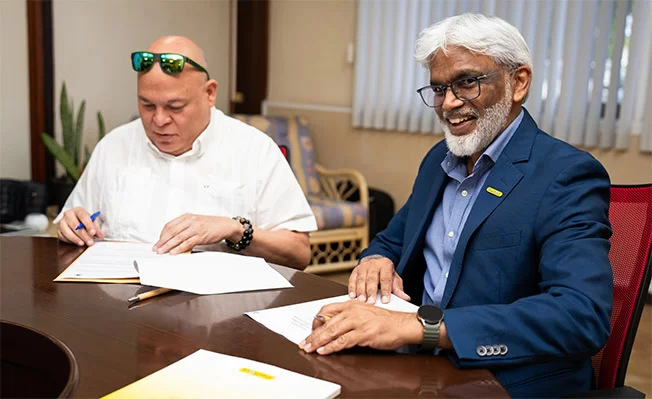
    Six indigenous pineapple growers in Suriname have formalized loan agreements to expand organic pineapple production, marking a significant advancement in strengthening the country’s agricultural value chain. The milestone signing ceremony occurred on Monday as part of the Agrifood Systems Transformation Accelerator (ASTA) Joint Programme, a collaborative initiative involving four United Nations agencies—FAO, UNIDO, UNFPA, and ILO—in partnership with the Surinamese government.

    Funded by the Joint SDG Fund and Islamic Development Bank, the program specifically targets sustainable development within Suriname’s pineapple sector. Approximately 90% of pineapple farmers in Suriname are indigenous communities operating collectively owned lands in Para’s village territories. Their lack of individual land titles has historically prevented access to traditional bank financing due to insufficient collateral.

    To overcome this barrier, ASTA established a Collateral Facility Fund managed by Trustbank Amanah (TBA), which serves as guarantee security for financial institutions. Roshnie Gangapershad, Acting Agri Business Manager at TBA, explained that loan applications undergo rigorous feasibility assessments before approval.

    The Horticulture Innovation HUB, established in 2024 under the ASTA project, provides comprehensive support through two core pillars: enhanced agricultural practices and strengthened agro-entrepreneurship. National agronomist Hemwatie Goeptar detailed the technical assistance process, which begins with thorough agronomic analysis covering field conditions, planting design, and fertilization programs developed in consultation with farmers and village leadership.

    Practical implementation is already underway. Farmers Jerry Birambie and Harvey Read from Pierre Kondre have prepared one-hectare plots for soil enhancement and planting. Despite equipment accessibility challenges in remote regions—Jeanne Patra from Marowijne requires machinery transported from Para—the program maintains momentum through adaptive solutions.

    Continuous field support remains crucial to the project’s success. Goeptar and field agents assist growers with irrigation, fertilization, and maintenance protocols. The application of artificial flower induction technology enables year-round production, with flowering induced after nine months and harvest occurring approximately fourteen months post-planting.

    Additional growers are preparing for expansion. Stuart Makosie from Powaka will commence land preparation shortly, while Cyrell Sabajo from Matta has established an on-site bio-factory for organic fertilizers and natural pesticides following training sessions.

    According to Swami Girdhari of the Horticulture Innovation HUB, the project aims not only to increase production but also to modernize the sector and attract youth participation. Innovative digital applications facilitate knowledge sharing, communication, and monitoring. Future phases will focus on processing and value-added pineapple products to enhance market opportunities both domestically and for export.

  • Energie, water, obligaties: Wat zijn de doelen van Iran als Trump elektriciteitscentrales aanvalt?

    Energie, water, obligaties: Wat zijn de doelen van Iran als Trump elektriciteitscentrales aanvalt?

    In a dramatic escalation of Middle East tensions, former U.S. President Donald Trump has ordered a five-day pause in planned attacks on Iran’s energy infrastructure, according to his statements on Monday. This development follows Trump’s 48-hour ultimatum issued Sunday demanding Iran reopen the Strait of Hormuz—a critical global oil transit route—or face targeted strikes on Iranian power facilities.

    Trump claimed on Truth Social that Washington and Tehran had engaged in “very good and productive talks” regarding a “complete and total resolution of our hostilities in the Middle East,” adding that “this time Iran is serious; they want to settle. They want peace.” These assertions were immediately contradicted by Iranian officials, with the Tasnim news agency reporting no negotiations were occurring and Parliament Speaker Mohammad Bagher Ghalibaf dismissing the claims as “fake news” designed to manipulate financial markets.

    The confrontation stems from Iran’s March 2nd announcement closing the Strait of Hormuz, through which 20% of global oil and gas passes, contributing to oil prices surpassing $100 per barrel. Trump’s Saturday threat specified that if Iran didn’t fully reopen the strait within 48 hours, the U.S. would “ATTACK AND DESTROY their various ELECTRIC POWER PLANTS, STARTING WITH THE LARGEST.” Potential targets include Iran’s Damavand plant near Tehran (2,900 MW capacity), Kerman plant (1,910 MW), and Ramin plant (1,890 MW).

    Iran’s Islamic Revolutionary Guard Corps (IRGC) responded with counter-threats, vowing to target Israeli power plants and facilities supporting U.S. military bases in the region. The IRGC stated the strait would remain closed “until our destroyed power plants are rebuilt,” while Iranian officials clarified the passage remains open to all except “ships belonging to our enemies.”

    The situation has triggered regional energy disruptions, with QatarEnergy halting LNG production after attacks on Ras Laffan and Mesaieed facilities, and Saudi Arabia suspending operations at its Ras Tanura refinery following fires allegedly caused by intercepted Iranian drones. Iranian officials denied involvement in these incidents.

    Iran has expanded its potential retaliation targets to include financial entities supporting U.S. military activities, specifically mentioning U.S. Treasury bond holders. Companies like Berkshire Hathaway ($360 billion in holdings), Tether ($100 billion), and Circle—all with regional investments—could potentially be affected. The IRGC-linked Tasnim agency also listed technology firms including Google, Microsoft, Palantir, IBM, Nvidia, and Oracle as “new targets for Iran” due to their Israeli connections and military applications.

    Critical water desalination infrastructure has already been impacted, with both Iran and Bahrain reporting attacks on facilities. This is particularly significant for Gulf states which rely on desalination for 50-100% of their water needs due to extreme water scarcity.