
In a significant development for Caribbean aviation, Surinam Airways and LIAT Air have initiated formal discussions to establish an interline partnership agreement. This strategic collaboration aims to substantially enhance air connectivity between the Caribbean region and South America, creating a more integrated transportation network for travelers.
标签: Suriname
苏里南
-

Landvreugd voorzitter van MAS: focus op financiën en groei scheepvaart
President Jennifer Simons has formally installed Delano Landvreugd as the new Chairman of the Board of Commissioners for Suriname’s Maritime Authority (MAS). The appointment signals continuity with the strategic direction established by previous leadership while introducing strengthened governance protocols. Landvreugd immediately emphasized transparency, rigorous oversight, and organizational professionalism as foundational pillars of his mandate.
The newly constituted board comprises members P. Dawsa, A. Dankerlui, S. Biervliet (Pakkitow), S. Sitaram, S. Badjalala, and J. Koese. According to Suriname’s Communication Service, Landvreugd committed to fostering constructive collaboration both within the board and with MAS executive leadership. He acknowledged that operational adjustments would be implemented where necessary to enhance organizational effectiveness.
A key presidential directive requires the board to address specific concerns identified in submitted reports, with particular attention to enhanced monitoring of financial flows within the institution. Landvreugd acknowledged there is always room for improvement and pledged full board engagement toward achieving established objectives.
The Chairman anticipates structured and transparent dialogue between the Board of Commissioners and executive management, expecting complete openness in all collaborative efforts. Notably, the maritime authority will intensify its focus on developments within Suriname’s burgeoning oil and gas sector, anticipating increased vessel traffic in national waters. Beyond ensuring navigational safety, Landvreugd identified potential revenue generation opportunities that could contribute significantly to state coffers.
-
Vakbeweging vraagt structurele aanpak vastlopende sociaal-economische dossiers
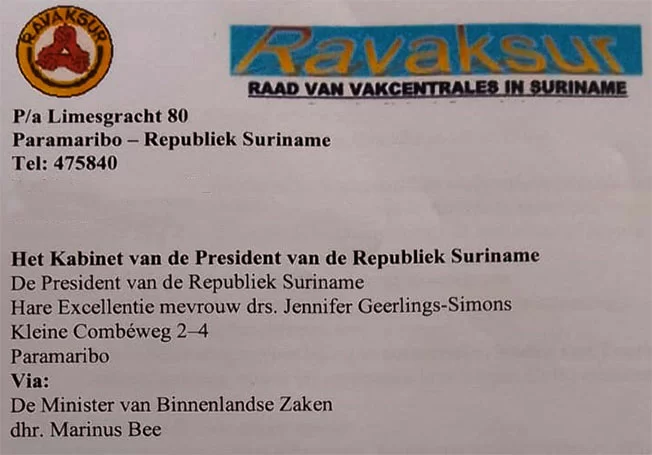
Suriname’s largest labor coalition, Ravaksur Plus, has issued an urgent appeal to President Jennifer Simons for immediate government intervention to address the nation’s deepening socioeconomic crisis. In a comprehensive letter dated February 4th, the coalition detailed multiple systemic failures affecting workers across all sectors and proposed establishing a joint commission to develop actionable solutions.
The coalition identified several critical areas requiring immediate attention. Foremost among these is the absence of a dedicated Ministry of Labor, which has resulted in fragmented labor policies and inadequate enforcement mechanisms. Ravaksur Plus advocates for reinstating this ministry with enhanced authority to strengthen social dialogue and better protect workers’ rights.
Persistent inflation and volatile exchange rates have created a severe purchasing power decline, with cumulative losses affecting all workers. The current minimum wage, poverty threshold, and tax measures no longer reflect economic realities, creating widespread financial hardship. The tax burden on employed individuals particularly hampers economic recovery, prompting calls for adjusting tax-free thresholds and implementing targeted fiscal relief.
Public sector employees face specific challenges including unimplemented wage agreements from 2020, revoked official ranks and periodic benefits, unequal healthcare provisions, and unresolved backlogged promotions and permanent appointments. Multiple government departments, including Regional Development and Social Affairs, reportedly have structurally stalled cases.
Education represents a separate crisis point, with teachers’ incomes becoming insufficient for basic subsistence. This has triggered significant brain drain and staff outflow from the education sector. The coalition demands income restoration measures, clearance of overdue payments, and structural improvements to working conditions.
Private sector workers similarly confront constrained wage growth, high fiscal pressure, and inadequate inflation protection. The minimum wage has become completely disconnected from actual living costs, creating additional financial strain.
Ravaksur Plus additionally called for progress on previously agreed arrangements with the former administration and outstanding benefit packages from affiliated unions, requesting clear timelines and implementation agreements.
The letter was coordinated by Armand Zunder and endorsed by all major education unions including the Federation of Suriname Teachers’ Organizations (FOLS) and its member organizations, the Teachers’ Union (BvL), and the Alliance for Teachers in Suriname (ALS).
-
Pakistaanse leger: 216 strijders gedood in Balochistan
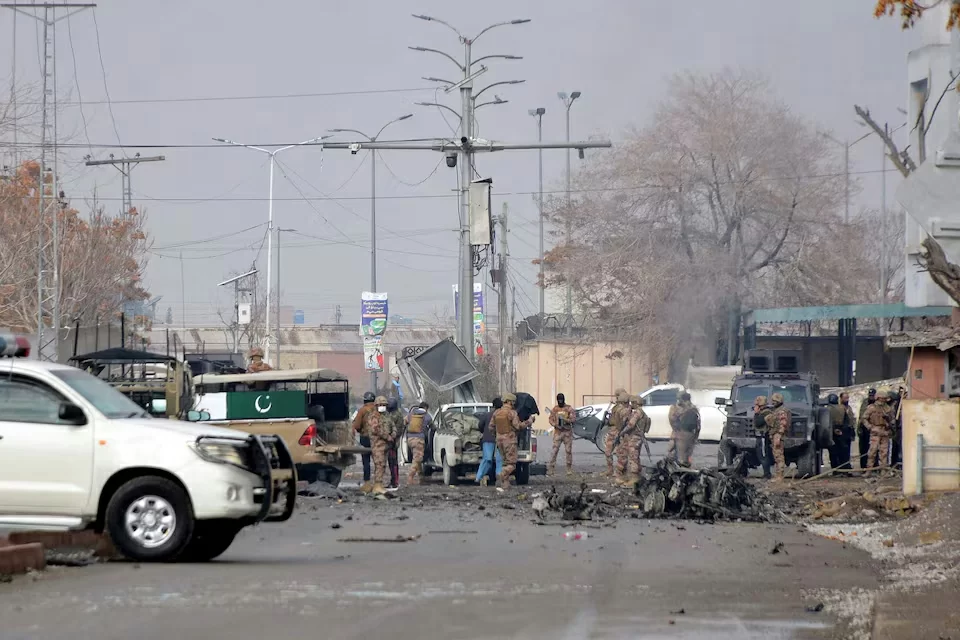
Pakistan’s military has successfully concluded a week-long comprehensive security operation in the restive southwestern province of Balochistan, announcing the elimination of 216 militants during targeted offensives. The operation, codenamed Radd-ul-Fitna-1 (Elimination of Chaos), was launched on January 29th in response to coordinated attacks by the separatist Balochistan Liberation Army (BLA) that targeted educational institutions, banking facilities, public markets, and military installations across the province.
According to an official military statement released Thursday, the carefully planned operation utilized actionable intelligence to dismantle terrorist sleeper cells through sustained search and clearance missions. Security forces conducted precision strikes based on meticulous planning, significantly degrading the leadership hierarchy, command structures, and operational capabilities of terrorist networks in the region.
The military reported seizing substantial quantities of foreign-origin weapons, ammunition, explosives, and military equipment during the operations. Preliminary analysis indicates the militants benefited from systematic external facilitation and logistical support, though the military did not specify the sources of this assistance.
Tragically, the conflict resulted in significant collateral damage, with 36 civilian casualties including women and children, alongside 22 fallen members of security forces and police personnel.
Balochistan has endured decades of separatist insurgency, with escalating violence in recent years as armed groups protest against perceived exploitation of the province’s abundant natural resources. The region possesses substantial deposits of coal, gold, copper, and natural gas, generating considerable revenue for the federal government.
Prime Minister of Balochistan Sarfraz Bugti revealed to journalists on Sunday that security forces have eliminated over 700 terrorists in the province during the past twelve months, with approximately 70 neutralized in the preceding 48 hours alone. He emphatically stated that these attacks would not weaken the government’s counterterrorism resolve.
The provincial leader further accused neighboring nations India and Afghanistan of providing support to the militants—allegations consistently denied by both governments. The operation represents the latest chapter in Pakistan’s ongoing struggle to maintain stability in its strategically important but volatile southwestern region.
-
Van Trikt onder politiebegeleiding naar specialist; detentie volgt na weigering uitstel door OM
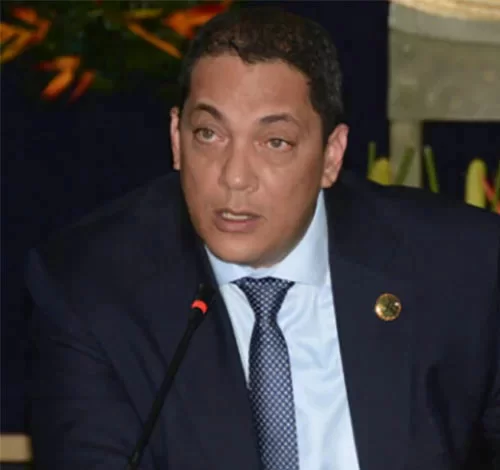
Robert van Trikt, the convicted former governor of Suriname’s Central Bank, was taken into police custody this morning to begin serving his prison sentence. Despite having a scheduled medical specialist appointment today, Van Trikt was escorted by law enforcement to complete the visit before commencing his term. The former bank official informed Starnieuws that he had intended to surrender voluntarily tomorrow but acknowledged the authorities’ decision to enforce the sentence immediately.
The Public Prosecution Service had previously granted Van Trikt a one-week window to report to the Santo Boma penitentiary after rejecting his request for a three-month postponement of sentence execution. The prosecution emphasized that after this deadline expired, the verdict would be implemented without further delay.
Through his attorney Chandra Algoe, Van Trikt had sought postponement citing personal circumstances and his intention to challenge the conviction through international legal channels. The prosecution dismissed these appeals, insisting on immediate enforcement following the expiration of the granted period.
On January 19, the Court of Justice upheld Van Trikt’s conviction in the appellate hearing concerning the Central Bank of Suriname case, reducing his sentence from eight to six years imprisonment. Having already spent approximately three and a half years in pre-trial detention, he had been temporarily released on humanitarian grounds prior to this final ruling.
Van Trikt’s defense team maintains that his actions resulted from policy decisions made with full knowledge and explicit approval of the government, particularly former Finance Minister Gilmore Hoefdraad. The international appeal will reference a Kroll advisory report that the defense claims received insufficient consideration during domestic proceedings, along with the court’s acknowledgment that his nearly two-year pre-trial detention was unlawful.
Separately, Van Trikt faces additional investigations stemming from a 2020 complaint filed by Finabank and fourteen citizens regarding the use of cash reserve funds during his tenure as central bank governor, demonstrating the ongoing legal challenges confronting the former financial official.
-
Rusland trekt zich terug, New START-verdrag loopt af
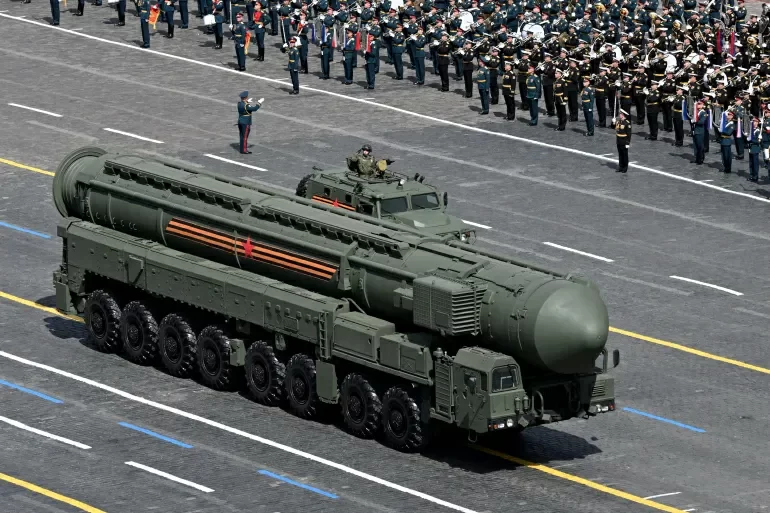
The expiration of the New START treaty—the final major nuclear arms control agreement between Russia and the United States—has officially taken effect, marking a critical juncture in global security dynamics. Russia declared on Wednesday that it no longer considers itself bound by the treaty’s deployed warhead limits, citing the U.S.’s lack of response to President Vladimir Putin’s proposal to extend the pact for an additional year.
Signed in 2010 by former President Barack Obama and Russian President Dmitry Medvedev, New START imposed strict limits on the number of strategic nuclear weapons each nation could deploy. The treaty, which came into force in 2011, was designed to regulate nuclear arsenals and prevent a renewed arms race between the world’s two largest nuclear powers.
With the treaty’s lapse, both Moscow and Washington are now technically free to significantly expand their missile and warhead arsenals—though such moves would entail considerable logistical challenges and time. Russian Foreign Minister Sergey Lavrov accused the U.S. of “consciously ignoring” Moscow’s extension proposal, labeling Washington’s stance as “deeply flawed and regrettable.”
Despite the expiration, U.S. President Donald Trump has expressed openness to negotiating a new agreement. In an interview with The New York Times, he emphasized the need for a “better deal” and insisted that China must be included in future nuclear negotiations.
Arms control experts warn that the collapse of New START could trigger a dangerous new nuclear arms race, exacerbated by China’s rapidly expanding nuclear capabilities. Matt Korda of the Federation of American Scientists cautioned that both nations could now deploy hundreds of additional warheads, potentially doubling their strategic arsenals in a worst-case scenario.
The looming expiration also drew concern from Pope Francis, who issued an urgent appeal urging both countries not to allow the treaty to lapse. “It is more urgent than ever to replace the logic of fear and distrust with a shared ethic focused on the common good,” the pontiff stated during his weekly audience.
The international community now watches anxiously to see whether the U.S. and Russia can negotiate a successor agreement to maintain nuclear oversight—or whether the end of New START will usher in an era of heightened nuclear tension and global instability.
-

Column: Duurzaamheid clubvoetbal
Suriname’s football landscape reveals a paradoxical reality where undeniable talent coexists with systemic limitations. While the nation has produced exceptional players since the Caribbean Cup-winning generation decades ago, the sporadic emergence of standout performers has failed to translate into consistent regional success.
The historical achievements of Transvaal in the 1970s and more recently Robinhood’s 2019 CONCACAF Caribbean Club Shield victory and 2023 Caribbean Cup triumph demonstrate Suriname’s potential. Remarkably, these accomplishments were achieved while maintaining amateur status—a testament to the players’ dedication but also highlighting structural constraints.
Despite these flashes of brilliance, neither club has sustained their peak performance levels. Robinhood’s disappointing follow-up to their magnificent 2022-2023 season raises serious questions about the sustainability of current approaches within Surinamese football.
The core issue lies in the semi-professional reality masked by professional labels. Suriname Major League clubs are officially professional organizations but operate as amateur entities in practice. Players juggle full-time jobs with limited training schedules—typically a few afternoon hours several days weekly—creating an impossible competitive disadvantage against genuine professional opponents.
This structural deficiency directly impacts national team prospects. Selection for international duty requires players to maintain professional standards: full football dedication without external employment, multiple daily training sessions, and complete athletic focus. Without meeting these fundamental conditions, local players remain ineligible for national team consideration.
The solution requires transformative change. Clubs must grant genuine professional status through living wages that support families, eliminating players’ need for secondary employment. Where financial constraints exist, strategic partnerships could provide necessary funding infrastructure. Such modernization would simultaneously advance regional competitive goals and enable international careers for Surinamese athletes.
-
Openbaar Ministerie gaat in hoger beroep na vrijspraak Danielle Veira
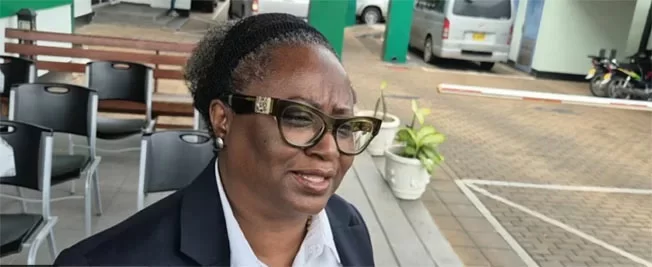
The Public Prosecution Service has formally filed an appeal against the full acquittal of Danielle Veira, former head of the Directorate of National Security (DNV), by the Court of Martial Appeals. This move signals the prosecution’s refusal to accept the court’s finding that insufficient evidence existed to prove Veira’s involvement in the April 16, 2020 hostage operation targeting Rodney Cairo.
Presiding Judge Cynthia Valstein-Montnor emphasized during Friday’s ruling that the central consideration was whether the operation genuinely constituted an official DNV action. The court determined that only one convicted co-suspect, Imro Miedema, had testified about Veira’s potential involvement when police requested explanations, while other objective evidence confirming her role as instigator remained absent.
The court also dismissed allegations regarding Veira’s unauthorized distribution of weapons and firearm permits, noting that providing arms to informants and civilians had been an established practice within DNV—sometimes even under presidential instruction. The judiciary deemed it unreasonable to hold Veira solely criminally responsible for what constituted an institutionalized organizational practice.
Following her emotional release, Veira expressed profound gratitude outside the courthouse, repeatedly referencing her religious faith. She described enduring five arduous years and affirmed her belief in divine justice, while also thanking the judges for their discernment and her family for their unwavering support.
The case remains unresolved as it proceeds to appellate review, where the higher court will reexamine both factual evidence and legal assessments. The prosecution had initially sought a nine-year prison term with immediate custody.
-
Digitaal systeem gelanceerd voor volledige controle op vuurwapens
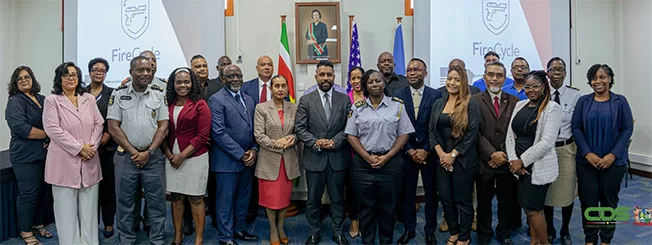
Suriname has officially launched a comprehensive digital firearm tracking system designed to monitor weapons throughout their entire lifecycle—from import and ownership to eventual destruction. The system, developed in collaboration with CARICOM’s Implementation Agency for Crime and Security (IMPACS), represents a significant advancement in regional security cooperation.
Justice and Police Minister Harish Monorath emphasized that the registry will provide complete traceability for every firearm in the nation. “From production and purchase to import, ownership, use, and final destruction—even after destruction, it remains recorded that the weapon was actually destroyed,” Monorath stated during the system’s inauguration.
The registry encompasses all firearms in Suriname, including handguns and hunting rifles owned by civilians, weapons from shooting associations, and arms belonging to police, military, correctional facilities, and other legally authorized entities. Any weapon not registered in the system will automatically be considered illegal, with stricter sanctions to be implemented in the future.
The digital infrastructure forms part of a broader regional strategy and interfaces with similar systems across Caribbean nations—a critical feature given the influx of illegal weapons from neighboring Brazil, French Guiana, and Guyana.
Trained personnel operating the system adhere to international standards, with the Directorate of National Security assuming coordinating responsibilities. The registry integrates with Suriname’s recently digitized firearm license system, which now enables complete online application and payment processes.
Minister Monorath addressed security concerns by highlighting multiple protective layers and warning mechanisms designed to prevent cyber threats and data breaches. Parallel to the registry implementation, authorities are advancing additional projects including the destruction of illegally obtained weapons.
Michael Jones, Executive Director of CARICOM IMPACS, noted that the digital transition significantly enhances operational efficiency and analytical capabilities. “The shift from paper to digital enables faster information analysis and recognition of patterns that previously remained invisible,” Jones explained. The regional interconnection substantially improves tracking capabilities for illegal firearm distribution networks across Caribbean borders.
-

Wereld Kanker Dag: Suriname zet in op versnelde strijd tegen baarmoederhalskanker
Suriname faces a severe healthcare challenge as cancer ranks as the nation’s second leading cause of death, with distinct patterns emerging across genders. Women predominantly suffer from breast, cervical, and colorectal cancers, while men most frequently develop prostate, lung, colorectal, and head-neck cancers. This alarming situation comes into sharp focus on World Cancer Day, observed globally on February 4th, which emphasizes cancer’s profound impact and the critical importance of prevention, early detection, timely treatment, and comprehensive care.
The World Health Organization reveals that approximately 40% of all cancer cases are preventable through avoiding key risk factors including tobacco use, excessive alcohol consumption, unhealthy diets, physical inactivity, and exposure to air pollution. Vaccination against Hepatitis B and Human Papillomavirus (HPV) plays a pivotal role in preventing liver and cervical cancers respectively. Regular screening significantly enhances early detection and successful treatment outcomes for cervical, breast, and colorectal cancers.
Across the Americas, cervical cancer diagnoses exceed 78,000 annually among women, resulting in over 40,000 deaths. The situation is particularly dire in Latin America and the Caribbean—where Suriname is located—where mortality rates triple those in North America, highlighting substantial disparities in prevention and care access.
The Pan American Health Organization has issued an urgent call to accelerate efforts toward eliminating cervical cancer by 2030. This ambitious goal requires achieving three targets: 90% HPV vaccination coverage for girls under 15, 70% screening coverage with high-quality tests for women at ages 35 and 45, and 90% treatment access for women with pre-cancerous or invasive cancer. While 24 countries have implemented single-dose vaccination schedules and regional first-dose coverage reaches 70%, screening and treatment programs lag significantly behind.
PAHO is supporting member states through technical assistance and leveraging regional funds to ensure affordable vaccines, screening equipment, and treatment tools. Collaborations with partners including Unitaid and Spain’s AECID strengthen this comprehensive approach to make quality care accessible through primary healthcare systems.
Meanwhile, Suriname’s Ministry of Health emphasizes the crucial role of mental and emotional support for cancer patients and their families, recognizing that psychological care is indispensable within overall cancer management.
Marking World Cancer Day 2026, WHO/PAHO is hosting the webinar ‘Supporting the Elimination of Cervical Cancer’ to accelerate action on vaccination, screening, and care access to eliminate cervical cancer as a public health problem.