标签: Suriname

苏里南

  • Hoe Iran Starlink stoorde en hoe Iraniërs proberen dit te omzeilen

    Hoe Iran Starlink stoorde en hoe Iraniërs proberen dit te omzeilen

    Iranian authorities have escalated their digital suppression tactics by deploying sophisticated jamming technologies against SpaceX’s Starlink satellite internet service, which had become a vital communication tool for citizens amid widespread protests. The campaign represents a significant evolution in Tehran’s censorship capabilities, targeting both GPS signals and satellite transmissions simultaneously.

    The crackdown intensified on January 8, 2026, when Iranian regulators implemented massive internet and telephone network blackouts. While partial service was later restored, severe restrictions remain in effect. The regime’s latest offensive focuses on disrupting Starlink’s satellite connectivity through multiple interference methods.

    According to data from gpsjam.org, significant GPS interference was detected in Tehran and surrounding areas on January 8, coinciding with the internet shutdown. Professor Kave Salamatian of Savoie University explains that GPS jamming represents a classical method for disrupting Starlink services, as terminals rely on GPS signals to orient their antennas toward satellites.

    However, the interference extends beyond GPS disruption. Victoria Samson of the Secure World Foundation reports data loss rates between 30-80%, indicating active signal jamming where transmission channels are saturated with noise or false signals. This sophisticated approach suggests Iranian authorities may be employing advanced electronic warfare systems, potentially including Russian-made Murmansk-BN jammers or domestic equivalents like the Cobra-V8 system developed at specialized institutions such as Imam Hossein University and Sharif University.

    SpaceX has responded with technical countermeasures. A recent software update enables Starlink terminals to bypass GPS jamming through satellite-based triangulation and automatically reroute signals to unaffected satellites when interference is detected. While this has significantly reduced data loss, the update compromises terminal mobility as devices struggle to maintain connections while in motion.

    According to Nasnet, Iran’s largest Starlink community, service remains functional despite concentrated interference around Tehran characterized by temporary, non-persistent disruptions. The cat-and-mouse game continues with approximately 50,000 Starlink terminals serving a small fraction of Iran’s 90 million population, highlighting both the technological arms race and the limitations of satellite internet as a comprehensive solution against state-level censorship.

  • Column: Eendracht maakt macht

    Column: Eendracht maakt macht

    Surinamese football faces a critical juncture as recent promising developments have given way to concerning regression. Several seasons ago, amateur-status national champions Robinhood achieved an unexpected triumph by capturing the Caribbean championship title, defeating professional clubs in a remarkable underdog story. This breakthrough generated widespread optimism for Suriname’s football future, but the success proved fleeting as the team suffered early elimination in subsequent tournaments.

    The club’s recent transition to professional status has paradoxically coincided with a decline in performance quality. This deterioration stems from the departure of key players and failure to develop adequate replacements through youth systems. This situation raises fundamental questions about the effectiveness of domestic player development programs and whether clubs must consistently recruit from competitors to maintain competitiveness.

    A growing trend of foreign player and coach recruitment has emerged throughout Surinamese football leagues. This development warrants thorough investigation to determine whether clubs pursue international talent for superior quality or simply because foreign professionals accept lower wages. Similarly, the increasing reliance on foreign coaches prompts examination of whether these appointments reflect quality improvements or desperate measures for organizational survival.

    Football associations must proactively address these developments through strategic partnerships and development initiatives. Collaboration with Natio Nieuwe Stijl could elevate coaching standards, subsequently improving player quality through enhanced training methodologies. Such cooperation could establish sustainable pathways for developing local talent capable of regional competition while providing coaches opportunities to demonstrate their capabilities through team performance.

    The Surinamese diaspora represents a valuable resource for football development, with internationally experienced professionals expressing willingness to contribute their expertise. Embracing this knowledge transfer while prioritizing quality and professionalism over individual egos could establish a new football culture where both players and coaches can thrive, potentially reversing the current decline.

  • VS stopt tijdelijk immigrantvisa uit 75 landen; Suriname en Guyana niet erbij

    VS stopt tijdelijk immigrantvisa uit 75 landen; Suriname en Guyana niet erbij

    The United States Department of State has implemented a temporary suspension of immigrant visa processing for citizens from 75 countries worldwide, citing concerns about potential dependence on public assistance programs. The policy shift, which takes effect January 21st, significantly impacts 26 nations across the Caribbean and Latin America including Cuba, Brazil, Colombia, Guatemala, Nicaragua, Uruguay, and Belize.

    Caribbean nations affected by the suspension include Antigua and Barbuda, Barbados, Dominica, Grenada, Saint Kitts and Nevis, and Saint Lucia. Notably exempted from the measure are Suriname, Guyana, and Trinidad and Tobago.

    Under Secretary Marco Rubio’s leadership, the State Department has instructed consular officials to halt processing immigrant visa applications from these countries while continuing to process non-immigrant visas such as tourist and business permits. The suspension aligns with broader immigration policy reforms announced last November that establish stricter criteria to prevent newcomers from becoming reliant on social welfare programs.

    The temporary visa freeze comes amid anticipated increased demand for non-immigrant visas ahead of major international events hosted by the United States, including the 2026 World Cup and 2028 Olympic Games. Most affected countries have adopted a wait-and-see approach pending formal notification, with the Caribbean Community (CARICOM) yet to issue an official response.

    The global list extends beyond the Western Hemisphere to include nations from Africa, Asia, and Europe, with Afghanistan, Iran, Russia, and Somalia among the designated countries.

    New consular guidelines require enhanced vetting of visa applicants based on multiple criteria including age, health status, family circumstances, financial resources, educational background, professional skills, history of public assistance, and English language proficiency. These assessments supplement existing medical screenings and vaccination requirements.

    The policy reflects continuity with the previous administration’s immigration framework aimed at restricting entry of individuals who might potentially burden American social support systems.

  • Wereldbank verhoogt groeiverwachting 2026, waarschuwt voor ongelijkheid

    Wereldbank verhoogt groeiverwachting 2026, waarschuwt voor ongelijkheid

    The World Bank has issued a cautiously optimistic yet concerning assessment of global economic prospects in its latest Global Economic Prospects report, published Tuesday. While upgrading its 2026 global growth forecast to 2.6%—a 0.2 percentage point increase from June’s projection—the institution simultaneously warned of significant headwinds including cooling international trade and widening disparities in living standards across nations.

    This modest upward revision still represents a slowdown from 2025’s 2.7% growth rate, continuing what the Bank describes as potentially “the weakest decade for global economic growth since the 1960s.” The report acknowledges unexpected economic resilience throughout the past year despite what it characterizes as “historic escalation of trade tensions and policy uncertainty.”

    Much of this uncertainty stemmed from the return of U.S. President Donald Trump to power last year and his administration’s implementation of broad import tariffs against major American trading partners. These measures significantly disrupted international supply chains and amplified volatility across global markets.

    The economy’s relative resilience was attributed partially to accelerated goods imports by U.S. companies stockpiling ahead of anticipated tariffs, alongside surging investments in artificial intelligence technologies that provided substantial economic stimulus.

    Looking ahead, the World Bank anticipates noticeable deceleration in global trade growth throughout 2026 as businesses complete inventory replenishment and the full effects of new trade restrictions become more pronounced. A tentative recovery in trade expansion isn’t expected until 2027, when nations presumably adapt to the new policy environment and uncertainty diminishes.

    Perhaps most alarmingly, the report highlights growing disparities in living standards between countries despite moderate overall growth. World Bank Chief Economist Indermit Gill warned that the global economy faces slower growth in coming years than even during the economically troubled 1990s, while simultaneously confronting record levels of both public and private debt.

    To avert prolonged stagnation and rising unemployment, Gill advocates for comprehensive policy measures including robust liberalization of private investments and trade, curtailment of government consumption growth, and substantial investments in emerging technologies and education systems across both emerging and developed economies.

  • Zorg voor kinderen die stotteren wordt versterkt

    Zorg voor kinderen die stotteren wordt versterkt

    A significant advancement in speech therapy services is unfolding across the Dutch Caribbean region as specialized training programs enhance care for children who stutter. Suriname currently hosts an intensive professional development course bringing together speech therapists from Suriname, Curaçao, and Aruba with the primary objective of improving support systems for young stutterers and their families.

    Fifteen speech therapists from Suriname are participating in the ‘Stuttering in Children’ certification program, while seven colleagues from Curaçao and Aruba are attending via virtual platforms. The training is conducted by certified stuttering therapists Irma Uijterlinde and Liesbeth Zoontjens, who traveled specifically to Suriname to deliver the specialized curriculum according to therapist Gracia Nelson.

    Zoontjens emphasized the critical need for expanded expertise, noting that only three specialized stuttering therapists currently serve the entire Dutch Caribbean population. ‘With improved knowledge and techniques, speech therapists can provide more targeted guidance to both children who stutter and their parents,’ she explained. Uijterlinde reinforced the importance of early intervention, stating: ‘The sooner a child receives appropriate help, the greater their chances of recovery and normal developmental progression.’

    Medical statistics indicate that approximately 1% of the general population experiences stuttering conditions. The phenomenon is more prevalent among young children, with about 8% of children under six years old undergoing a stuttering phase. Notably, one quarter of these children will develop persistent stuttering patterns without professional intervention. Timely therapeutic support can substantially reduce the long-term impact on communication abilities and social development.

    The comprehensive curriculum addresses multiple facets of stuttering management, including diagnostic procedures, parental guidance strategies, and collaborative approaches with educational institutions. The initial training days focus on therapeutic techniques for children under six years old, followed by specialized modules addressing the needs of children aged six to twelve years. A follow-up session is scheduled for March to reinforce learning outcomes and clinical applications.

    The professional development initiative commenced Monday at the Association of Medici building and will continue through January 17th, representing a concerted effort to address regional healthcare disparities in speech pathology services.

  • Snelle Guyana olieproductie verkort levensduur Liza-velden drastisch

    Snelle Guyana olieproductie verkort levensduur Liza-velden drastisch

    Guyana’s emerging oil economy faces a significant challenge as production data reveals the rapid depletion of its flagship Liza One and Liza Two oil fields. According to information from Guyana’s Ministry of Natural Resources, these strategic assets operated by ExxonMobil in the Stabroek Block may exhaust their recoverable reserves within just 2-3 years—dramatically shorter than the originally projected 20-year lifespan.

    The Liza One field, operational since December 2019, currently holds approximately 189 million remaining barrels. With its 2025 production averaging 140,000 barrels daily (51 million annually), calculations suggest complete depletion could occur within slightly over three years. Similarly, Liza Two—commissioned in February 2022 with 266 million barrels remaining—produced at 250,000 barrels daily in 2025 (91 million annually), potentially exhausting its reserves in just over two years.

    This accelerated timeline stems from production agreements between ExxonMobil and the Guyanese government that prioritized rapid extraction. However, this approach has substantially shortened the economic viability of these fields while coinciding with unfavorable market conditions. Brent crude prices have declined from approximately $100 per barrel during the 2022 Russia-Ukraine conflict to current levels around $62, with analysts warning potential further drops to $50 due to geopolitical developments including U.S. interventions in Venezuela.

    Compounding these challenges, Guyana’s revenue-sharing model has limited national benefits. The absence of ring-fencing provisions allows ExxonMobil to allocate up to 75% of monthly production to recover costs from other Stabroek Block projects—a particularly disadvantageous arrangement during periods of high oil prices.

    Vice President Bharrat Jagdeo previously defended this strategy, stating in October 2023 that the country was ‘sacrificing current revenues for massive future returns.’ However, the combination of rapidly depleting reserves, declining prices, and contractual terms now raises serious questions about whether Guyana will maximize benefits from its petroleum resources. The situation threatens to significantly impact funding for the national development agenda, highlighting the complex tradeoffs between accelerated extraction and sustainable resource management.

  • Somohardjo: OCER-terrein NDP deels uitgegeven in vorige periode

    Somohardjo: OCER-terrein NDP deels uitgegeven in vorige periode

    A significant land management scandal has emerged in Suriname, revealing that a portion of the National Democratic Party (NDP) party grounds operated by Stichting Ontspanningscentrum Eerste Rijweg (OCER) was unlawfully allocated during the previous government term. This finding comes from an official investigation conducted by the Ministry of Land Policy and Forest Management (GBB).

    Assembly Member Bronto Somohardjo, who chairs the GBB’s permanent committee, provided documented evidence to substantiate these claims. The disputed property has been legally leased to OCER since 1991 for social and recreational purposes. According to cadastral maps and official registrations, the allocated parcel was not state-owned domain land but fell entirely within an existing land lease right.

    The Land Survey Service’s conclusion is unequivocal: the allocation was legally incorrect. Somohardjo disclosed that over recent months, he has been approached by hundreds of citizens and organizations who had completely lost confidence in the land management system. These individuals presented concrete cases with requests for official verification of what had actually occurred.

    “These were not mere stories or rumors,” Somohardjo emphasized. “People came forward with documents in hand, stating: ‘Check this for us because we no longer trust the system.’ I take such concerns seriously.”

    The OCER case confirms what many citizens have experienced for years, according to Somohardjo. “If even OCER wasn’t safe, then no one was safe during that period. That’s the harsh reality we must face.” He noted that rules provided no protection, and people who believed their rights were secure could still lose them, causing profound damage to public trust in government.

    However, Somohardjo highlighted that a different approach now prevails. “What matters to me is that complaints today aren’t dismissed. They’re investigated. This isn’t an easy path and progress can be challenging, but it’s the correct approach.”

    The politician pointed out that the GBB ministry has since addressed and resolved multiple stalled cases. Despite significant backlogs and complex problems, progress is being made step by step toward restoring legal certainty.

    “People no longer need to fear that their property might simply disappear,” Somohardjo stated. “Those who come forward today will be heard. As long as I bear responsibility, I will ensure that rules provide protection rather than uncertainty.”

  • Politie Nederland: ruim 300 kilo cocaïne aangetroffen in bevroren vis uit Suriname

    Politie Nederland: ruim 300 kilo cocaïne aangetroffen in bevroren vis uit Suriname

    Dutch law enforcement agencies have made a significant narcotics interception after discovering 319 kilograms of cocaine concealed within a shipment of frozen fish. The sophisticated smuggling operation was uncovered on Monday, January 12th, following a targeted investigation prompted by intelligence regarding potential drug trafficking activities.

    The suspicious container, originating from Suriname, was intercepted at a commercial facility in Barneveld. Specialist units including the National Investigation and Intervention Unit and the National Expertise and Operations Unit initiated a comprehensive examination after initial scans revealed unexplained anomalies within the cargo.

    Despite preliminary scans failing to directly identify narcotics, investigators detected irregularities that warranted further manual inspection. Each frozen fish underwent individual scanning, leading to the discovery of anomalous substances within portion of the shipment.

    Upon forensic examination, law enforcement personnel surgically opened the frozen fish, revealing professionally packaged cocaine bundles concealed within the marine products. The total seizure amounted to approximately 319 kilograms of high-purity cocaine with substantial street value.

    Authorities have clarified that the Barneveld-based company where the container was intercepted currently shows no indications of involvement in the smuggling operation. The criminal investigation continues to focus on identifying the trafficking network’s origins and those responsible for the sophisticated concealment methodology.

    The confiscated narcotics have been securely transferred to customs authorities and subsequently destroyed in accordance with Dutch drug enforcement protocols. This interception represents one of the more inventive concealment methods recently encountered by European border security agencies.

  • Natascha Kalo voorgedragen als gedelegeerd commissaris bij Grassalco

    Natascha Kalo voorgedragen als gedelegeerd commissaris bij Grassalco

    In a significant corporate governance development, Natascha Kalo has been appointed as interim executive commissioner of N.V. Grassalco following her nomination by shareholders. The company’s Board of Commissioners ratified the appointment during an emergency meeting held Thursday morning.

    Kalo’s elevation to this temporary leadership position comes just days after the Board suspended CEO Wesley Rozenhout on Monday, January 12th. This decisive action is directly connected to an ongoing investigation into the disappearance of approximately four kilograms of gold from the state mining enterprise.

    The Board of Commissioners, chaired by Berto Sampi, emphasized the critical need for unimpeded information flow to ensure a thorough and independent investigation. The suspension of Rozenhout was additionally justified by alleged violations of company statutes according to official statements.

    In her new capacity as executive commissioner, Kalo will assume specific temporary duties and authorities to exercise intensified oversight of organizational operations. This interim governance structure will remain effective until the appointment of a new permanent chief executive officer.

    Meanwhile, Grassalco has initiated an internal ‘quickscan’ assessment while maintaining normal daily operational activities. The current Board of Commissioners comprises Chairman Berto Sampi alongside members Steven Jungerman, Joël Anches, and Ivan Brunswijk, who will continue to provide governance during this transitional period.

  • Na Iraanse vergeldingswaarschuwing, VS trekt personeel terug uit Midden-Oosten

    Na Iraanse vergeldingswaarschuwing, VS trekt personeel terug uit Midden-Oosten

    The United States has initiated a partial withdrawal of personnel from strategic military installations across the Middle East, confirmed a senior U.S. official on Wednesday. This precautionary measure follows intelligence indicating Tehran has alerted neighboring nations about potential retaliatory strikes against American facilities should Washington authorize military action against Iran.

    The escalating tensions occur amid Iran’s most severe domestic unrest since the 1979 Islamic Revolution, with the regime facing unprecedented pressure from widespread anti-government protests. According to informed sources, the personnel withdrawal specifically targets key operational centers including U.S. regional headquarters in Qatar and Bahrain.

    European and Israeli intelligence assessments suggest American military intervention appears increasingly probable, potentially within a 24-hour window. Qatari authorities acknowledged the ongoing withdrawal from Al Udeid Air Base—the largest U.S. military installation in the region—citing heightened security concerns.

    While select personnel have received evacuation orders, defense officials note the absence of large-scale withdrawal patterns previously observed before major confrontations, such as during last year’s Iranian missile attacks.

    The human cost continues to mount with Iranian authorities reporting over 2,000 fatalities since protests began, while independent human rights organizations document at least 2,600 deaths and approximately 18,000 arrests—marking this as the deadliest civil unrest in decades. Iranian military leadership attributes the instability to foreign adversaries, with France’s Foreign Minister condemning the government’s crackdown as “the most violent suppression in contemporary Iranian history.”

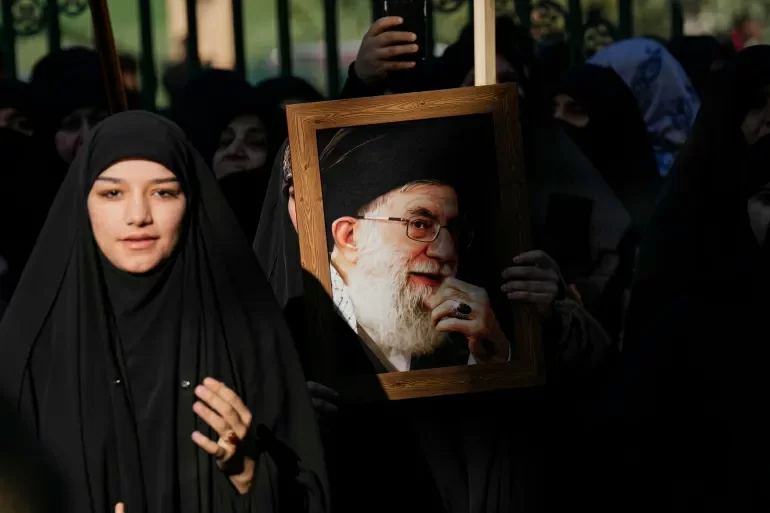
    Tehran has formally accused the United States and Israel of instigating protests, labeling demonstrators as “armed terrorists.” Simultaneously, Iranian officials have warned regional allies that American bases in Saudi Arabia, the United Arab Emirates, and Turkey would become immediate targets should the U.S. launch attacks against Iran.

    Diplomatic channels have deteriorated significantly with the suspension of communications between Iranian Foreign Minister Abbas Araqchi and U.S. Special Envoy Steve Witkoff. The Iranian government continues to stage public ceremonies demonstrating regime support while maintaining tight security control.

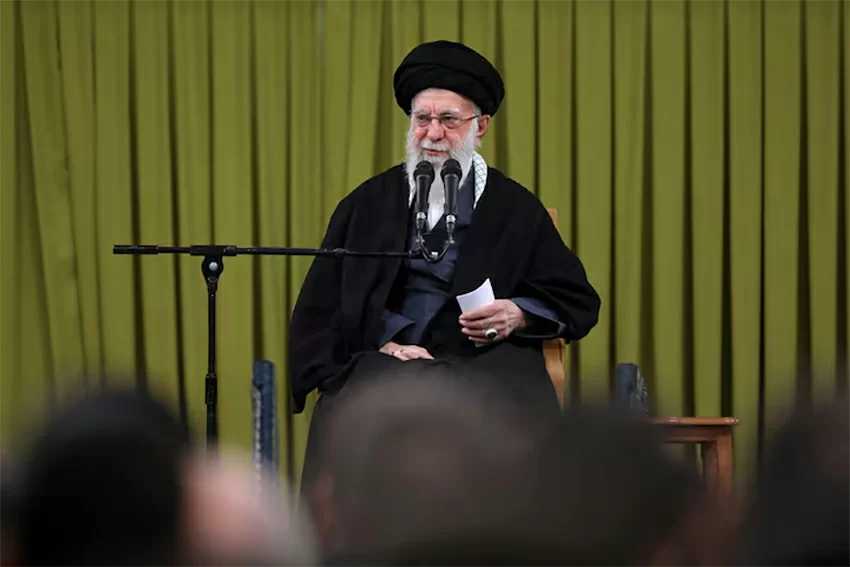
    Western analysts suggest that despite unprecedented domestic challenges, Iran’s security apparatus remains firmly intact with no immediate threat of governmental collapse. President Masoud Pezeshkian emphasized that “enemy efforts will achieve nothing” as long as public support persists.

    Meanwhile, Iran’s judiciary announced accelerated trials for individuals accused of serious violence during protests, with human rights organizations warning of imminent executions—including that of a young man allegedly involved in demonstrations.

    The situation remains critically volatile with the international community monitoring developments with profound concern. The coming days are expected to prove decisive for regional stability and potential escalation in U.S.-Iran hostilities.