标签: Suriname

苏里南

  • COFCOR-voorzitter Bouva wil sterkere positie CARICOM op wereldtoneel

    COFCOR-voorzitter Bouva wil sterkere positie CARICOM op wereldtoneel

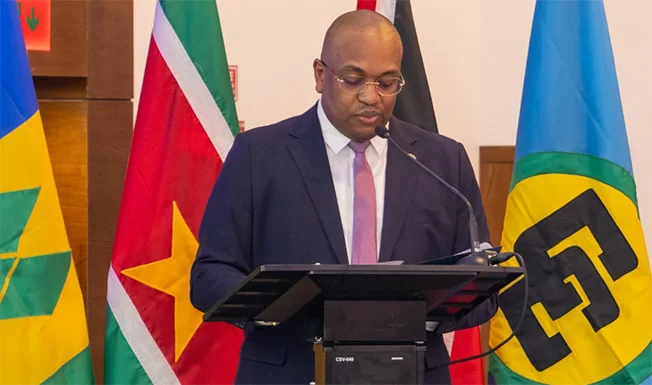
    On May 20, Suriname officially took over the rotating chairmanship of the Council for Foreign and Community Relations (COFCOR), the key ministerial coordination body for foreign affairs of the Caribbean Community (CARICOM), at the opening of the body’s 29th plenary session held in Paramaribo. The gathering, hosted at Paramaribo’s Yogh Hospitality, brought together top foreign affairs officials from across the Caribbean bloc to align shared positions on pressing cross-regional and global challenges.

    In his keynote opening address, incoming chairman Melvin Bouva, Suriname’s Minister of Foreign Affairs, outlined a clear priority agenda for his tenure, emphasizing that the Caribbean bloc must amplify its collective profile on the global stage. Bouva argued that CARICOM, as a region rich in natural resources, holds unique strategic importance for the entire world. He called on member states to not only deepen existing partnerships with major international actors, but also conduct rigorous reviews of current cooperation frameworks to ensure they deliver tangible, equitable benefits to all Caribbean nations.

    Bouva also noted that Suriname’s leadership of COFCOR lays critical groundwork for the country’s upcoming assumption of the overall CARICOM presidency, which President Jennifer Simons will take over in July this year. During Suriname’s COFCOR chairmanship, top policy priorities will include advancing coordinated action on climate change adaptation, strengthening regional energy and food security, and expanding cross-regional connectivity infrastructure. Expanding strategic cooperation with partner nations across Africa, Asia, Europe and the Middle East also sits high on the agenda. Beyond these new priorities, the ongoing humanitarian and political crisis in Haiti remains a core ongoing focus for the bloc, while discussions will also cover shifting global geopolitical dynamics and the potential expansion of CARICOM’s membership.

    Outgoing chairman Denzil Douglas, who led COFCOR through the 2025-2026 term, opened the session with a retrospective of his tenure, marked by rising global tensions and growing instability in the international rules-based order. Douglas pointed to ongoing armed conflicts in Eastern Europe and the Middle East as key sources of spillover risk for small island and coastal Caribbean states, noting that small nations increasingly face challenges navigating a global order where narrow national interests often override agreed international norms.

    Douglas stressed that sustained unity among CARICOM member states remains non-negotiable to protect regional stability, pointing to ongoing crises in Haiti, Cuba and Venezuela, alongside recurring global public health threats including hantavirus and Ebola, as clear examples of challenges that demand a coordinated collective response. He concluded his address by formally congratulating Bouva and the Suriname delegation on assuming the COFCOR chairmanship, expressing his confidence that the incoming leadership will successfully strengthen CARICOM’s collective voice in global affairs.
  • Vragen  in DNA over vermeende ‘gestopte onderzoeken en contractverlenging bij Luchthavenbeheer

    Vragen in DNA over vermeende ‘gestopte onderzoeken en contractverlenging bij Luchthavenbeheer

    During a routine plenary session for processing incoming parliamentary documents in Suriname’s National Assembly, two sitting assembly members have thrown the spotlight onto two unresolved public administration issues, prompting internal debate over how to handle unconfirmed allegations against government entities.

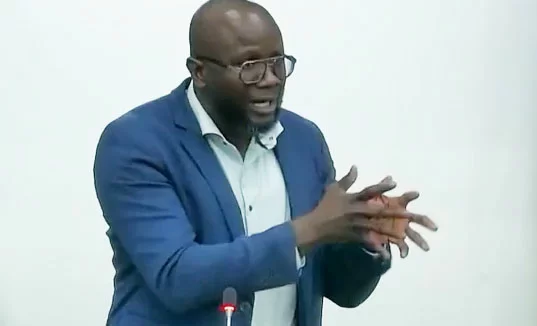
    NDP parliamentarian Ebu Jones first drew legislative attention to a series of stalled probes targeting senior officials across multiple public agencies, including the Ministry of Agriculture, Livestock and Fisheries (LVV), gold mining firm Grassalco, and the Ministry of Public Works. Jones specifically centered his query on the investigation into former LVV Minister Parmanand Sewdien, claiming that the dedicated police task force assembled to handle the case has already been disbanded. “I want clear answers on the exact status of these investigations, and why they have been halted mid-process,” Jones stated in his address to the assembly.

    Following Jones’ remarks, NPS lawmaker Ivanildo Plein raised a separate allegation related to NV Luchthavenbeheer, Suriname’s state-owned airport management company. According to unconfirmed information obtained by Plein, the government has unilaterally approved a 10-year contract extension for a senior executive at the firm, a decision he calls highly unusual given the company’s well-documented strained financial position. “If this report is accurate, this move is simply unjustifiable,” Plein said, calling on the administration to release a full public explanation of the deal.

    The unsubstantiated allegations quickly sparked debate among parliamentary leaders from across the political spectrum. VHP parliamentary group leader Asiskumar Gajadien pushed back against the claims, warning that serious public accusations are being brought forward in the national legislature without any supporting documentary evidence to back them up.

    NDP parliamentary leader Rabin Parmessar echoed Gajadien’s concerns, noting that the government must respond to the allegations before unconfirmed reports spread and gain unwarranted public credibility. At the same time, Parmessar emphasized that all assembly members have a responsibility to approach unvetted information with extreme caution. “When we do not have supporting documents to present, we should not be making these claims publicly,” he said, adding that any information must be fully verified before it is shared from the parliamentary floor. “I could bring up dozens of unconfirmed questions myself, but verification must come first before any public statement.”

    Vice President Gregory Rusland, responding on behalf of the administration, noted that the government was not prepared to deliver an immediate response to the questions raised during the incoming documents session. He confirmed that formal, detailed answers to all the queries will be provided at a scheduled future parliamentary sitting.

  • Escalatie van protesten in Bolivia: duizenden eisen aftreden president Paz

    Escalatie van protesten in Bolivia: duizenden eisen aftreden president Paz

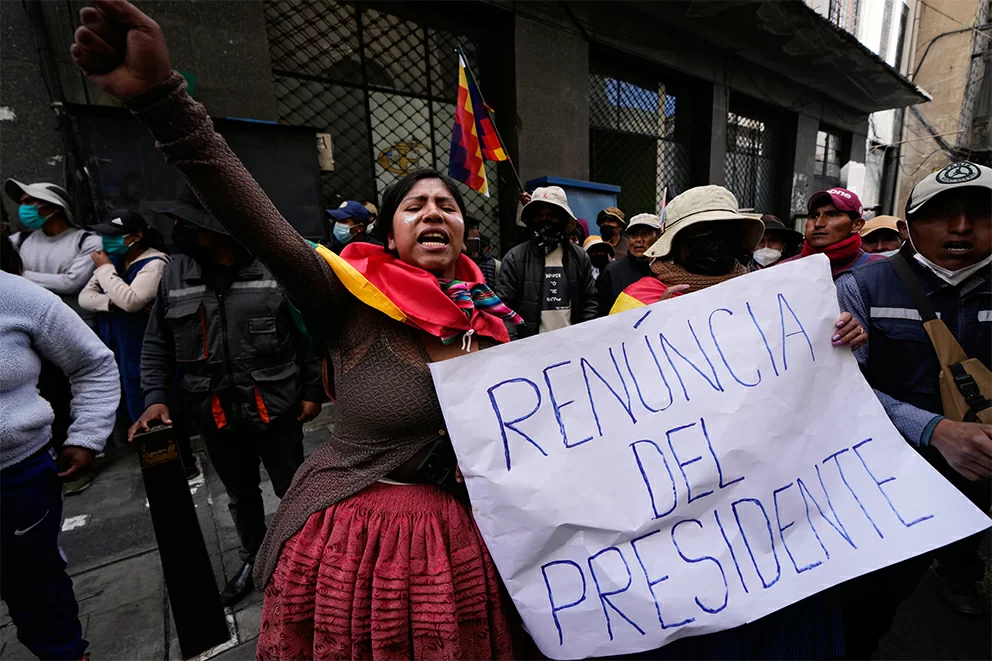
    Bolivia has been rocked by rapidly escalating mass anti-government demonstrations that have swept the nation in recent days, bringing the administrative capital La Paz to a near-standstill. Thousands of protesters drawn from across Bolivian society – including small-scale farmers, artisanal miners, teachers, public sector workers and Indigenous communities – have shut down key arterial routes surrounding the city, creating critical shortages of food, fuel and life-saving medications for local residents.

    The unrest first erupted weeks ago, targeting the administration of center-right President Rodrigo Paz, who took office less than six months ago, ending nearly two decades of continuous socialist rule in the South American nation. Demonstrators are demanding Paz’s immediate resignation, citing skyrocketing living costs, persistent widespread economic instability, and controversial plans to privatize state-owned enterprises as core grievances.

    Bolivia is currently grappling with its most severe economic crisis in four decades. Official data puts annual inflation at 14% as of April, a figure that has gutted household purchasing power and amplified public discontent across all income groups. For many protesters, the crisis has reached an unmanageable breaking point. “Paz is unfit to govern, and our country is spiraling into chaos,” said 60-year-old farmer Ivan Alarcon, who traveled 90 kilometers to join the demonstrations in La Paz.

    Artisanal small-scale miners, another key bloc of protesters, have marched through the city to demand expanded access to mining territories, escalating tensions in already volatile streets. Clashes have broken out between demonstrators and riot police in central La Paz, with tear gas deployed to disperse crowds attempting to reach the main city square, which houses major government administrative buildings. Protesters have thrown stones and homemade explosive devices, with at least two demonstrators confirmed injured. Local media reports more than 100 arrests have been made, and on-the-ground footage shows protesters entering government office buildings and removing property from the sites.

    A major flashpoint for the unrest was Paz’s recent decision to cut long-standing national fuel subsidies, a move his administration defended as necessary to reverse the depletion of the country’s foreign currency reserves. Far from stabilizing energy supplies, however, the policy triggered immediate fuel price hikes and worsened existing supply shortages, giving new momentum to the growing protest movement.

    The escalating political crisis has drawn international attention, with the United States formally weighing in on the unrest. U.S. Deputy Secretary of State Christopher Landau expressed deep concern following talks with President Paz, framing the mass demonstrations as an attempted coup partially funded by what he called an “unholy alliance between political actors and organized crime” in the region. Landau called for international support for Bolivia’s democratically elected government, warning that prolonged political instability would have damaging ripple effects across the entire South American region. He added that the U.S. is actively working to prevent anti-government and anti-institutional factions from seizing power.

    Amid the ongoing street violence and political uncertainty, multiple commercial banks across La Paz have temporarily suspended operations, closing their doors to the public out of caution for staff and customer safety.

  • Brunswijk zet strijd tegen bondsvoorzitter Hellings voort met hoger beroep

    Brunswijk zet strijd tegen bondsvoorzitter Hellings voort met hoger beroep

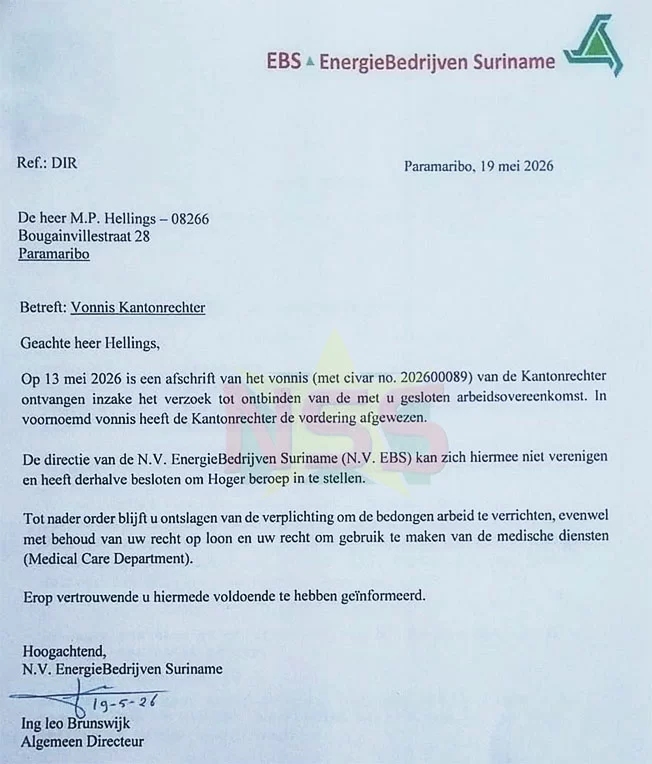
    A long-running high-profile labor conflict at Suriname’s state-owned energy utility Energiebedrijven Suriname (EBS) has entered a new phase, after EBS General Director Leo Brunswijk launched an appeal against a lower court ruling that favored Marciano Hellings, chair of the EBS employees’ union. The formal notice of appeal was officially served to Hellings on Tuesday, court documents confirm. In the notification, Brunswijk states that EBS leadership rejects the cantonal court’s earlier decision, which dismissed the utility’s request to terminate Hellings’ employment contract.

    Per the terms outlined in the appeal notice, Hellings will remain temporarily relieved of his work duties while retaining full access to his regular salary and all medical benefits through the duration of the appellate process. The contentious dispute between EBS executive leadership and the union chair first emerged in July of the previous year, and has since grown into one of the most widely discussed labor controversies at any state-owned enterprise in Suriname. Prior to the cantonal court’s ruling, EBS had already lost previous procedural challenges brought before the Labor Inspectorate, marking the second consecutive setback for the utility in the conflict.

    When contacted for comment by local outlet Starnieuws, Hellings responded calmly to the news of the appeal, saying he had fully anticipated the move from EBS leadership. “This doesn’t keep me up at night,” the union leader told reporters. He added that it had been clear for months that EBS intended to push the case to appellate court regardless of the lower court outcome.

    Hellings also echoed a observation the cantonal judge made in the initial ruling: the conflict has primarily been driven by a single individual within EBS’s executive leadership. The union chair expressed full confidence in the appellate process, saying he expects the lower court’s ruling will be upheld. “I am convinced that when this case is heard on appeal, we will get the same outcome,” he said.

    In additional comments, Hellings pointed out that the prolonged legal battle has already incurred substantial public costs, including fees for attorneys, court procedures and process servers. “The lawyer gets paid again, the process server gets paid, and all of that comes at the expense of state-owned NV EBS,” he noted.

  • DNA keurt in korte tijd twee belangrijke wetten van Justitie en Politie goed

    DNA keurt in korte tijd twee belangrijke wetten van Justitie en Politie goed

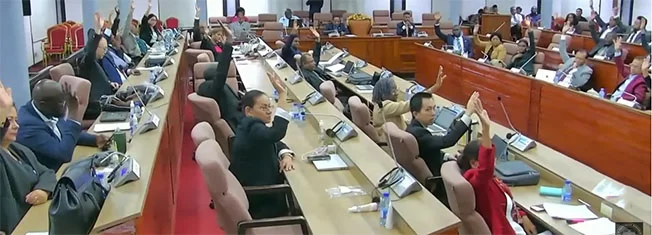
    On Tuesday, Suriname’s National Assembly (DNA) passed the amended Suriname Fire Service Bill with a unanimous 39-0 vote, marking the second major piece of legislation from the Ministry of Justice and Police to clear parliament in a single week. Just seven days prior, the Road Traffic Act also secured unanimous approval from the legislative body, signaling a productive stretch for the justice portfolio.

    Debate over the fire service law amendments included pointed scrutiny from assembly members, who raised detailed questions on core provisions ranging from expanded fire department authority and proactive fire prevention frameworks to cross-agency coordination with other emergency response units and fire safety standards for inland rural areas.

    Minister of Justice and Police Harish Monorath emphasized that the overarching goal of the revised legislation is to drive comprehensive modernization of Suriname’s fire corps and strengthen coordinated response across all emergency scenarios. Under the new law, greater institutional priority will be placed on proactive fire prevention, public fire safety education, and integrated collaboration between fire services, police, ambulance units and other relevant public agencies. Monorath also noted that the law establishes mandatory unified fire safety standards that will apply to all residential and commercial buildings, industrial operations, and public infrastructure across the country.

    A key topic of extensive discussion during plenary debate was the gap in fire coverage for remote inland communities that currently lack permanent fire stations. To address this gap, Monorath outlined that volunteer fire corps and partnerships with local community groups will form the core of the solution for underserved areas. He confirmed that the ministry has already held preliminary consultations with traditional community leaders to develop local frameworks for fire prevention and emergency response.

    Multiple assembly members stressed that while the amended law represents a critical first step forward, additional investment and institutional strengthening for the Suriname Fire Corps remains an urgent priority. Lawmakers noted that as Suriname’s rapidly expanding oil and gas sector drives national development, the fire service needs enhanced operational capacity and upgraded equipment to meet growing public safety demands. They also called for greater clarity on the role of district commissioners in unserved areas, pushed for alternative emergency response models for remote regions, and advocated for stricter routine fire safety inspections for existing buildings and private businesses.

    At the close of the debate, multiple assembly members including committee chair Dinotha Vorswijk urged the full chamber to support the legislation, framing the vote as a landmark milestone in building a more modern, professional, and responsive fire service for all Surinamese communities.

  • Studenten krijgen weer studiebeurzen voor Ghana

    Studenten krijgen weer studiebeurzen voor Ghana

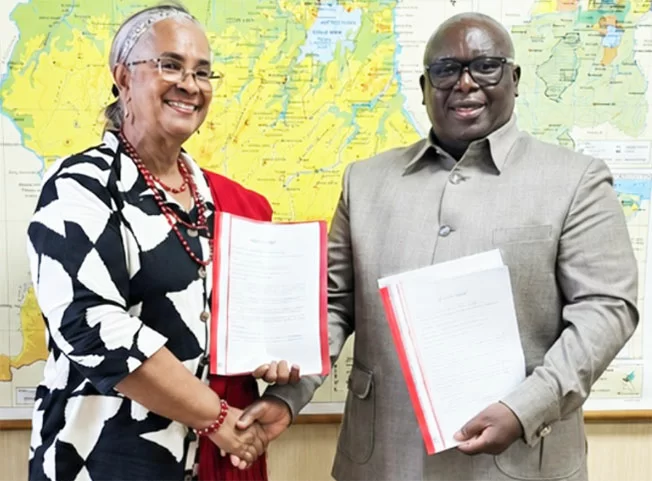
    A groundbreaking educational partnership has been established that will soon open new academic doors for Surinamese students seeking advanced technical training. The Anton de Kom University of Suriname (AdeKUS) has signed a memorandum of understanding with Ghana’s Kwame Nkrumah University of Science and Technology and the Otumfuo Osei Tutu II Foundation to launch a annual scholarship scheme for Surinamese learners.

    The collaborative initiative is designed to offer up to five scholarships each year to Surinamese students admitted to postgraduate programs at the Ghanaian institution. Priority for the awards will be given to candidates enrolling in high-demand technical fields critical to Suriname’s growing resource sector, including mining engineering, oil and gas technology, general engineering and other related technical disciplines.

    The initial signing of the non-binding intent agreement took place during an official working visit by a Ghanaian delegation to Suriname, with senior government representatives including Sergio Akiemboto, Chief of Staff to the President of Suriname, in attendance to mark the milestone. At present, AdeKUS confirms that the university is awaiting final formal signatures from its Ghanaian partners on the intent agreement. Once that step is completed, work will begin to draft and finalize a binding full partnership agreement that outlines the details of program administration, selection criteria and funding arrangements.

    Organizers are moving forward with an ambitious timeline, with plans to have the first cohort of scholarship recipients begin their academic programs in Ghana as early as this August. To streamline the process for selected students, planning teams are working alongside Suriname’s Ministry of Foreign Affairs, International Trade and Cooperation to work out logistical details, including visa processing, in-country student support, and preparation of required travel documentation.

    The partnership represents a deepening of educational cooperation between Suriname and Ghana, addressing a gap in advanced technical training opportunities for Surinamese students in sectors that form a core part of the country’s national economy.

  • Lezen & Lunchen: Waarom Toen de Val van Iraida Ooft je aan tafel krijgt

    Lezen & Lunchen: Waarom Toen de Val van Iraida Ooft je aan tafel krijgt

    There are two types of books one encounters in a lifetime: those you finish reading and set aside on a shelf never to revisit, and those that beg to be pulled out, set next to a plate and a glass on a shared table, and discussed at length by a group of people. During a recent lunch at a small Amsterdam café with close friend Guus Pengel and my father Carlo Jadnanansing, two men who do not just read literature, but live it, I discovered that Iraida Ooft’s *Toen de Val* falls firmly into the second, more memorable category. Around our table, it became immediately clear that this work is far more than a work of fiction: it is a full, immersive experience that demands conversation, reflection, and collective recognition.

    The story opens with loss, no slow buildup, no gentle foreshadowing – it hits readers abruptly, anchored to the 1989 Surinam Airways Flight PY764 crash that casts a long, quiet shadow over every character and their choices. For our small group, the novel pulled us sharply back to an era when distance was still a tangible thing, where breaking news did not ping into our pockets within seconds of a tragedy unfolding. As we set down our forks, we all found ourselves asking the same unplanned question: Where were you when the crash happened? That shared collective memory is what gives the novel its extraordinary power. The crash is not just a footnote in history; it is an emotional milestone for countless Surinamese people and Dutch residents of Surinamese descent, a moment everyone who lived through it still carries.

    What Ooft does exceptionally well is frame the crash as a metaphor for broader society itself. The downed plane becomes a microcosm of community, where grief, love, ancestral roots, and quiet hope collide and coexist. The author’s core insight is this: stories do not crash and burn alongside tragedy; instead, they take flight once loss is given space to be felt and acknowledged. *Toen de Val* lays bare how people find one another in the aftermath of disaster, showing how grief does not only break people apart – it can also bind them closer. As Pengel put it perfectly over our lunch that day: “This book shows that sorrow can bring people closer together.” That line lingered in our conversation long after we finished our meal.

    One of the novel’s strongest throughlines is the undercurrent of spirituality that runs through every chapter. The prophecies of the character Bisri, the quiet mysticism surrounding the jaguar, and the tonka tree that speaks Sranan Tongo lend the story an almost mythic weight, yet never once does this narrative choice feel forced or gimmicky. It feels as if this layered, spiritual world has always existed alongside the characters’ everyday lives. My father observed that worldly, material power pales in comparison to the strength of spiritual connection, and that theme resonates through every page of the novel. Indigenous spirituality is not reduced to a decorative folk trope here; it is portrayed as a living, breathing reality that guides the choices of the people at the heart of the story.

    The characters themselves stay with readers long after the final page, precisely because they are written as deeply, imperfectly human. Carlos chooses to build his life in Suriname, leaving his wife Tineke and their son behind in the Netherlands. Hanna and Theo drift apart as they process their shared grief, while Theo finds a deeper connection to himself through Hindu ritual. Marjorie navigates the challenge of raising her child in a world that does not always understand her identity or her experience. Even through all the pain they carry, each character keeps searching for meaning, connection, and peace. Their choices are often difficult and painful, but never shallow or unthinking. This leaves readers constantly aware of the quiet tension between individual desire and responsibility to family, culture, and homeland.

    At the same time, the novel paints an unflinchingly authentic portrait of 1980s Suriname: a time of widespread economic scarcity, hard-to-access foreign currency, and constant tension under military dictatorship. Ooft refuses to romanticize the country, presenting its struggles with unvarnished honesty. Yet there is still endless room for warmth and humor throughout. Surinamese culture has long held a tradition of spinning stories, or tori, that bring light even in the hardest times, and that warmth radiates through Ooft’s narrative. This careful balance between weight and lightness is what makes the story feel both credible and deeply moving.

    For me personally, the most moving element of the novel is its approach to death. Ooft does not frame death as a final ending, but as a transition to another form of existence. The spiritual world in this novel never feels frightening or menacing; instead, it is quiet, peaceful, and almost lyrical. The scenes where nature, spirits, and living people intersect are written with such vivid imagery that readers find themselves wanting to linger in that in-between space. The novel invites audiences to rethink their relationship to loss: it is not just a goodbye, but a form of continued existence in memory, nature, and spiritual connection.

    In the end, the 1989 plane crash becomes far more than a single historical event. It becomes a metaphor for society itself: different stories collide, fall apart, and ultimately coalesce into something new. The iconic instruction “PY 764 prepare for landing” remains heart-wrenching for readers, who know all too well what awaits the plane and its passengers. But the novel makes clear that knowing what happened is not the same as understanding its legacy. Sometimes, a fall can open the door to an entirely new way of seeing the world.

    That is what makes *Toen de Val* a book you do not just finish and pass along to a friend. It is a book you bring to the lunch table, to shared memories, to conversations about history, identity, and spirituality. It makes grief tangible for readers, and shows how storytelling can bind people across generations and experiences. That is precisely why this book belongs at the center of a shared meal: it was made to be shared.

  • Pompen bij Sabaku project en Indira Gandhiweg aanpak wateroverlast

    Pompen bij Sabaku project en Indira Gandhiweg aanpak wateroverlast

    Cross-border cooperation is delivering much-needed relief for flood-prone communities in Suriname, as two water pumps borrowed from neighboring Guyana are set to be deployed to tackle persistent flooding in two high-need areas.

    The newly arrived pumps, provided on a loan basis by Guyana, are designed to speed up the drainage of excess rainwater and surface water in regions that have long struggled with recurrent waterlogging, according to Suriname’s Ministry of Public Works and Spatial Planning (OWRO).

    Installation schedules are already in place: the first pump will go into place at the Sabaku Project site starting Wednesday, while the second unit will be installed along Indira Gandhiweg. This second pump will support drainage operations for the Rahemal development project and the residential neighborhoods surrounding the corridor.

    As construction teams prepare to install the new equipment, the ministry has issued a public advisory noting that temporary road closures and traffic disruptions are expected during the installation work. Motorists and local residents have been asked to plan ahead for the construction, adjust travel itineraries and use alternative routes when necessary to avoid delays.

    Beyond the immediate deployment of the borrowed pumps, OWRO confirmed that long-term, systemic solutions to address flooding across multiple regions of Suriname remain a top priority. The government will continue advancing structural interventions that build long-term resilience to chronic water overcapacity across vulnerable communities.

  • Onverwagt viert 145 jaar geschiedenis: Onze voorouders bouwden aan een toekomst

    Onverwagt viert 145 jaar geschiedenis: Onze voorouders bouwden aan een toekomst

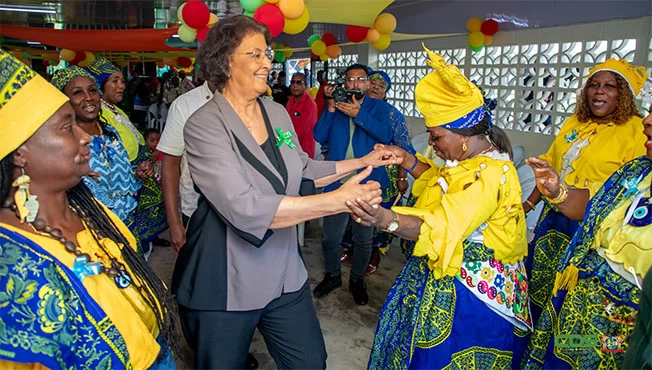
    On a reflective and celebratory Monday, Plantation Onverwagt in Suriname gathered residents and national leaders to mark 145 years since local community members secured ownership of the land, a milestone that came just years after the abolition of slavery across the region. The event blended lively music, shared personal memories, and intergenerational storytelling, centering two core goals: honoring the site’s complex history and charting a path forward to protect the community’s shared heritage and social cohesion for decades to come.

    Speaking at the celebration, Suriname President Jennifer Simons emphasized the critical urgency of documenting the unique history of the Para region and preserving the oral histories passed down by elder generations. She warned that without intentional efforts to transfer these collective memories to younger cohorts, large portions of the nation’s vulnerable cultural heritage risk fading into permanent loss.

    According to Suriname’s Communication Service, the 145th anniversary commemorates the 1881 purchase of the plantation by its residents, a transaction that took place shortly after chattel slavery was abolished in the region. Simons stressed that this historic act of self-determination offers a powerful example of how Suriname’s ancestors built a stable, hopeful future for their descendants even in the face of immense systemic hardship and displacement.

    “Our ancestors refused to remain trapped in the identity of victims. Instead, they came together to build a lasting community for the generations that would come after them,” the head of state told attendees. She used the occasion to make a major policy announcement: this coming August, Suriname will launch its first annual National Heritage Month, a nationwide initiative designed to draw greater public attention to the country’s diverse cultural heritage and advance the values of peaceful coexistence across all communities.

    Beyond the new heritage initiative, President Simons also raised urgent concerns about the long-term protection of collective land holdings tied to historic plantations like Onverwagt. She issued a call to action, urging local community leaders, academic and cultural heritage experts, and national government bodies to collaborate closely to develop sustainable solutions that will safeguard the collective land rights of these communities in perpetuity.

    Local community leader Clyde Vyent also reflected on the plantation’s enduring meaning for the people who call it home. He framed Onverwagt as a lasting national symbol of human dignity and resilience, noting that the 1881 land purchase by ancestors was a deliberate act designed to free future generations from economic dependence on outside actors. At the same time, Vyent acknowledged the persistent challenges the Onverwagt community still grapples with today, including high rates of unemployment, gaps in educational access, and outdated, inadequate public infrastructure. “Our goal is to leave behind a community that our children and grandchildren will be proud to call home,” he said.

  • Offerfeest dit jaar op woensdag 27 mei

    Offerfeest dit jaar op woensdag 27 mei

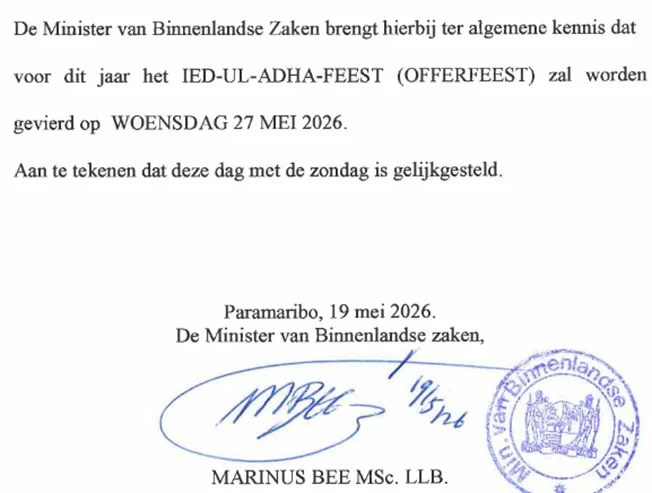
    Authorities in Suriname have formally confirmed the official date for this year’s observance of Eid al-Adha, known locally as Offerfeest, scheduling the major Islamic religious holiday for Wednesday, 27 May. The announcement came directly from the country’s Ministry of Internal Affairs, which has officially designated the holiday to hold the same legal status as a Sunday, granting it recognition as a nationwide public holiday for all residents.

    As one of the most sacred and widely celebrated religious observances in the Islamic faith, Eid al-Adha, also called the Feast of Sacrifice, centers on core themes of devout faith, willingness to sacrifice for one’s beliefs, communal unity and mutual solidarity. The holiday marks a key moment in Islamic tradition: it commemorates the prophet Ibrahim’s unwavering obedience to God, which saw him prepared to sacrifice his own son as an act of devotion. According to centuries-old Islamic lore, God ultimately accepted a sacrificial animal in the young man’s place, establishing the tradition of animal sacrifice that remains central to the celebration today.

    Across global Muslim communities, traditional observances of the holiday bring together worshippers for collective prayer services, held both in mosques and open-air prayer grounds across the world. A core pillar of the celebration is the value of sharing with others: after sacrifice, families customarily divide the meat between their own households, extended relatives, neighbors, and low-income community members who face economic hardship, ensuring that all can participate in the festive occasion.

    In Suriname, the Feast of Sacrifice holds deep cultural and social significance for the country’s large Muslim community, who mark the occasion annually with full traditional observances. This year’s designation as an official national public holiday will allow residents across the country to fully participate in long-standing customs, including communal prayer services, family gatherings and visits, and acts of charity that form the backbone of the celebration.