标签: Saint Vincent and the Grenadines

圣文森特和格林纳丁斯

  • NDP’s position same as 2009; Gonsalves’ has shifted — lawyer

    NDP’s position same as 2009; Gonsalves’ has shifted — lawyer

    A long-simmering constitutional debate over candidate eligibility for general elections in St. Vincent and the Grenadines (SVG) has entered a critical new phase, with the newly elected New Democratic Party (NDP) government moving to codify a clarification that directly contradicts a dramatic shift in position by former prime minister Ralph Gonsalves and his Unity Labour Party (ULP).

    The controversy traces back to the 2009 constitutional referendum, when Gonsalves, then serving as prime minister, openly acknowledged that SVG’s founding constitution allowed any Commonwealth citizen — not just native-born or naturalized Vincentians — to qualify as a candidate in national general elections. At the time, Gonsalves pushed voters to approve constitutional changes that would narrow that eligibility, a position the NDP, then the opposition, campaigned against vigorously. The referendum was soundly defeated, leaving the original Commonwealth citizen eligibility rule intact.

    Now, 16 years later, the political landscape has flipped dramatically. After Gonsalves’ 25-year incumbent ULP government was defeated in the November 2025 general election, the former leader has reversed his 2009 stance. He now claims Commonwealth nations qualify as “foreign powers”, and has challenged the eligibility of two top NDP officials — Prime Minister Godwin Friday, who has represented Northern Grenadines in Parliament since 2001, and Foreign Affairs Minister Dwight Fitzgerald Bramble, first elected as MP for East Kingstown in 2020 — on the grounds that both hold Canadian citizenship obtained through their own application. The ULP has filed two electoral petitions, which are scheduled to go to trial in June, asking the courts to remove the two officials from their parliamentary seats.

    In response to the legal challenge, the NDP, which won a 14-1 supermajority in Parliament after the 2025 election, has brought forward a constitutional amendment for a parliamentary vote scheduled for Tuesday. The amendment would formally add a definition of “foreign power” to the constitution’s interpretation section, explicitly stating that a foreign power is any state that is not a member of the Commonwealth. Because the change only affects the definition section, not an entrenched core provision of the constitution, no new public referendum is required to enact it, and the amendment is all but guaranteed to pass given the NDP’s overwhelming parliamentary control.

    Kay Bacchus-Baptiste, a prominent constitutional lawyer and former NDP senator, has defended the government’s move, framing it as a long-overdue clarification rather than a substantive rewrite of the nation’s supreme law. Speaking to iWitness News earlier this week, she noted that the 2009 referendum result, which defeated all proposed constitutional changes, confirmed that the Vincentian public intended to keep the original Commonwealth citizen eligibility rule in place. She pointed out that the original constitution’s definition section never explicitly defined the term “foreign power”, even as the core text clearly restricts eligible candidates to Commonwealth citizens.

    “‘Commonwealth citizen’ is a clear definition,” Bacchus-Baptiste said. “Canada is part of the Commonwealth. So, it is clear. The law says that you have to be a Commonwealth citizen, which is different from the constitutions of other Caribbean nations like Dominica and St. Kitts, which restrict candidates to their own citizens.”
    Bacchus-Baptiste emphasized that Gonsalves’ own words from 2009 confirm that the original interpretation has long been understood: back then, Gonsalves himself acknowledged that any Commonwealth citizen with one year of residence in SVG could run for office, and campaigned to change that rule. She called the current ULP argument a complete reversal of the party’s long-stated position.

    “In our law, it says a Commonwealth citizen. That alone is a massive distinction that would be difficult to get over. And I do agree that enough has been said, and it should be clarified, because even Dr. Gonsalves himself had said that a Commonwealth citizen can run; he had said it over and over and wanted to amend it. Now he’s changing his mind or pretending that that is not what the law says,” she said. “It says that, and I commend this government for clarifying it by simply including in the definition section something that was omitted. That is what they’re doing and I commend them.”

    Gonsalves and ULP spokespeople have pushed back against the amendment, accusing the NDP government of enacting an “insurance policy” to pre-emptively protect its officials from a potential unfavorable court ruling in the upcoming petitions. In an about-face from his position during the 2015 post-election legal challenges brought by the NDP, Gonsalves said in an April 15 interview with Star Radio that the courts should be allowed to issue an independent ruling on the eligibility petitions.

  • Leacock renews call for Taiwan’s help with constituency dev’t fund

    Leacock renews call for Taiwan’s help with constituency dev’t fund

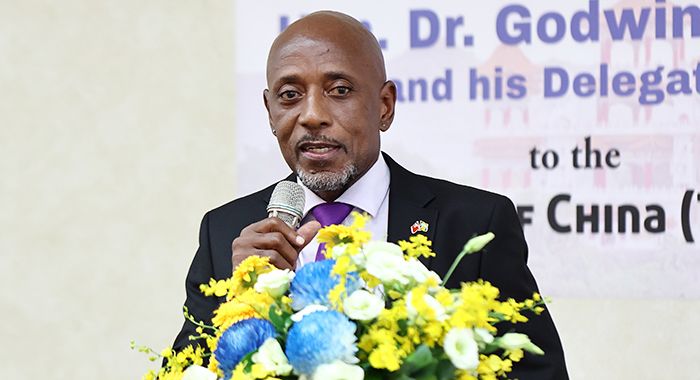
    As bilateral diplomatic ties between Taiwan and St. Vincent and the Grenadines mark their 45-year milestone, the Caribbean nation’s acting prime minister St. Clair Leacock has reaffirmed the long-standing partnership while publicly pushing for Taiwanese financial support for a new grassroots development program.

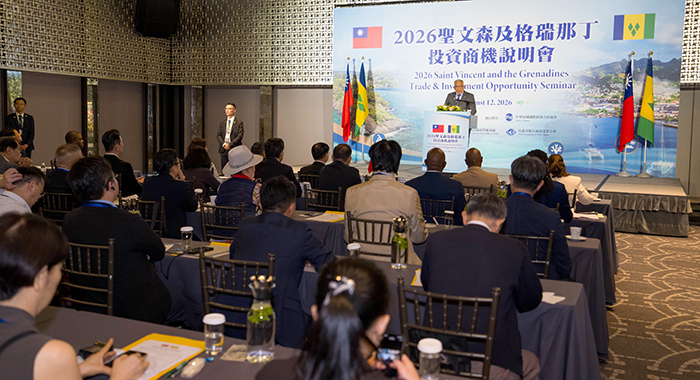
    Leacock made his remarks during celebrations that included a joint parade by a visiting Taiwanese naval squadron and the Royal St. Vincent and the Grenadines Police Force, held in Arnos Vale. Speaking directly to Taiwanese President Lai Ching-te, Leacock referenced a private conversation the two held during his official visit to Taipei earlier this year – the first cabinet-level visit from St. Vincent and the Grenadines since the New Democratic Party won national elections in November 2025, when Leacock led a four-member delegation to the island.

    Opening his address, Leacock praised the four-and-a-half decades of collaboration between the two sides, noting that geographic distance has never weakened their close friendship, in line with the proverb that distance never separates true family and friends. Over the years, Taiwan has contributed to key infrastructure projects including bridges, roads and hospitals in St. Vincent and the Grenadines, and provided agricultural support and educational scholarships for local students.

    However, Leacock stressed that significant development challenges remain for the small Caribbean nation. Acknowledging that widespread poverty persists across the country, he argued that existing assistance has not fully addressed grassroots economic needs. For nearly 20 years, Leacock – who also serves as the Member of Parliament for Central Kingstown – has championed the creation of a national constituency development fund, which would give elected representatives direct resources to address local needs and create sustained job opportunities for their constituents.

    He explained that the most frequent request he receives from local residents is for greater economic autonomy and more work opportunities, rather than relying on ad-hoc political assistance. The constituency development fund, he argues, would empower local representatives to deliver sustained support directly to communities, putting financial resources directly into the hands of constituents to reduce poverty and drive local growth. Leacock said he remains confident that Taiwan will agree to contribute to the new fund, repeating his appeal to President Lai three times to provide the urgently needed financing to help St. Vincent and the Grenadines achieve its national development goals.

    Leacock also added that the government of St. Vincent and the Grenadines remains deeply grateful for Taiwan’s long-standing support, noting that many Vincentian students who have taken up Taiwanese scholarships have chosen to build their careers in Taiwan, while the government hopes that expanded opportunities at home will encourage more graduates to return and contribute to national development.

  • VIDEO: Grieving mother on murder charge arrives in court

    VIDEO: Grieving mother on murder charge arrives in court

    A 46-year-old Layou security guard, grieving the fatal shooting of her son just seven days prior, has made her first court appearance alongside a 22-year-old local man, after the pair were hit with conspiracy and murder charges over the death of a 19-year-old labourer.

    Rosia John and Augustus Mathews, a Layou resident, face two formal criminal allegations connected to the killing of Perrance Mathews, a 19-year-old Layou-based labourer. Court documents outline that between April 10 and April 13, 2026, the two defendants conspired to carry out a plan that would have culminated in a murder. The second, more severe charge accuses them of intentionally and maliciously causing Perrance Mathews’ death by shooting him multiple times across his body.

    Authorities confirm the alleged crimes took place in Buccament, a coastal community in St. Vincent and the Grenadines. On Friday, April 17, 2026, John and Mathews appeared at Kingstown’s Serious Offences Court for the formal reading of their charges, an event that was captured on video by local media.

    The court appearance comes exactly one week after a double shooting in Kingstown’s Stoney Ground neighbourhood that claimed the life of John’s 29-year-old son, Enrique John, also known locally by the nickname Shoubu. Raheem Guy, 22, was also killed in that same April 10, 2026 attack. The overlapping timeline of the two violent incidents — the double killing that left Rosia John bereaved, followed just days later by her being charged in the murder of 19-year-old Perrance Mathews — has cast a spotlight on the surge of violent gun crime impacting the small Caribbean nation.

  • Top cop confirms link between Stoney Ground, Buccament killings

    Top cop confirms link between Stoney Ground, Buccament killings

    A wave of brazen, daylight gun violence that left three people dead across two communities in St. Vincent and the Grenadines has pushed the nation’s top law enforcement official to launch a full-scale operational crackdown on organized criminal activity, confirming a clear connection between the two separate shooting incidents that shocked the country over the weekend.

    Police Commissioner Enville Williams made the confirmation and announced the offensive in an official public address shared across social media channels, framing the brutal killings as a defining moment for the small Caribbean nation. In his address, Williams emphasized that the recent violence is far more than a routine law enforcement challenge—it is a direct attack on the country’s core values of peace and public safety.

    The string of violence began on the afternoon of April 10, when two men—29-year-old Enrique John, widely known by his alias Shoubu, and 22-year-old Raheem Guy, identified by sources as a close associate of John—were gunned down in the Stoney Ground neighborhood. John was killed inside a retail store at the local Russells Shopping Centre, a busy commercial hub, while Guy was fatally shot on the public sidewalk just outside the Caribbean Medical Imaging Centre, just steps away from the first shooting scene.

    Hours later, on Saturday, the body of 19-year-old Perrance Matthews, a relative of John from the Layou community, was discovered along the river defense embankment in Buccament Bay. Autopsy preliminary findings confirmed he died from multiple gunshot wounds to the head and chest. One additional person was wounded in the related violence, Williams confirmed.

    In the wake of the three deaths, Williams said the nation has reached an unavoidable crossroads: “There are moments in the life of a nation that demand more than mere observation, that demand a reckoning. Today, we stand at such a crossroad.”

    Calling the open violence “a direct assault on the peace, the dignity and the very soul of this country,” Williams said the public’s growing fear—sparked by the question of whether it is even safe to walk outside in their own communities—demanded a decisive response. “This is where we draw the line, and we’ll bring everything we’ve got to the fight,” he stated.

    The commissioner announced that the entire constabulary would shift from routine patrol to an absolute operational offensive against criminal networks. “We are focusing every lawful resource on this, and from here forward, our actions will speak louder than any words. We will be mobilising the machinery of the state to hunt down those who believe they can act without consequence,” Williams said.

    He issued a direct warning to both the perpetrators of the violence and anyone who aids them, saying: “To the criminal elements who believe they can transform the society into private hunting grounds, your arrogance is your undoing. Anyone who provides a roof, a vehicle or a wall of silence for these killers, you are not bystanders. You are accomplices to the destruction of your own country.”

    Williams added that law enforcement will dismantle the entire criminal infrastructure supporting the gun violence, using the full force of the law to target every person involved. He described the pattern of gun-related lawlessness as a dangerous cancer that must be stopped before it spreads to every town and village across the country, noting that national safety depends on the courage of everyday citizens.

    Acknowledging that the public’s anger and anxiety over the violence are completely justified, Williams called on residents to break their silence and share any information they have with authorities. “If you possess a single fragment of information, a name, a sighting, a whispered plan, bring it forward. Do not let misplaced loyalty become the solder under which more of our sons and daughters are buried,” he urged, warning against private retribution.

    “Vigilantism is not justice. It is the fuel that feeds the fire. Let the law be your shield and the police your sword,” he said. Williams also asked the public for patience in the coming days as the expanded operation unfolds, noting that all actions are being taken to protect the public good.

    To make it easier for residents to submit tips, the country’s Criminal Investigations Department and major crime units have posted dedicated hotlines—456-1801 and 457-1211—for anonymous tips. In the coming days, authorities will also launch a new QR code system that will allow residents to share information securely and freely, with all identities protected under the strictest confidentiality protocols.

    “This is the hour for our national resolve. This will not be defined by the violence of a few, but by the unity of many,” Williams said. “We will reclaim our streets, we will restore our peace, and we will ensure St. Vincent and the Grenadines remains a land where law and order are absolute.”

    As of the latest update, authorities have already made two arrests in connection with Perrance Matthews’ death. Rosia John, Enrique John’s mother, and 19-year-old Augustas Matthews, another Layou resident, have been charged with murder and conspiracy to murder. Rosia John additionally faces charges of cocaine possession and drug trafficking. Both suspects are scheduled to make their first court appearance later this Friday.

  • ‘We do not take this friendship for granted,’ Taiwan tells SVG

    ‘We do not take this friendship for granted,’ Taiwan tells SVG

    As the 45th anniversary of official diplomatic relations between St. Vincent and the Grenadines (SVG) and Taiwan approaches on August 15, senior diplomatic representatives from Taiwan have emphasized that the island nation deeply values its long-standing alliance with the Caribbean state, stating that the friendship is not taken for granted.

    The milestone commemoration took center stage on Wednesday at a public event in Arnos Vale, where a joint ceremonial parade was held by the 2026 Midshipmen Cruising and Training Squadron of Taiwan’s Navy and the Royal St. Vincent and the Grenadines Police Force.

    Addressing attendees at the gathering, Fiona Fan, Taiwan’s top envoy to Kingstown, framed the anniversary not as a mere formal commemoration, but as a celebration of a deep, unbreakable connection built over four and a half decades through reciprocal sincerity, mutually beneficial collaboration, and consistent mutual respect between the two sides.

    Fan highlighted the symbolic weight of the Taiwanese Navy squadron’s 50-day transoceanic journey, which took the vessel across the West Pacific Ocean and through the Caribbean Sea to reach SVG. She described the voyage as a tangible demonstration of courage, unwavering commitment, and steadfast resolve, adding that for Taiwan, the journey underscores a core conviction: peace is not a passive, guaranteed state. Instead, it must be actively protected, preserved, and reinforced through collective resilience and a commitment to global responsibility.

    Positioning Taiwan as a responsible actor in the international community, Fan asserted that the island remains a consistent force for positive global good, dedicated to advancing peace, stability, and widespread prosperity across the Indo-Pacific region and beyond. She noted that the 45-year partnership has evolved far beyond standard diplomatic engagement, delivering tangible, transformative development outcomes for SVG over the decades. These outcomes include key national infrastructure projects that Taiwan has supported through donations and concessional loans, such as the Argyle International Airport, the Rabacca Bridge, the country’s national library, and the ongoing expansion of the Arnos Vale acute care hospital.

    Looking ahead to the next chapter of bilateral cooperation, Fan shared that the two sides are set to explore new collaborative frontiers, including advances in smart agriculture, expanded access to improved healthcare, tech-driven innovation, targeted programming for youth and women’s empowerment, and the development of sustainable, community-centered tourism. Fan outlined Taiwan’s core vision for the partnership: a future where ongoing joint work continues to lift living standards and strengthen local communities across both nations.

    Amid widespread global geopolitical uncertainty, Fan noted that the enduring bilateral partnership sends a powerful message that resonates far beyond the borders of SVG and Taiwan. She extended sincere gratitude on behalf of Taiwan’s government and people to SVG for its long-standing, unwavering support for Taiwan’s meaningful participation in key international organizations, including the United Nations, the World Health Organization, and Interpol. Reaffirming the value Taiwan places on the alliance, Fan stated: “We do not take this friendship for granted. We honour it, we cherish it, and we remain committed to being a reliable partner, sharing knowledge, contributing expertise and working hand in hand for global well-being.” She closed her remarks by expressing hope that the friendship will continue to stand as a beacon of hope, a symbol of shared resilience, and a promise of a brighter shared future for the people of both nations.

    Speaking at the same event, Rear Admiral Ming-feng Chen, commander of the Taiwanese Navy training squadron, echoed these sentiments, noting that the joint military parade serves a dual purpose. Beyond showcasing the discipline, precision, and capability of both participating forces, the event is first and foremost a celebration of 45 years of deep friendship between two nations separated by thousands of miles of ocean but united by shared commitments to the values of freedom and democracy. Chen added that the joint performance by the Taiwanese Navy military band and the SVG police force band further highlights the deep harmony and shared alignment between the two countries. He concluded by thanking the government and people of SVG for their warm hospitality extended to the squadron during its visit, and offered a toast to the enduring, unshakable bond between the two nations.

  • Murder victim’s mother charged with murder, other crimes

    Murder victim’s mother charged with murder, other crimes

    A shocking development has emerged in a string of connected gang-related killings across St. Vincent and the Grenadines: the mother of one of two men gunned down in a public shooting spree last week has been arrested and charged with murder and conspiracy to commit murder in the death of a 19-year-old found dead in Buccament Bay over the weekend.

    Rosia John, whose 29-year-old son Enrique John — also known by the alias Shoubu — was killed in a two-minute shooting rampage in Stony Ground this past Friday, will appear before the Serious Offences Court this coming Friday to face her charges. She is accused alongside 19-year-old Augustas Matthews, also a resident of Layou, in the fatal shooting of Perrance Matthews, 19, whose body was recovered along Buccament Bay’s river defence with multiple gunshot wounds to the head and chest.

    In addition to the violent conspiracy and murder charges, John also faces separate counts of cocaine possession and drug trafficking. Local law enforcement rules in St. Vincent and the Grenadines prohibit bail for individuals accused of murder until a nine-month period has elapsed following arraignment, a restriction that means John will almost certainly be denied temporary release and will miss the opportunity to arrange or attend the funeral of her only child.

    This is not the first time John has made headlines for involvement with the criminal justice system. Nine years prior, police were forced to restrain her outside the Kingstown Magistrate’s Court after she attempted to instruct her son to hide his face as he was led away following an arraignment on statutory rape charges. The victim in that 2015 case was a minor between the ages of 13 and 15. John was a regular presence in court for her son throughout a string of subsequent criminal hearings, and multiple charges against him remained unresolved at the time of his death.

    Enrique John was not the only fatality in last Friday’s Stony Ground violence: his close associate 22-year-old Raheem Guy was also shot and killed on the sidewalk outside the Caribbean Medical Imaging Centre, while John died inside a shop at the Russells Shopping Centre. The spree marked the start of a deadly 24 hours that ended with the discovery of Perrance Matthews’ body in Buccament Bay the next day.

    Local authorities and community observers have linked all three killings to long-running gang warfare across the country. The conflict pits an alliance of factions from Central Kingstown and their Layou-based associates against a rival gang based in West Kingstown. Perrance Matthews, who went by the alias “Suspect”, was reportedly a former member of one of the involved groups who had left the faction and was in the process of attempting to rejoin at the time of his death. At the time of his own killing, Enrique John was still awaiting the verdict on two outstanding attempted murder charges against him.

  • Ralph, Camillo, ‘ULP bigwigs’ lack ‘moral authority’ on constitutional issues

    Ralph, Camillo, ‘ULP bigwigs’ lack ‘moral authority’ on constitutional issues

    A longstanding political and legal figure in St. Vincent and the Grenadines has delivered a blistering rebuke to top leaders of the opposition Unity Labour Party (ULP), arguing they have forfeited any moral standing to condemn the current government’s planned constitutional amendments over ongoing election legal challenges.

    Jomo Thomas, a former Speaker of the House of Assembly, practicing lawyer, journalist, and one-time New Democratic Party (NDP) electoral candidate, laid out his case in an interview with iWitness News on Wednesday, calling out ULP Opposition Leader Ralph Gonsalves, his son and former ULP Finance Minister Camillo Gonsalves, and other senior ULP figures for their recent sanctimonious rhetoric about constitutional respect.

    The current dispute traces back to last November’s general election, when after two decades in power under Ralph Gonsalves, the ULP was decisively voted out of office by the electorate. The ruling NDP, now led by Prime Minister Godwin Friday, took office, but the ULP has since filed two high-stakes election petitions challenging the legitimacy of Friday’s win in Northern Grenadines and Finance Minister Dwight Fitzgerald Bramble’s victory in East Kingstown. The ULP argues the pair were ineligible to run for office because they hold Canadian citizenship, a fact that has been public since before they first stood for election.

    In response to the pending challenge, scheduled for trial in June, the NDP government has proposed a constitutional amendment to clarify the legal definition of “foreign power” to resolve eligibility questions. The ULP has decried this move as an unconstitutional power grab to protect the sitting government, framing the change as a threat to St. Vincent and the Grenadines’ founding governing document. Thomas, however, says this outrage rings hollow given the ULP’s own long history of disregarding constitutional norms when it held power.

    Thomas points to a 2015 parallel that exposes the ULP leadership’s hypocrisy. After that year’s election, the NDP filed its own election petitions challenging ULP seat wins, and when the courts agreed to hear the case, Ralph Gonsalves, who was still prime minister at the time, publicly dismissed the court’s role in determining election outcomes. In 2017 comments that still stand on record, Gonsalves argued that only voters, not judges, get to decide who represents the public, saying “The courthouse doesn’t determine who represents you… Judges do not decide who are your representatives.” Now, Thomas notes, Gonsalves is insisting the court must be the final arbiter a direct contradiction of his own previous stance.

    Beyond this flip-flop, Thomas details a series of past actions by the Gonsalves-led ULP administration that he says amount to direct assaults on the constitution. He cites the Public Administration Act, which Ralph Gonsalves championed and Camillo Gonsalves supported, a law that Thomas argues improperly stripped the independent Public Service Commission of its constitutional authority over public sector hiring. Thomas’s own legal chambers have won multiple court rulings that found the ULP administration violated the constitution during its time in office. He also points to violations of the Finance Act related to unregulated special warrants, documented in a 2020 article he wrote, as well as the ULP’s maneuvering to block an NDP no-confidence motion when the party held a narrow 8-7 parliamentary majority.

    Thomas acknowledges that he, as speaker at the time, allowed the ULP’s procedural gambit to block the no-confidence debate, but says he was pressured into the decision by Camillo Gonsalves, who argued that standing orders allowed the amendment to kill the motion. Thomas now says that was a mistake: standing orders are subsidiary legislation that cannot override the constitutional requirement to hold votes on no-confidence motions, a fact the ULP leadership knew full well when they pushed the maneuver through to protect their government.

    While Thomas rejects the ULP’s moral authority to comment on constitutional respect, he does not fully back the NDP’s planned amendment either. He agrees with the ULP’s top leadership’s prediction that the court will throw out their election petitions, and says the NDP’s push to amend the constitution ahead of the June trial signals unnecessary insecurity about the legal case. Thomas confirms that the government only needs a two-thirds parliamentary majority to pass the amendment, but argues that moving forward with the change is unnecessary, even as it remains within the government’s power to do so.

  • From Washington, focused on home

    From Washington, focused on home

    From the corridors of Washington D.C., where global financial leaders have gathered for the annual World Bank Spring Meetings, Prime Minister of St. Vincent and the Grenadines (SVG), the Honourable Dr. Godwin Friday, has laid out his administration’s core priorities: delivering tangible progress to the people of SVG, expanding high-quality, well-paying employment, reducing the crippling national debt to unlock domestic investment, and ensuring that policy gains directly translate into higher incomes for ordinary citizens.

    Accompanying Friday on this trip are Foreign Minister Bramble and a cohort of senior government officials, who have joined multilateral discussions focused on small island developing states. The Prime Minister emphasized that across the entire Caribbean region, robust employment is the foundation of national resilience. During the 2023 general election campaign, his administration made a clear promise: people will always take precedence over prestige projects. Every government initiative, he says, is rooted in the single objective of improving living standards for all Vincentians.

    For small island economies like SVG, Friday explained, employment is far more than a source of household income—it is the backbone of social stability, post-shock economic recovery, and long-term public and private sector confidence. This year’s Spring Meetings theme, “Building Prosperity Through Policy,” aligns closely with SVG’s domestic agenda: for small vulnerable states, consistent, predictable policy acts as critical economic infrastructure, enabling the government to build the physical and social systems needed to serve citizens. Friday acknowledged that his government inherited a severe economic crisis from the previous administration, but confirmed that targeted corrective measures are already underway to reverse the downturn and put the country on a sustainable path forward.

    This year’s Washington meetings are taking place against a backdrop of heightened global uncertainty, with the spillover effects of ongoing conflicts in Ukraine and the Middle East rippling through global markets and small economies alike. Friday noted that all nations have a shared responsibility to mitigate the impact of these shocks on vulnerable populations. A central focus of his delegation’s work this week has been advancing efforts to address the unsustainable debt burden accumulated by the previous SVG government. Reducing this debt, he argues, will free up critical fiscal space to invest in domestic social and economic programs, unlock the untapped potential of individual Vincentians and local businesses, drive job growth, raise living standards, and address the deep-seated social challenges the country faces.

    No nation can tackle these challenges alone, the Prime Minister stressed. SVG remains fully committed to deepening collaboration with regional and international partners, including the Caribbean Community (CARICOM), the Organisation of Eastern Caribbean States (OECS), the Washington-based multilateral development agencies, and longstanding international partners like Taiwan. This week, a joint ceremonial drill between the Taiwanese Navy honor guard and the Royal Saint Vincent and the Grenadines Police Force is set to take place, a public demonstration of the strength of the bilateral relationship. Though Friday regrets he cannot be present for the event in SVG, he says it embodies the core mission of his trip to Washington: working with all willing partners to advance national development.

    Friday says there is abundant reason for cautious optimism across the Caribbean. The region shares a unified sense of purpose and a growing recognition that collective action is the most effective path to improving lives across all island nations. He offered a metaphor to capture this collective potential: during the Christmas yachting season, SVG’s coastal waters are dotted with the lights of visiting vessels, turning the bay into a glowing sight reminiscent of a Christmas tree. This scene, he noted, is a reminder that the Caribbean’s natural and cultural assets are a shared regional resource, and that instead of competing for investment and tourism, islands should pursue complementary diversification that lifts all regional economies.

    If governments, local populations, and international development partners remain aligned and united, Friday concluded, sound policy will indeed translate into shared prosperity. This prosperity will be measured not just by gross domestic product growth, but by the creation of more jobs, expanded dignity and opportunity for all Caribbean people.

    This op-ed reflects the personal views of the author, and does not necessarily represent the editorial position of iWitness News. The outlet accepts opinion article submissions via email.

  • NDP gov’t ‘unnecessarily burning political capital’ – Jomo

    NDP gov’t ‘unnecessarily burning political capital’ – Jomo

    A prominent Saint Vincent and the Grenadines political figure has launched a sharp rebuke of the incumbent New Democratic Party (NDP) administration’s sudden push to amend the national constitution, arguing the last-minute change is a self-interested move to shield two top ruling party lawmakers from ongoing election challenges rather than a genuine effort at legislative reform.

    Jomo Thomas, a former House of Assembly speaker, trained lawyer, veteran journalist and longtime political commentator who once ran as a Unity Labour Party (ULP) candidate before splitting from the opposition in 2019, shared his critical assessment in an exclusive interview with iWitness News. Thomas, who stepped down from the speaker’s post in early 2020, made clear that despite his break with the ULP, he remains convinced the opposition’s election petitions challenging Prime Minister Godwin Friday and Foreign Minister Fitzgerald Bramble will ultimately fail in court. That, he argues, makes the government’s hasty amendment push all the more unnecessary.

    The controversy stems from two separate election petitions filed by the ULP’s unsuccessful 2025 general election candidates Carlos Williams and Luke Browne. Williams ran in Northern Grenadines, while Browne contested the East Kingstown seat; both challengers failed to unseat Friday and Bramble, who secured their sixth consecutive and second five-year terms respectively, with the ULP having never won either constituency. The petitions center on the fact that Friday and Bramble hold dual Saint Vincentian and Canadian citizenship, a status that opponents argue violates eligibility requirements for parliamentary office.

    After the Order Paper for next Tuesday’s parliamentary sitting was distributed to lawmakers earlier this week, opposition leader Ralph Gonsalves first accused the NDP of rushing the constitutional change to protect its two top officials. Thomas has echoed that critique, going further to argue that the amendment reveals a hidden lack of confidence in the government’s own legal case, despite Friday’s public dismissal of the petitions as “frivolous” after the first court hearing.

    Thomas pointed out that the constitutional section targeted for change is not an entrenched provision, meaning it does not require a two-thirds parliamentary majority or a public referendum to revise. With the NDP holding a dominant 14-1 majority in the 15-seat parliament, the amendment can be passed with a simple majority vote. He noted that if the NDP’s goal was actually to modernize dual citizenship rules for all elected office — a legitimate policy objective — the government could have crafted a broad, forward-looking reform that would allow any native-born Vincentian to run for parliament regardless of what foreign citizenship they hold.

    Instead, Thomas argues the amendment is narrowly tailored to provide short-term protection specifically for Friday and Bramble. “This is not broad, inclusive reform — this is an insurance policy for two of the NDP’s most senior leaders,” Thomas explained. “If the government truly believed their legal position was solid, why would they need to change the law retroactively to insulate themselves from a court ruling? This move makes it look like they don’t actually believe their own claims that the case is frivolous.”

    The former speaker also raised red flags over the proposed change’s retroactive scope, which would apply back to SVG’s independence in 1979, a provision he calls deeply troubling and unnecessary. “Constitutional changes should lay the groundwork for the future, not rewrite the rules of the past to benefit sitting officials,” he said. “I am convinced Friday and Bramble would prevail if the case is decided on its legal merits under the existing constitution. The uniqueness of our constitutional framework means the opposition’s cited precedents from St. Kitts and Nevis, Jamaica, and Australia simply do not apply here. Letting the court issue a ruling would permanently settle all the ongoing debate about dual citizenship eligibility for high office, which is exactly what we need.”

    Thomas also questioned the justification for Friday retaining his Canadian citizenship while serving as prime minister, arguing claims that the status is needed for future health and social security benefits ring hollow. “Former prime ministers in this country already have full access to taxpayer-funded top-tier health care, a benefit that past leaders including Arnhim Eustace and James Mitchell have already used,” he noted. “There is no justifiable reason for a sitting head of government to maintain citizenship in another country, and the public has a right to ask why this is such a priority for the prime minister.”

    Beyond the substance of the change, Thomas criticized the NDP’s process for pushing the amendment through parliament. Reports indicate the government plans to complete all three readings of the bill in a single sitting, cutting off any opportunity for meaningful public input or robust legislative debate. “Changing your country’s constitution is one of the most consequential actions a parliament can take, and doing it in a single day without public discussion does a disservice to democratic governance,” Thomas added.

  • Opposition ‘ramping up’ actions against gov’t

    Opposition ‘ramping up’ actions against gov’t

    Four months after the New Democratic Party (NDP) swept the Unity Labour Party (ULP) out of power after 25 years in government, the newly-minted opposition is preparing to escalate its political pushback against the ruling administration, according to opposition leader and former prime minister Ralph Gonsalves.

    Gonsalves, who retained his own parliamentary seat in the November 2024 election as the sole ULP representative to win office, laid out the case for intensified opposition action during an appearance on his party’s owned broadcaster Star Radio Monday. The opposition leader highlighted three core areas of alleged mismanagement by the new government that are driving its planned escalation: widespread dismissals of public sector and allied workers, irregular payment of salaries and benefits to multiple groups of workers, and controversial actions related to state land transactions.

    Among the land disputes Gonsalves cited was a case involving a female buyer who entered into a land purchase agreement with the previous ULP administration and submitted an initial down payment in October 2024, just weeks before the election. Since the NDP took office, the buyer has been blocked from making any further installment payments on the property, effectively freezing the transaction. Gonsalves said he intends to coordinate with Saboto Caesar, the former ULP lands minister and an attorney by training, to pursue legal redress for aggrieved parties like this buyer, noting that binding contracts are being disregarded by the new government.

    “NDP is pushing forward policies that harm working-class and low-income people, from freezing land purchases to holding back paychecks,” Gonsalves said, criticizing the government’s slow response to emerging national issues. He specifically called out the administration’s delayed reaction to market disruptions linked to the Iran conflict, noting it took more than a month for officials to announce any policy response—an action that ultimately only amounted to creating a new task force rather than implementing immediate solutions.

    The NDP government has formally established a task force to address the outstanding salary and economic issues raised by the opposition, with the group scheduled to deliver its preliminary recommendations to Prime Minister Godwin Friday’s cabinet on April 24. Friday has so far declined to publicly comment on potential policy changes, stating that he does not wish to prejudge the task force’s findings. Gonsalves dismissed this approach as a classic delaying tactic, arguing that after four months in office, the NDP administration has failed to deliver any meaningful action on key domestic challenges including rising consumer prices, worker payment issues, and land rights.

    “There is little to no forward momentum in the country right now,” Gonsalves said. “After four months, all we have is firings, unresolved land disputes, late and missing paychecks, and zero action on the cost of living. This government is just kicking the can down the road and hoping problems disappear on their own.”

    To counter what the opposition calls ongoing governmental mismanagement, Gonsalves confirmed that the ULP will ramp up public and political pressure, and pursue legal action in court to resolve disputes over land and contractual agreements reached under the previous administration.