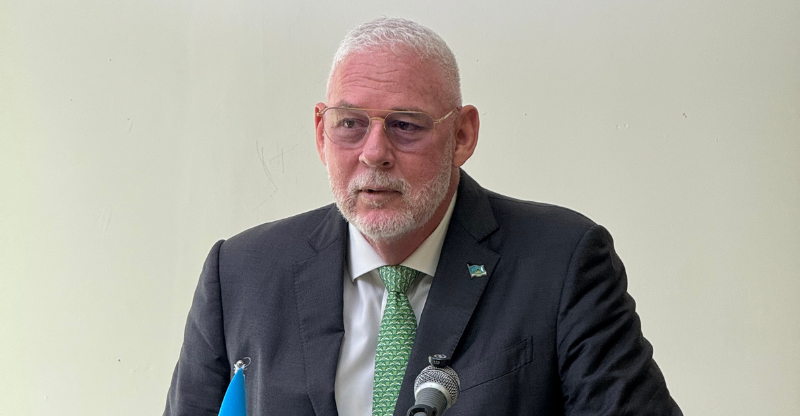
Six months ago, following a disappointing defeat in the most recent general election, Allen Chastanet, leader of Saint Lucia’s United Workers Party (UWP), announced the party would launch a comprehensive internal performance review, with the entire process expected to wrap up within half a year. As that deadline draws near, the review is still ongoing, and the party has not yet announced a firm date for its leadership convention, leaving supporters waiting for clarity on the opposition party’s future direction. Critics have suggested the extended timeline is a sign of internal stagnation, but Chastanet pushed back against that narrative during a press briefing held Tuesday, insisting that meaningful work is advancing behind closed doors. The core sticking point that has slowed progress, he explained, is a fundamental strategic debate dividing party stakeholders: should the UWP first resolve the structural and operational weaknesses uncovered by the internal review, or hold its long-awaited convention first and roll out reforms after new leadership is confirmed? During the briefing, Chastanet openly acknowledged that the party’s internal structures have clear flaws that demand attention. “There are clearly things within the party that we need to look at,” he told reporters from the St. Lucia Times, adding that meaningful organizational change requires widespread consensus from party members to succeed. “You need to get buy-in to what that change is going to be. And that’s what the party’s process is right now. Change within any organisation can be difficult.” When Chastanet first announced the review back in March, he explicitly stated that the convention would ultimately formalize the party’s leadership going forward, a comment that fueled speculation about potential challenges to his position. Today, the UWP leader does not shy away from the open questions about his leadership, calling the scrutiny entirely reasonable. “There’s significant questions about my leadership. And that’s fair. That’s a fair question,” he said. He added that lingering uncertainty around the top party position has created a drag on reform efforts, with many members hesitant to fully commit to organizational overhauls while the leadership question remains unresolved. In the coming weeks, a series of high-stakes closed-door meetings will be held to settle the debate over the convention and review timeline. “There will be a couple of critical meetings coming up to make a determination. Do we go and have a convention earlier and have a staged process to the changes we think that the party thinks needs to be taking place? Or do we make the changes and go to the convention afterwards?” Chastanet explained, noting that a final decision on the path forward is expected within the next few weeks. Chastanet rejected claims the party has been inactive during this period of internal deliberation, noting that party leadership has remained actively engaged in planning and stakeholder outreach. “I think it’s unfair to say that the party’s doing nothing. The party is extremely active,” he said. That said, he did concede that he wants to see more engagement and organizing work at the local grassroots level across the island. Despite the current internal challenges and the post-defeat slump in public confidence, Chastanet stressed that the UWP remains a robust, competitive political force. He did, however, acknowledge that the party has significant work ahead to rebuild trust with voters after its general election loss. “I will accept that we have to do more to build up people’s confidence in the party,” he said. “And that is why this part of the process is so important that you get it right.”
标签: Saint Lucia
圣卢西亚
-

Canadian authorities classify Kesi Fevrier’s death a femicide
Ottawa law enforcement has publicly named a 34-year-old man connected to the killing of a 27-year-old Saint Lucian woman whose body was discovered in a downtown Ottawa apartment building, in a case that Canadian authorities have formally classified as a femicide.
The victim, Kesi Fevrier, a former pageant competitor and recent university graduate from Mom Repos, Saint Lucia, had just returned to the Canadian capital from her home country to resume her academic work when she was killed. Fevrier, who graduated from Carleton University in 2023, was a well-known community volunteer with deep roots in local organizations. She previously attended secondary school at Saint Joseph’s Convent and post-secondary studies at Sir Arthur Lewis Community College, and earned the title of first runner-up in the 2018 Miss Universe Saint Lucia pageant.
The sequence of events unfolded over the weekend of Fevrier’s death, starting on Friday night, the evening before her body was found. According to local sources, neighbors of Fevrier’s Lowertown apartment reported hearing loud, disturbing sounds coming from her unit and placed a call to police that night. Fevrier herself had also told a family member that her ex-boyfriend, the man later linked to her death, had requested a meeting to talk before her killing.
On Saturday morning at 11:09 a.m., police entered Fevrier’s apartment and found her unresponsive, and she was pronounced dead at the scene.
Roughly concurrent to the discovery of Fevrier’s body, law enforcement officers in Quebec responded to a report of a single-vehicle crash on the eastern side of Highway 50, near the small town of Papineauville. First responders found 34-year-old Kingsley Nwude, an Ottawa resident originally from Nigeria and Fevrier’s former romantic partner, trapped inside the vehicle with serious injuries that did not align with the damage from the car crash. Nwude was later pronounced dead at the crash site.
It took Ottawa police until Monday to formally confirm Nwude’s identity and his connection to Fevrier’s killing. An official autopsy to confirm the cause and manner of Fevrier’s death is scheduled to take place later this week.
News of Fevrier’s violent death has prompted an outpouring of grief across both the Saint Lucian and Canadian communities, with community groups, local organizations, and close friends sharing heartfelt condolences and tributes celebrating her life and impact.
-

Joseph warms up for WCPL with star turn in Seattle
As the 2024 Massy Women’s Caribbean Premier League (WCPL) draws near, Saint Lucian cricket allrounder Qiana Joseph has turned heads with a standout performance across the border in the United States, building critical momentum ahead of her return to the Barbados Tridents for the September 5-17 tournament hosted at Bridgetown’s Kensington Oval.
The 25-year-old West Indies veteran was one of the handful of international invites to feature for the Redmond Raptors at the Seattle Orcas Women’s T20 Exhibition, a pre-tournament showcase linked to Major League Cricket’s growing American program. The inaugural three-team event featured a core of emerging domestic talent from across the U.S., sprinkled with four top-tier players from the Caribbean to boost competitive depth.
Despite battling a flu that sidelined her briefly for Match #5, Joseph delivered a series of game-changing performances that cemented her status as the event’s breakout star. Bowling left-arm orthodox spin, she claimed four wickets across the competition while maintaining an impressively tight economy rate of just 5.50 runs per over. Her most iconic moment came in the fixture against Bellevue Blazers, where she bounced back from illness to score a blistering 54 runs off 41 deliveries, powered by seven fours and two sixes. Her knock anchored an eight-wicket victory for the Raptors, earning her well-deserved Player of the Game honors.
In comments after the standout win, Joseph opened up about pushing through illness to deliver for her side: “I have the flu, but I’m feeling much better today. So today, I just wanted to put up my hand and bat as long as possible, bring the game as close as possible for my team and come out victorious on the day. I was just playing every ball on its merit. Back myself, back my ability, my skills, and my strength also.”
The tournament marked Joseph’s first trip to the U.S. West Coast, and she praised organizers for launching what she described as a landmark initiative for growing women’s cricket globally. “It’s a great initiative. For me, it’s the first time coming all the way to Seattle, and it’s a great experience,” she said. “I really wish to come back again next year and more again. I love the tournament. I wish it gets bigger and better every year.”
The showcase concluded on August 23 with the home team Washington Waves claiming the inaugural title, defeating Bellevue Blazers in the final at Fairfield County Park in Monroe, Washington. For Joseph, the high-stakes exhibition provided the perfect warm-up, allowing her to test her form against new opposition ahead of one of the most anticipated women’s T20 leagues in the Caribbean this year.
-

Unbeaten Top Ranking Electrical win maiden Commercial Basketball League title
Over the weekend, the Beausejour Indoor Facility played host to a dramatic climax to the 2026 Commercial Basketball League season, where Top Ranking Electrical capped a perfect, undefeated campaign to claim the first championship title in the franchise’s history. The dominant outfit pulled off a convincing 19-point victory over Saint Lucia Fire Service (SLFS), finalizing the scoreboard at 85-66 to etch their name into the league’s record books.
Both sides entered Saturday’s title decider having navigated the entire group stage without a single loss, setting high expectations for a high-octane clash between two of the league’s strongest competitors. For Top Ranking Electrical, the win marked another career milestone for national basketball standout Andre Louison, who secured his second championship title in as many months. Just weeks prior, Louison claimed the KFC National Basketball League crown with the Bonne Terre Blazers, and he carried that winning momentum into the Commercial League final. He delivered a standout performance, scoring a game-high 31 points and grabbing six rebounds to lead his new team to victory.
Louison was far from the only contributor to Top Ranking’s win, however. Forward Sidney Didier posted a solid double-digit score of 14 points, paired with eight rebounds to shore up the team’s interior defense and offensive rebounding. Guard Fabian Florton added eight critical points off the bench, while playmaker Junior Dupre chipped in seven points and notched three key steals that disrupted SLFS offensive rhythm. By the end of the first half, these combined efforts had pushed Top Ranking to a commanding 42-27 lead that would ultimately decide the matchup.
Though the SLFS team, made up of active fire service personnel, mounted a determined and spirited comeback in the second half, they could not overcome the 15-point halftime deficit. Veteran center Marcian Calderon turned in an impressive double-double performance for the runners-up, finishing with 19 points and 13 rebounds to lead SLFS in both categories. Forward Ajini Ferdinand added 14 points and five rebounds, while guard Jerry Charles contributed 12 points and four rebounds in the losing effort.
In the earlier matchup for third place, the Saint Lucia Teachers Union team held off a late charge from the Ministry of Finance side to claim the third position on the league podium. The tight, thrill-filled contest ended with a narrow three-point margin, as Saint Lucia Teachers Union secured a 71-68 win to round out the tournament’s top three finishers.
-

Auguste ruled out of Kings squad for medical reasons
In an official announcement released on Monday afternoon, Caribbean Premier League franchise Saint Lucia Kings confirmed that 22-year-old top-order batsman Ackeem Auguste will miss the upcoming 2026 Republic Bank Caribbean Premier League (CPL) tournament, citing unspecified medical reasons for his withdrawal.
Auguste, who was retained by the franchise ahead of the 2026 edition, had been pegged as a key contributor to the Kings’ batting lineup ahead of the new campaign. The young batsman has already featured in one match for the side this tournament, notching up an impressive 63 runs against Barbados Royals – a performance that came despite the Kings falling to defeat in that fixture. Immediately following that match, Auguste was forced to sit out the team’s next fixture, sparking speculation about his fitness status ahead of Wednesday’s critical fixture.
In the franchise’s official statement, the Kings emphasized that Auguste’s health and overall well-being are the organization’s top priority at this time. The franchise confirmed that the batsman will receive all necessary medical care and team support throughout his recovery process. “The Saint Lucia Kings wish Ackeem a full and speedy recovery and look forward to welcoming him back when he is medically cleared to return,” the statement added.
As the tournament progresses, the Kings are preparing to face off against Trinbago Knight Riders at Queen’s Park Oval this Wednesday. Both sides enter the fixture in desperate need of a win to boost their tournament standing, with Trinbago Knight Riders currently struggling for form this season. As of Monday’s announcement, it remains uncertain whether Auguste will be able to make a return to the squad later in the 2026 CPL campaign, with no further details released about the nature of his medical issue.
-

Warriors win 4th in a row at Loloy youth basketball
After five days of high-energy, skill-driven competition between top youth basketball squads from across the Caribbean, the fifth annual Aloysius “Loloy” Daniel Youth Basketball Tournament concluded Friday at Beausejour Gymnasium, capping off a week of standout athletic play from emerging young talent. Trinidad & Tobago’s New Chapter Academy (NCA) Warriors cemented their status as the region’s dominant youth program, wrapping up an undefeated tournament run to claim their fourth consecutive championship title in decisive fashion. The Warriors delivered a lopsided 120-50 win over host side East Coast Academy (ECA) Lions, who claimed third place in the final tournament rankings.
From the opening tipoff, the Trinbagonian squad showcased elite defensive intensity and unselfish team play that defined their campaign throughout the week, finishing the tournament with a perfect 5-0 record. Tournament Most Valuable Player Josiah John-Andrew led the squad’s aggressive swarming defense and sparked high-efficiency fast breaks that put the game out of reach for the host Lions in the first half, setting the tone for the championship blowout.
In other final-day matchups, Antigua & Barbuda’s Pitbulls locked up the second spot on the podium with a commanding 133-27 victory over Saint Lucia’s Basketball For The Future (BFTF) Pitbulls. Guyana’s D-Up Academy closed their tournament campaign on a high note, defeating winless ECA Tigers 71-44 to secure fourth place in the overall final standings.
Following the conclusion of final games, the tournament announced its official All-Tournament Best Starting Five lineup, headlined by MVP Josiah John-Andrew who claimed the point guard spot. John-Andrew was joined on the elite roster by his NCA Warriors teammate Rannan Howard, who took the center position. ECA Lions standout Nyel Joseph earned the shooting guard slot, while Antigua & Barbuda’s dynamic forward pair Jayden Lewis and Yohhan Nicholas rounded out the starting five as small forward and power forward respectively.
-

Why Americans keep choosing the Caribbean
Against the backdrop of a sharp nationwide increase in U.S. citizens traveling internationally, the Caribbean region continues to hold strong, enduring appeal for American vacationers, with industry leaders identifying geographic proximity, cultural accessibility, diverse recreational options and easy entry as the core pillars of its sustained demand.
This ongoing momentum took center stage at the 2026 ASTA Caribbean Showcase, a flagship industry event hosted by the American Society of Travel Advisors (ASTA) in St Kitts and Nevis, which gathered leading travel advisors from across the United States to discuss emerging trends and regional opportunities. In an interview with the *St Lucia Times* on the sidelines of the conference, ASTA Chief Executive Officer Zane Kirby broke down the key factors drawing Americans to the region. According to Kirby, the top draws in order are proximity to the U.S. mainland, widespread traveler familiarity with regional destinations, universal use of English and the acceptance of U.S. currency, removing common barriers that often discourage international travel. Beyond practical accessibility, Kirby emphasized that the Caribbean’s iconic natural landscapes remain the heart of its allure, noting that the region’s turquoise azure waters, clear tropical skies and wide range of activity options keep it a top bucket-list destination for American travelers of all ages.
The Caribbean’s growing traction comes as part of a larger, well-documented boom in outbound travel from the United States. The *Wall Street Journal* recently dubbed this trend the rise of the “unstoppable American traveler,” linking the surge to two key demographic groups: wealthy Baby Boomers, who collectively hold more than $110 trillion in accumulated wealth, and adventure-seeking millennials hungry for international experiences. Broader societal shifts have also laid the groundwork for this growth: just 5% of Americans held a valid passport in 1990, a figure that has skyrocketed to over 50% today, opening the door for far more citizens to travel abroad regularly.
While Europe continues to dominate as a top long-haul destination for American international travelers, travel advisors at the ASTA event noted that the broader outbound boom has created significant new opportunities for Caribbean nations to capture a larger share of the growing travel market. Blair Hutchinson, owner of North Carolina-based travel planning firm B Anise Events, shared that she has observed a clear uptick in bookings for Caribbean getaways, a trend she attributes heavily to the region’s close proximity to the U.S. east coast. For Hutchinson, who specializes in planning destination weddings, the Caribbean also checks every box for couples seeking a romantic, accessible tropical wedding location, making it a top recommendation for that niche market.
Hutchinson added that the Caribbean’s wide range of islands caters to every type of traveler, from first-time international vacationers to experienced globetrotters. Islands closer to the U.S. are particularly popular among travelers new to international trips, who value shorter flight times and easier access, while more distant islands including Barbados and St Lucia tend to draw seasoned travelers looking to explore beyond the most well-known mainstream destinations. Beyond geographic positioning, the unique range of experiences each island offers shapes advisor recommendations, with Hutchinson singling out St Lucia as a standout option, citing its diverse outdoor excursions, warm local hospitality, vibrant culinary scene and dramatic volcanic terrain as major draws for her clients.
As international travel continues to rebound and expand, travel industry professionals note that modern travelers are becoming far more discerning about the types of experiences they prioritize when visiting a destination, shifting away from generic, tourist-focused itineraries. Hutchinson pointed to growing demand among her clients for immersive experiences that connect them deeply to local life and culture, rather than just checking off iconic tourist landmarks. This shifting consumer preference was a major topic of discussion during an August 23 panel at the ASTA Showcase.
Natalie John, CEO of luxury wedding planning firm Dreamy Weddings, told attendees that today’s travelers increasingly prioritize intimate, customized experiences that align with their personal interests, rather than one-size-fits-all group tours. Davina Baptiste, owner of Kitts Teas, a representative for Christophe Harbour Development and a specialist in Caribbean wellness tourism, added that the growing desire to escape stressful, fast-paced modern lifestyles is also reshaping traveler expectations. Baptiste noted that many visitors are now seeking experiences that go beyond standard resort spa treatments, pointing to partnerships with local artisans that offer one-of-a-kind cultural activities such as guided local dive trips and traditional Caribbean cooking classes as examples of high-demand offerings.
For individual Caribbean destination, this shift in consumer demand opens an exciting new opportunity to move beyond the generic “sun, sea and sand” branding that has long defined the region and highlight the unique cultural, culinary and outdoor experiences that set each island apart. With more travelers actively seeking out new destinations to add to their travel lists, industry leaders agree that the Caribbean has massive room to continue growing both new and repeat visitor numbers. Anna Luquingan, a luxury travel advisor with Peekture, emphasized that the region’s incredible diversity means even travelers who have visited one or two islands have barely scratched the surface of what the Caribbean has to offer, creating endless opportunities to encourage return trips.
Kirby echoed this optimism, noting that the Caribbean still has enormous untapped growth potential for American visitors, provided regional destinations continue to invest in critical infrastructure and improved air and cruise connectivity to accommodate rising demand. He cautioned that limited infrastructure and capacity constraints are currently the biggest barriers to faster growth, urging local governments and tourism boards to prioritize targeted investments to keep up with increasing visitor numbers. As the ASTA Showcase made clear, the future of sustained growth for Caribbean tourism will depend on balancing improved infrastructure with authentic, culturally rooted experiences that turn growing traveler interest into long-term, consistent visitation.
-

Pierre: Cabinet to consider Joy St Omer inquiry request, but no decision yet
Prime Minister Philip J. Pierre has confirmed that his Cabinet will on Tuesday deliberate on a formal request from the family of the late Joy St Omer for an independent Commission of Inquiry, clarifying that the government has not yet taken a final stance on the proposal, neither approving nor turning it down.
Speaking to reporters ahead of Monday’s pre-Cabinet briefing, Pierre emphasized that the request was delivered just ahead of last week’s scheduled Cabinet meeting, leaving no time for full deliberation. “That request came to me on Monday morning at 10:20, and the Cabinet met at 11,” the Prime Minister detailed.
Unlike routine administrative matters, Pierre explained that authorizing a formal Commission of Inquiry demands thorough, collective review by the full Cabinet, and cannot be resolved with an impulsive instant decision. “A Commission of Inquiry is not something that I can just say yes or no,” he said. “I just want to make it clear that the Government is very concerned as to the circumstances that surround all deaths.”
Noting that several Cabinet ministers were out of the country or otherwise absent on Monday, Pierre confirmed that even with an incomplete quorum, the body would begin its review of the family’s petition. When pressed for a timeline on when the St Omer family and the general public can expect a formal ruling, Pierre noted that the full process could take as long as 14 days from the date of initial consideration.
Even if Cabinet reaches a final decision during Tuesday’s deliberation, the outcome must still complete a mandatory ratification process before any public announcement, the Prime Minister added. “If a decision is made today, it’ll be ratified next week,” he explained.
Pierre pushed back against any claims that the extended process reflects a lack of urgency or concern from his administration over the 24-year-old’s death. “It’s not because we’re tardy, not because we do not care, but because there are processes, because Cabinet decisions are important decisions, they have repercussions,” he said. The Prime Minister added that the full Cabinet requires adequate time to weigh all relevant legal, procedural, and policy factors before settling on a final position.
Last week, the St Omer family formally submitted a petition to the Governor General under the country’s Commissions of Inquiry Act, calling for an independent review of the systemic and institutional responses to Joy’s pleas for assistance in the lead-up to her death. The family has explicitly stated that it is not seeking to interfere with the ongoing criminal case tied to St Omer’s death, which is already working its way through the national court system.
Instead, the proposed inquiry would focus on evaluating gaps in the institutional response to the case, including how protection orders were processed and enforced, inter-agency communication protocols, and existing procedures for handling reports of domestic and gender-based violence. If the inquiry or the review process identifies systemic flaws that contributed to the tragedy, Pierre confirmed that his government would move quickly to implement necessary reforms.
“If the circumstances warrant any changes in the system, in the processes, the government will surely initiate it,” he said. The Prime Minister also firmly rejected claims that his administration had ignored warning signs or remained indifferent to the risks St Omer faced before her death. “I wanna say to you that the Government did not sit idly by and allow this young lady to lose her life,” Pierre said. “It’s something that we’re very concerned about.”
-

Police asset seizure operation targeting 10 criminals at ‘advanced stage’
Six months have passed since Saint Lucia Police Commissioner Verne Garde first made a groundbreaking announcement: local law enforcement had pinpointed 10 high-priority criminal targets whose illegally obtained assets were eligible for seizure. Now, in an exclusive update shared after inquiries from the St. Lucia Times, the top law enforcement official has confirmed the ambitious anti-crime effort remains a core priority – and it has now entered an “advanced stage” of development.\n\nThe initiative was first unveiled to the public at a formal police press conference back in February, launched as a central plank of a broader government campaign to crack down on the proceeds of organized and transnational crime in the Caribbean nation. At its launch, Garde outlined that investigators had already named 10 individuals suspected of accumulating real estate, cash and other assets through illicit activity, and authorities were moving forward with formal preparations to seize those holdings. The operation draws on the expertise and resources of multiple local agencies, including the police service’s specialized serious investigations unit, the national Financial Intelligence Agency (FIA), and the Saint Lucia Customs Department.\n\nContrary to speculation that the high-profile announcement had stalled, Garde confirmed that investigative work on the initiative has continued nonstop. In fact, the interagency task force assembled for the operation held a progress assessment and strategy planning meeting just one day before the Commissioner shared his latest public update.\n\n“I can report up to [last Tuesday] the team met to strategise and to brief in regard to where we are in that regard,” Garde told reporters.\n\nWhile the Commissioner declined to share a specific timeline for when the first asset seizures will be carried out, citing operational security, he expressed clear confidence in the work the task force has completed to date. “We are doing well to present a very good product, and I am of the view it will be very successful,” he said.\n\nNot all of the cases are confined to Saint Lucia’s national borders, however. Garde revealed that three of the 10 target investigations have a transnational dimension, with assets or suspects linked to jurisdictions outside the island nation. That adds an extra layer of complexity to these probes, requiring the task force to coordinate closely with international law enforcement and financial regulatory partners. “With three of the matters, it’s more delicate because it’s somewhat of a transnational nature and of course our transnational partners are on board,” he explained.\n\nWhen Garde first launched the initiative six months ago, he left no question about the government’s end goal: to strip suspected criminals of the illegal wealth they have accumulated. “These people will be losing some of the property they achieved through nefarious activities,” he said at the time. “The targets are named already, and we are getting the packages ready to manage them. So the wealth they enjoyed before 2026, they will not enjoy it.”
-

La Clery, Vieux Fort South dominate at SLFA awards
On a celebratory Saturday night at Gros Islet’s Bay Gardens Hotel, the Saint Lucia Football Association Inc. (SLFA) brought together the island’s top football talent, coaches, administrators and supporters for its annual National Awards Ceremony, held under the unifying theme “Taking Football To Higher Heights”. The evening served as a formal tribute to 12 months of outstanding achievement, resilience, and growth across every level of the domestic game, with two clubs emerging as the biggest winners of the night.
Leading the pack of honorees was La Clery, a side that turned in a historic campaign across domestic and regional competition over the past year. The club claimed the most prestigious team honor of the ceremony: Team of the Year. The award capped a dominant run in the Saint Lucia Semi-Professional League, where the side outperformed every competitor, as well as a gritty, memorable showing in the Caribbean Football Union (CFU) Club Shield. La Clery also notched a second-place finish in the first-ever edition of the Blackheart Under-20 tournament, underscoring the depth of talent across its youth and senior rosters.
Zaine Pierre, La Clery’s head coach and a former captain of Saint Lucia’s national men’s team, was recognized with the Coach of the Year award for his transformative leadership. A holder of the Concacaf B Licence, Pierre has seamlessly translated the tactical discipline and competitive instincts he honed as a star player into elite touchline management. Under his guidance, La Clery has developed into a disciplined, attacking-focused side that dominates domestic competition and holds its own against top regional clubs.
The club’s standout goalkeeper Devone St Prix, who anchors the defense for the north Castries-based side, took home one of the night’s top individual honors: Male Footballer of the Year. The award solidified St Prix’s reputation as the top shot-stopper in all of Saint Lucian domestic football, following a season of game-changing saves and consistent leadership between the posts.
Vieux Fort South (VFS), another of the island’s most improved and ambitious clubs, followed closely behind La Clery in major honors, capping a breakthrough season with the League of the Year title. The side claimed the championship of the inaugural Blackheart Under-20 tournament and finished as runners-up in the Saint Lucia Semi-Professional League, marking a year of sustained progress across all age groups.
VFS’s Examin Philbert earned the League Administrator of the Year award for his extraordinary leadership amid challenging circumstances. Stepping into his role following a tragic loss, Philbert united players, mobilized fan support, and secured critical corporate sponsorship through Jannou Credit Union. Under his leadership, VFS has launched vibrant youth competitions and maintained competitiveness across every national youth and senior division, building a sustainable model for club success.
Ahead of the main team and coaching honors, the SLFA recognized top individual talent across men’s, women’s, youth and officiating ranks. National women’s team captain Racquel John was named Female Footballer of the Year, capping a year of strong leadership and standout performances for club and country. Shaquil Martelly, a young striker for GMC United and Gros Islet, took home Junior Male Footballer of the Year for his exceptional play at the Under-16 level. Junior Female Footballer of the Year went to Kayla Polius, who made history at the CFU Under-14 Championship last year by scoring three consecutive hat-tricks, emerging as one of the island’s most exciting young attacking prospects.
Longstanding FIFA referee Renlee Napoleon was honored as Football Referee of the Year, recognizing his consistent off-pitch contributions and high-standard officiating across top national competitions. Dara Wilson received the evening’s Staff Appreciation Award, honoring the unsung work that keeps Saint Lucian football running at all levels.
The gala closed as a celebration of the island football community’s collective progress over the past year, aligning with the ceremony’s theme of pushing Saint Lucia football to new competitive heights ahead of the next 12 months of domestic and regional competition.