标签: Jamaica

牙买加

  • Missing Manchester woman found dead in barrel

    Missing Manchester woman found dead in barrel

    MANDEVILLE, JAMAICA — A grim discovery has shaken the quiet community of Gray’s Hill Close in Mandeville, where authorities have recovered the body of a 72-year-old woman who was first reported missing three days prior.

    Identified by local police as Primrose Hall, the elderly woman’s remains were discovered face-down inside a storage barrel used for holding clothing at her own property, at roughly 10 a.m. local time on Wednesday. The search that led to the chilling find was launched independently after family members and close friends grew increasingly worried about Hall’s disappearance, which was first reported to officials this past Sunday.

    In the wake of the discovery, investigating detectives have moved quickly to secure the crime scene, cordoning off the access route leading to Hall’s home. Forensic teams are now working to process the area, collecting evidence to support ongoing inquiries into the circumstances of Hall’s death and disappearance. Local law enforcement has not yet released additional details about potential suspects or a cause of death, as the investigation remains in its early stages.

  • Accused in $93 million bank fraud to return to court in September

    Accused in $93 million bank fraud to return to court in September

    KINGSTON, Jamaica — A Jamaican man charged with playing a role in a massive $93 million fraud scheme targeting one of the country’s leading financial institutions appeared in a Kingston courthouse this Tuesday, where a judge scheduled his next hearing for mid-September and set strict bail conditions ahead of his trial.

    Ricardo Dennis, the defendant, was taken into police custody recently as part of an ongoing multi-defendant investigation that is already working its way through the Jamaican court system. He faces three separate felony charges: conspiracy to commit fraud, engaging in financial transactions with property derived from criminal activity, and unauthorized possession of criminal proceeds.

    Court documents and prosecution arguments allege that Dennis was an active participant in the sophisticated scam that defrauded Jamaica’s National Commercial Bank out of approximately $93 million total. Investigators claim the defendant personally walked away with $9.2 million in illegal gains from the scheme.

    Prosecutors requested that sitting Parish Court Judge Peter Wilson revisit and adjust the existing bail conditions for the defendant during Tuesday’s hearing. Before ruling, Judge Wilson directly addressed Dennis to urge him to secure legal representation ahead of his next court appearance, emphasizing the gravity of the accusations against him.

    “These are very serious charges against you,” Wilson told the defendant.

    Dennis, a young man, pushed back against the allegations in court, telling the judge “I didn’t receive any money” in connection with the suspected fraud.

    After hearing arguments, Judge Wilson granted Dennis bail set at $900,000, requiring between one and two financially responsible sureties to secure his release. As part of the bail agreement, the judge imposed strict check-in requirements: Dennis must report to local law enforcement three times every week to remain out of custody ahead of trial. He was also ordered to turn over all of his valid travel documents to authorities, and a formal stop order has been placed on his name at all of Jamaica’s international and domestic ports to prevent him from leaving the island while the case proceeds.

    Dennis is scheduled to appear back at the Kingston and St Andrew Parish Court for his next hearing on September 11.

  • The world behind Barita’s next chapter

    The world behind Barita’s next chapter

    KINGSTON, Jamaica — For years, Paul Simpson’s high-profile meetings with global political and business leaders at major international forums were largely dismissed as elite-level networking for the top Jamaican financial executive. Today, those connections have emerged as a core pillar of Cornerstone, Simpson’s financial group, as it guides subsidiary Barita into a sweeping new era spanning digital banking, asset management, real estate development, cross-regional growth and technology-driven financial services. The group frames these long-standing engagements as a deliberate knowledge-gathering exercise: studying how larger, faster-growing economies built the systems Jamaica needs to compete in the modern global economy.

    As the founder, president and chief executive officer of Cornerstone, Simpson’s years of photos alongside leaders in technology, payments, infrastructure, industrial development and economic policy tell a quiet story of strategic planning. For the group, the value of these interactions has never been just exclusive access — it is firsthand exposure to cutting-edge ideas, institutional frameworks and scalable execution models that will shape Barita’s next chapter.

    This new era stretches far beyond Barita’s historic identity as a traditional investment house. Cornerstone’s bold vision reimagines Barita as an integrated platform operating at the intersection of finance, technology, capital markets, real estate and regional development. The group’s central wager is that a homegrown Jamaican financial institution can build a strong local foundation, learn from global best practices, and ultimately compete successfully across the broader Caribbean and Latin American marketplace.

    Technology sits at the heart of this transformation. One of Simpson’s most notable engagements was a meeting with Elon Musk, the visionary entrepreneur behind SpaceX, Tesla and xAI, and co-founder of PayPal. For Simpson, the meeting carried two layers of relevance. First, on a national level, he thanked Musk for Starlink’s critical role in restoring communications across Jamaica in the wake of Hurricane Melissa, when reliable connectivity was essential for disaster relief, recovery coordination and emergency response.

    The second relevance was deeply strategic. Long before Musk became a global household name for electric vehicles, space exploration and artificial intelligence, he helped build PayPal — the fintech pioneer that revolutionized digital payments and proved how technology could rewrite the rules of global money movement. That history resonates directly with Cornerstone, as the group’s own digital banking ambitions revolve around the same core question: how can technology cut friction from financial services, making transactions faster, more affordable and accessible to underserved populations?

    To advance this goal, Cornerstone has established technology operations based in Miami, positioning the group closer to the top talent, strategic partners and innovation ecosystems that are reshaping payments, banking, AI, customer experience and digital transformation globally. “Our view has always been that Jamaica and the Caribbean should not be bystanders in the next wave of financial technology,” Simpson explained in an interview. “We have to build relationships with the people and ecosystems shaping the future, understand the technologies transforming global banking and payments, then apply those lessons to solve real problems for our people.”

    This focus on learning from global peers also drives Simpson’s engagement across Latin America. In one widely shared photo, Simpson appears alongside Edgar Amador Zamora, Mexico’s secretary of finance and public credit. The connection is strategic: Mexico has emerged as one of Latin America’s most dynamic fintech markets, with rapid growth in digital payments, digital banking, financial inclusion and technology-enabled financial services. For Cornerstone, Latin America is more than a neighboring region — it is a living market laboratory.

    Many of the challenges Barita’s digital banking platform is designed to address in Jamaica are shared across much of Latin America and the Caribbean: large populations of underserved customers, exorbitant transaction costs, heavy economic dependence on remittance flows, limited access to formal banking services, and small businesses desperate for faster money movement solutions. “Many of the challenges we are seeking to solve are not unique to Jamaica,” Simpson noted. “Across Latin America and the Caribbean there are millions of people who remain underserved by traditional financial institutions, millions more who depend on remittances, and countless businesses seeking faster, more efficient ways to transact.”

    That reality has pushed Cornerstone to think beyond a Jamaica-only business model. “As we build our platform, we are not only thinking about Jamaica. We are thinking about how technology can create a more connected financial ecosystem across the wider region,” Simpson said.

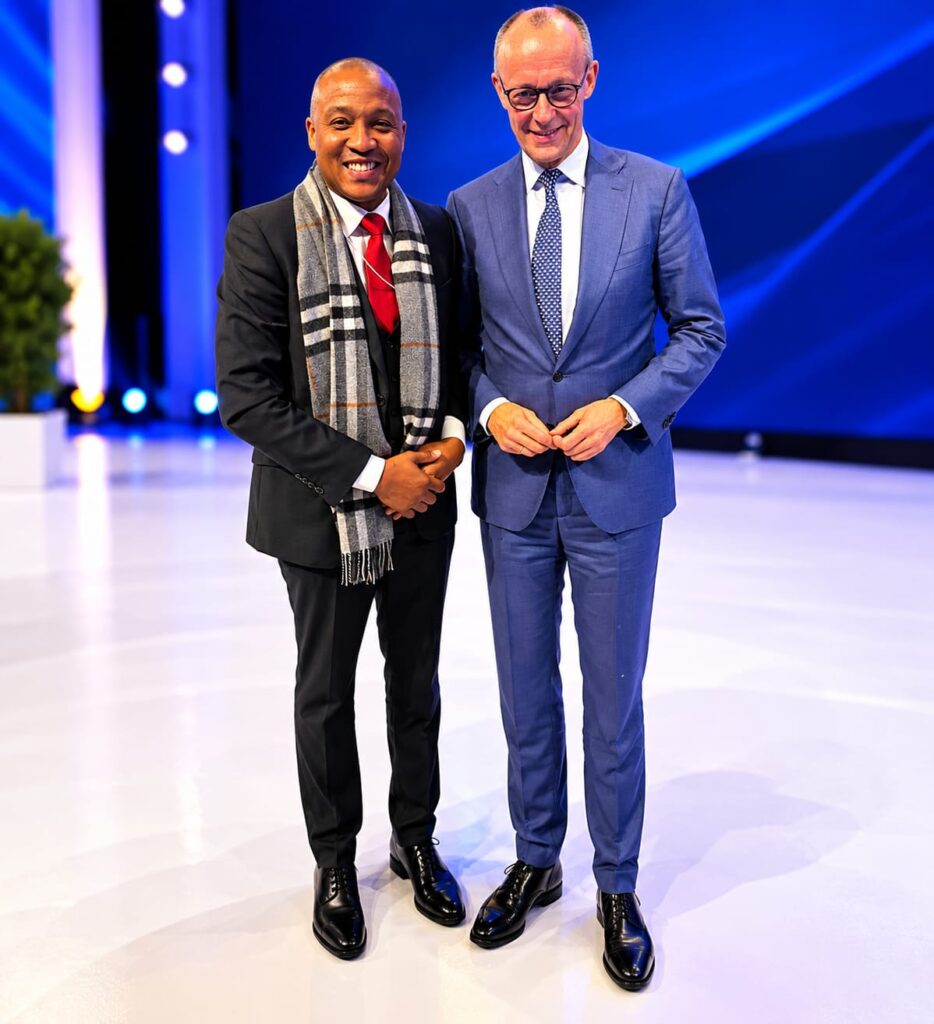
    While the Mexico connection focuses on financial inclusion and regional scale, Simpson’s engagement with German leaders highlights another critical pillar of Cornerstone’s strategy: economic competitiveness. A photo of Simpson with German Chancellor Friedrich Merz underscores the group’s interest in Germany, a country long renowned for its industrial leadership, engineering excellence, renewable energy transition and consistent technological innovation. For Jamaica, these themes are particularly urgent, as the country grapples with long-standing constraints including high energy costs, infrastructure gaps, low productivity, inefficient logistics and weak global competitiveness. Cornerstone’s interest in these issues extends beyond financial services, especially as the group expands its real estate and infrastructure development footprint.

    Simpson emphasized that the core value of these engagements lies in learning how advanced economies have approached long-term structural economic transformation. Another high-profile meeting, with Turkish President Recep Tayyip Erdoğan, offers a distinct set of lessons for large-scale infrastructure delivery, a priority as Cornerstone expands into real estate development.

    Over the past two decades, Türkiye has undertaken one of the world’s most ambitious infrastructure build-outs, spanning transportation networks, affordable housing, logistics hubs, energy projects, ports, airports and urban renewal. For Cornerstone, Türkiye’s experience offers a clear blueprint: how emerging economies can plan and execute large-scale projects efficiently. That expertise is directly relevant as Cornerstone grows its real estate division, which already holds a portfolio of strategic land parcels earmarked for residential, commercial, industrial, tourism and infrastructure developments. Bernhard Stocker, a recently appointed industry veteran, will lead the group’s real estate development arm.

    Cornerstone has also spent years cultivating partnerships with Turkish construction, engineering and infrastructure firms, with the goal of adapting global best practices in project execution and construction management to the needs of Jamaica and the wider Caribbean. “As we look at Jamaica’s future, we believe there is tremendous value in studying countries that have successfully transformed their economies through infrastructure investment and disciplined execution,” Simpson said. “Türkiye’s experience demonstrates what can be achieved when long-term vision is matched with the ability to deliver.”

    Taken together, these high-profile connections map out the full outline of Cornerstone’s new growth playbook. Musk represents technology, digital payments, artificial intelligence and connectivity. Mexico points the way toward financial inclusion and regional digital banking scale. Germany offers lessons in industrial competitiveness, energy transition and innovation. Türkiye provides a model for infrastructure delivery and large-scale development.

    The common thread running through all these engagements is Simpson’s core argument: Jamaica and the Caribbean cannot build their next phase of economic growth in isolation. This philosophy is the driving force behind Barita’s ongoing transformation. The group is shifting away from a conventional, narrow financial services model to build a far broader integrated platform that unites banking, investments, technology, real estate and regional ambition.

    Even with this clear strategic vision, the greatest hurdle remains execution. Relationships with global leaders and institutions open doors to ideas, capital and technical expertise, but they do not guarantee customer adoption, profitable projects or successful regional expansion. The ultimate test will be whether Cornerstone can translate its global exposure into tangible local products, investable projects and measurable value for both customers and shareholders.

    That makes the next phase of Barita’s development far more than a story of regulatory approvals, acquisitions or photo opportunities. It will ultimately be defined by whether a Jamaican-born financial group can turn global connections into a sustainable, leading Caribbean platform — and whether the bold ambition behind the headlines can be converted into real, on-the-ground results.


  • Bill Gates arrives for questioning in US Congress over Epstein ties

    Bill Gates arrives for questioning in US Congress over Epstein ties

    WASHINGTON (AFP) — On Wednesday morning, one of the world’s wealthiest individuals and most high-profile philanthropists, Microsoft co-founder Bill Gates, entered Capitol Hill to answer questions from U.S. lawmakers about his past connections to the deceased convicted sex offender Jeffrey Epstein. For years, Epstein’s sprawling network of elite, powerful associates has drawn intense public scrutiny and spawned widespread speculation across political and media circles.

    Gates sat for a closed-door transcribed interview with the House Oversight Committee, a panel probing the disgraced financier whose 2019 death in a New York jail cell came while he awaited trial on federal sex trafficking charges involving underage girls. As Gates made his way into the hearing room, he stopped briefly to address reporters, saying, “I hope my testimony is helpful to the work — important work — of the committee to find justice for the victims,” before declining to answer any additional questions.

    The committee called Gates to testify after recently released documents from the U.S. Department of Justice opened up new lines of inquiry about the extent of his interactions with Epstein. Gates joins a growing list of high-profile public figures who have already appeared before the panel, including former President Bill Clinton, former Secretary of State Hillary Clinton, and current U.S. Commerce Secretary Howard Lutnick.

    In a pre-interview statement provided to AFP, a spokesperson for Gates said the billionaire welcomed the opportunity to address the committee’s questions and reiterated that he “never witnessed or participated in Epstein’s illegal conduct.”

    Among the thousands of released Epstein documents is a 2013 draft email that appears to claim Epstein assisted Gates in managing public backlash after extramarital affairs, including helping Gates obtain antibiotics following a sexually transmitted infection exposure. Gates has repeatedly labeled the email a forgery and denied all the claims contained within it. In a February interview with Australian television, Gates acknowledged that his decision to build a relationship with Epstein was “foolish,” but stressed that the connection had no ties to Epstein’s criminal activities.

    “Every minute I spent with him, I regret, and I apologise that I did that… It’s factually true that I was only at dinners. I never went to (his) island, I never met any women,” Gates stated in that interview.

    Legal experts emphasize that mere inclusion in Epstein’s personal files does not constitute evidence of criminal wrongdoing on the part of any individual named. According to a prior Wall Street Journal report, Gates admitted to staff at his philanthropic foundation that he had engaged in extramarital affairs with two Russian women, but he has consistently denied ever interacting with any of Epstein’s victims. Gates has confirmed his relationship with Epstein began in 2011, three years after Epstein pleaded guilty in Florida to a state charge of soliciting a minor for prostitution. He has also acknowledged that his then-wife Melinda French Gates raised explicit concerns about his contact with Epstein as early as 2013, yet he maintained the relationship for at least another 12 months.

    Melinda French Gates, who finalized her divorce from Gates in 2021, has previously stated that all outstanding questions about her ex-husband’s ties to Epstein are a matter for Gates and other involved parties to address.

    The House Oversight Committee’s investigation into Epstein and his long-time accomplice Ghislaine Maxwell is part of a broader inquiry into how federal agencies handled the Epstein case and what transparency the government has provided around the thousands of documents tied to his crimes and network. U.S. President Donald Trump, who himself maintained a years-long relationship with Epstein, initially opposed the public release of the full cache of Epstein documents, leading to persistent accusations of a cover-up that have marked his first year back in office.

    Democratic members of the committee have made clear they intend to probe what Gates knew about Epstein’s criminal activities, as well as the full scope and nature of their professional and personal relationship. Unlike many previous interviews the committee has conducted and released publicly, Gates’ interview will not be videotaped.

    U.S. media outlets have also reported that Gates retained former Justice Department lawyer John Moran to represent him for the interview, and received preparatory assistance from Jake Greenberg, a former lead investigator for the House Oversight Committee. Ethics experts note that while the arrangement raises ethical optics concerns, it does not explicitly violate any congressional or ethics rules.

  • JHTA renews call for urgent talks on proposed GCT increase

    JHTA renews call for urgent talks on proposed GCT increase

    KINGSTON, Jamaica — Jamaica’s primary tourism industry advocacy group is escalating its calls for the government to open talks over a planned General Consumption Tax (GCT) increase for tourism-related activities, warning that the unconsulted policy shift threatens to destabilize one of the nation’s most critical economic drivers.

    In an official statement released Wednesday, the Jamaica Hotel and Tourist Association (JHTA) revealed that its leadership has been requesting formal discussions with government officials since March, with no response to date. Association President Christopher Jarrett emphasized that the proposed tax adjustment carries far-reaching consequences for tourism businesses, their workers, local investors, and regional communities across Jamaica, making stakeholder input non-negotiable.

    Jarrett clarified that the industry does not oppose the government’s core priorities, including post-Hurricane Melissa national recovery efforts and responsible fiscal management. However, he stressed that a policy of this magnitude that directly impacts the tourism sector cannot be finalized without meaningful consultation.

    “As a longstanding committed partner to Jamaica’s national growth and development, we are deeply disappointed that repeated requests for dialogue since March have gone unanswered,” Jarrett stated in the release. “This proposal will reshape the trajectory of our sector, and we deserve the opportunity to lay out our concerns before any final decision is made.”

    The JHTA president emphasized that the association is seeking collaborative problem-solving, not conflict. “We are only asking to have our voices heard. Decisions this impactful require genuine engagement with the industry that will live with their outcomes. Tourism must have a place at the policy table, and open dialogue should be a foundational step in this process,” he added.

    A key point of contention for the sector is the large number of long-term binding contracts that many hotels, tourist attractions, and tour operators hold through 2027 and beyond. These pre-negotiated agreements leave businesses with little flexibility to absorb new tax costs or pass them on to customers without eroding profit margins and undermining the global competitiveness of Jamaica’s tourism product, the JHTA argues.

    “Most tourism operators locked in pricing and contractual commitments years in advance to secure bookings and investment. A sudden, unplanned change to the tax regime creates avoidable operational and financial strain that demands careful review and collaborative discussion,” Jarrett explained.

    He also reminded policymakers of tourism’s outsize role in Jamaica’s economy: the sector is one of the nation’s largest employers, a top generator of foreign exchange, and a key support system for thousands of small and medium-sized enterprises operating across the island.

    “We do not disagree with the government’s goal of maintaining a stable, strong fiscal position,” Jarrett noted. “But reaching that goal must include input from one of the country’s most economically vital sectors. We are confident that there is enough goodwill and shared expertise on both sides to craft a balanced solution that works for all.”

    The JHTA is calling for immediate talks, warning that ongoing uncertainty around the tax proposal is already complicating critical decisions for businesses around investment, daily operations, and staffing. “Every additional day without dialogue adds more uncertainty for companies making choices that shape Jamaica’s economic future. Our sector is ready to engage constructively and find common ground, but the time for meaningful talks is right now,” Jarrett said.

    Despite the lack of response to date, the association remains optimistic that direct engagement between the Jamaican government and tourism industry stakeholders can deliver an outcome that both upholds the government’s fiscal goals and preserves the long-term competitiveness of Jamaica’s key tourism sector.

  • Odds rising for very strong El Nino — EU monitor

    Odds rising for very strong El Nino — EU monitor

    PARIS, France — A leading European climate monitoring body has issued an updated forecast showing growing consensus among global climate experts that a powerful El Niño event is on track to develop in the second half of 2024. Europe’s Copernicus Climate Change Service announced Wednesday that latest model projections have consistently trended upward over the past month, raising the likelihood of an extreme warming event.

    Carlo Buontempo, director of Copernicus, told Agence France-Presse that between May 1 and June 1, every leading climate model used in the monthly forecast revised its predictions to reflect greater warming potential. “The odds are strongly in favour of a moderate to strong, or probably strong to record-breaking, event at this stage,” Buontempo said.

    El Niño is a naturally occurring climate pattern marked by anomalous warming of surface ocean waters across the central and eastern equatorial Pacific. Beyond the Pacific basin, the phenomenon drives far-reaching shifts in global atmospheric circulation, altering wind patterns, barometric pressure systems and precipitation distributions across every continent.

    In its updated outlook, Copernicus reported that three out of every four contributing forecasters project that Pacific sea surface temperatures in key El Niño monitoring regions could climb to 2.5 degrees Celsius or more above long-term seasonal averages by November. Notably, only three El Niño events in recorded modern history have crossed the 2-degree warming threshold: the events of 1877/78, 1982/83, 1997/98 and 2015/16, none have surpassed 2.5C, meaning a 2024 event of that magnitude would rank among the most intense recorded since systematic observations began in the late 19th century.

  • Assault case against Spanish Town mayor resolved through mediation

    Assault case against Spanish Town mayor resolved through mediation

    In a resolution that closes out a high-profile legal matter tied to Jamaica’s upcoming national elections, all criminal charges against Spanish Town Mayor Norman Scott have been formally dismissed by the Balaclava Criminal Court in St Elizabeth, following a successful out-of-court mediation process announced Tuesday.

    Scott, who is running for a parliamentary seat in the St Elizabeth South Eastern constituency on the ticket of the opposition People’s National Party (PNP), faced two serious charges: assault occasioning actual bodily harm and malicious destruction of property. The allegations originated from a physical confrontation that broke out at a polling station located on the campus of BB Coke High School during pre-election polling activities held on September 3, 2025.

    According to initial incident reports, the conflict erupted over disagreements about compliance with polling station time limits. Prosecutors alleged that Scott physically struck Julie Francis, an election supervisor representing the ruling Jamaica Labour Party (JLP), and broke her prescription eyeglasses in the altercation. From the outset of the legal process, Scott has entered a firm not guilty plea to all accusations leveled against him.

    Scott’s defense counsel, Charles “Advoket” Ganga-Singh, consistently argued throughout pre-trial proceedings that his client was not the aggressor. Ganga-Singh maintained that Scott was actually the target of an unprovoked attack by a crowd of political opponents, and that Scott had already filed a separate counter-report with local law enforcement outlining his version of events.

    During an earlier court hearing, Senior Parish Court Judge Steve Stewart granted a request to move the dispute to alternative dispute resolution, after both Scott and Francis agreed to pursue a negotiated settlement rather than proceed to a public trial. When the case was called for a status hearing on Tuesday, the court confirmed that mediation had concluded with a mutually acceptable agreement between all involved parties, clearing the way for the full dismissal of charges against Scott.

    In comments to reporters after the court ruling, Ganga-Singh confirmed that every party to the dispute has expressed satisfaction with the mediated outcome. He added that the entire matter should now be considered fully resolved and closed, with no further legal action expected from either side.

  • We have a problem!

    We have a problem!

    Jamaica’s senior government official has sounded the alarm on the country’s decades-long land titling backlog, projecting that full resolution of the systemic issue could take up to two decades even with full public cooperation. Robert Montague, the minister responsible for Land and Titling, laid out the scope of the challenge during his address to the House of Representatives’ sectoral debate on Tuesday, emphasizing that delays will stretch even longer without widespread public buy-in for the government’s reform agenda.

    According to official valuations, Jamaica currently counts just under 1 million parcels of registered land across the island. Of that total, only 550,000 parcels hold active formal titles. Montague explained that pervasive informal subdivision practices have created a cascading set of problems: the majority of untitled parcels lack formal documentation entirely, while many titled parcels remain registered under the name of previous owners rather than current occupants.

    Across 379 formal and informal land settlements, which collectively include 62,690 designated parcels, government audits have found that roughly 35 percent have been split into smaller plots through unregulated, informal channels. Factoring in untitled land, unregistered subdivisions, out-of-date ownership records, and unprocessed claims in settlements, Montague estimates the country needs to issue roughly 600,000 new formal titles to completely resolve all existing land challenges.

    The crisis has already inflicted tangible harm across Jamaican society, the minister told lawmakers. Without clear formal titles, land cannot be smoothly transferred between generations, leading to frequent property disputes that have in some cases resulted in fatal violence and fractured families. Beyond social harm, the lack of clear titling also blocks economic potential: the government cannot collect accurate property taxes to fund public services, while communities without formal land documentation are locked out of access to basic amenities including regular garbage collection, fire department response, and public street lighting.

    To tackle the deeply entrenched problem, Montague’s ministry has unveiled a sweeping suite of coordinated reforms. The first major shift is elevating the land titling portfolio to full Cabinet level to prioritize the issue at the highest levels of government. The administration has also secured a landmark partnership with the South Korean government to build a specialized training institution for land sector professionals, a $9 million project fully funded by South Korea. The new school will train a new generation of surveyors, draftsmen, document verifiers, and other core land management specialists, expanding Jamaica’s limited pool of trained experts while introducing modern digital land management technologies from South Korea.

    Montague noted that the investment in human capital will directly increase the government’s capacity to process and issue new titles at a faster pace. The government has also partnered with the globally recognized Certified Commercial Investment Member Institute (CCIMI) to deliver advanced certification training for local real estate professionals, bringing Jamaican industry standards in line with 31 other leading countries around the world. Accredited workshops for legal practitioners focused on streamlining land application processes are also being rolled out on a regular basis.

    Other procedural reforms include expanding the number of local adjudication committees tasked with resolving land claims, with plans to route most adverse possession applications to these local bodies to cut down on processing backlogs in the national court system. A core pillar of the long-term modernization push is full digitization of all land management processes, including property surveys. Starting in September of next year, the ministry will begin issuing electronic land titles (e-titles) through a partnership with global tech firm Fujitsu, which is supporting the digitization of decades of existing paper land records to create a secure, searchable national database.

    Montague projected that once the e-title system is fully operational, Jamaica will be able to process up to 30,000 or more new titles each year, a dramatic increase from current output. The new digital system will also include a built-in property protection service: landowners will receive automatic alerts any time a third party submits a title application for their registered property, cutting down on fraudulent attempts to claim land through adverse possession. The optional property watch alert service will be available for a small user fee, the minister confirmed.

  • JTB cops 14th WAVE award for most supportive tourism board

    JTB cops 14th WAVE award for most supportive tourism board

    MARINA DEL REY, Calif. — On June 4, at an awards ceremony hosted at The Ritz-Carlton Marina del Rey, the Jamaica Tourist Board (JTB) added another milestone to its legacy in global tourism, taking home the award for Best Travel Advisor Support at the annual TravelAge West WAVE Awards. This win marks the 14th time Jamaica has claimed this top honor across the 21-year history of the prestigious industry awards, an unmatched streak that JTB officials say underscores the destination’s longstanding, trust-centered partnership with travel professionals across the United States.

    Unlike many industry awards judged by panels or editorial teams, the WAVE Awards draw their results directly from votes cast by practicing travel advisors across the U.S., as well as the readership of TravelAge West, a leading trade publication for North American travel professionals. Honoring the highest-performing destinations, suppliers and service providers across more than 70 categories, the awards center the perspectives of the practitioners who connect travelers with destinations every day.

    For JTB, winning the Best Travel Advisor Support award holds unique meaning, because the recognition comes from the very agents who recommend Jamaican getaways to their clients on a daily basis. The honor directly reflects the strength of the island’s ongoing investment in training, fast, responsive client service, and robust on-the-ground support for travel trade partners, JTB representatives noted.

    Tourism Minister Edmund Bartlett expressed deep gratitude for the repeated vote of confidence from the U.S. travel advisor community. “For the 14th time, the travel advisors of the United States have placed their trust in Jamaica, and we receive that vote of confidence with deep gratitude,” Bartlett said. “Behind every booking is an advisor who has chosen to put our island forward to their clients. This award belongs as much to them as it does to us. It signals to the world that when travellers seek an unforgettable Caribbean experience, the professionals they rely on think of Jamaica first.”

    Donovan White, JTB’s Director of Tourism, echoed that sentiment, emphasizing that recognition from the advisor community carries more weight than almost any other industry honor. “This category is decided by the people who know our product best, so the recognition is one we value above almost any other,” White explained. “It reflects the work our sales and marketing teams do every day: the training, the prompt service, and the genuine partnership, to ensure advisors have everything they need to sell destination Jamaica with confidence. As we continue to expand our airlift and deepen our presence across the US market, that close relationship with the trade remains central to our strategy.”

  • Jordan Scott rebounds to win triple jump at Oslo DL

    Jordan Scott rebounds to win triple jump at Oslo DL

    OSLO, Norway — At the sixth leg of the 2024 Wanda Diamond League held at Oslo’s iconic Bislett Games, Jamaica’s rising triple jump star Jordan Scott delivered a career-defining performance, bouncing back from his first season defeat to claim the top spot on the men’s triple jump podium. The Jamaican posted a wind-aided mark of 17.66 meters with a 2.6 m/s tailwind, securing his first major Diamond League win just weeks ahead of the Jamaica Athletics Administrative Association (JAAA) National Championships, scheduled to kick off on June 18.

    Scott’s path to victory was not without early missteps: he fouled his opening attempt, notched a 16.96m jump with a headwind of 1.8 m/s in the second round, and matched his personal best to seize the lead in the third round, ultimately holding off top competition to finish first. Only two of his six attempts fell within legal wind parameters, but his best jump was enough to outperform the field that included the athlete who had defeated him just weeks earlier.

    It was Italy’s Andy Diaz Hernandez, who upset Scott at the previous Diamond League stop in Rome, who claimed second place in Oslo, matching his own season best with a 17.59m jump in legal wind conditions. Algeria’s Yasser Mohammed Triki rounded out the top three with a wind-assisted 17.43m. Jamaican rising star Jaydon Hibbert, another entrant in the men’s triple jump, also fouled his opening attempt but logged two jumps over 17.00m, finishing fifth with a season best of 17.17m.

    Joining Scott on the podium was fellow Jamaican Rushell Clayton, a two-time World Athletics Championships 400m bronze medalist and World Athletics Indoor Championships silver medalist, who took second place in the women’s 400m hurdles. After finishing third in her two prior Diamond League outings this season, Clayton clocked 53.50 seconds, falling just short of winner Emma Zapletalova of Slovakia, who notched her third consecutive Diamond League victory with a 53.13-second finish. American Jasmine Jones took third with a time of 54.09 seconds.

    Ackelia Smith, making her 2024 season debut in the triple jump after focusing on long jump competitions earlier in the year, finished fourth with a mark of 14.50m in legal wind conditions. The event was won by Cuba’s Davisleydi Valazco, who posted a wind-aided 14.85m, while Senegal’s Saly Sarr claimed second with a personal best 14.75m, and another Cuban, Leyanis Perez Hernandez, took third with a 14.60m wind-assisted jump.

    In the women’s 400m, Jamaica’s Nickisha Pryce finished fifth with a time of 50.39 seconds. The home crowd had reason to celebrate, as Norway’s Henriette Jaeger took gold with a season best 49.52 seconds, followed by Lurdes Gloria Manuel of Czechia (50.13) and Poland’s Natalia Bukowiecka (50.34).

    Jamaica’s veteran shot putter Danniel Thomas-Dodd placed sixth with a throw of 18.83m, in an event headlined by a historic performance from American Chase Jackson. Jackson broke a 13-year-old Bislett Games meet record previously held by New Zealand legend Valerie Adams, tossing a season best 20.74m to claim gold. World leader Jessica Schilder of the Netherlands took second with a 20.11m throw, while Canada’s Sarah Mitton rounded out the top three with 19.89m.

    Scott and Clayton’s podium finishes mark the only top-three results for Jamaican athletes at the final major Diamond League event before Jamaica’s national qualifying championships for the upcoming global athletics championships, giving the pair momentum as they prepare to defend their national titles and secure spots on Jamaica’s global roster.