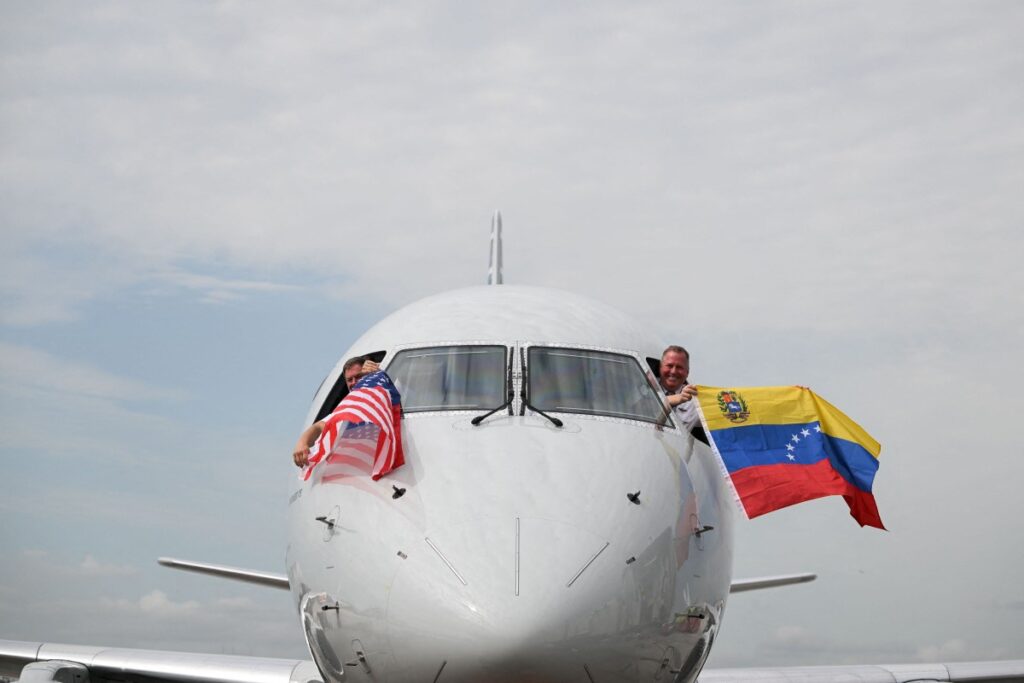
MIAMI, Fla. – After a years-long hiatus marked by bitter bilateral tensions, the first direct commercial flight between the United States and Venezuela departed Miami early Thursday, marking the most visible milestone to date in a rapidly unfolding normalization of relations between the two nations. American Airlines Flight 1236, the first scheduled service between the two countries since 2019, lifted off from Miami International Airport at 10:26 a.m. local time, bound for Caracas’ Simon Bolivar International Airport, commonly called Maiquetia, with an expected flight time of just over three hours. The flight’s passenger list is primarily composed of U.S. diplomatic officials and international journalists, as senior Washington envoys prepare for unprecedented talks with Caracas’ new interim government — a meeting that would have been considered impossible just six months ago. Greeting passengers at the departure gate were Miami city representatives and Venezuela’s ambassador to the United States Felix Plasencia, a fitting welcome for Miami, long a hub for Latin American diaspora communities and a strategic gateway for trade and travel between North and South America. In a nod to the historic occasion, American Airlines has rolled out a custom Venezuelan-inspired in-flight menu for these inaugural flights, featuring regional staples such as cachapas (traditional sweet corn pancakes) and Venezuelan-style chicken salad. The resumption of air links comes amid a sweeping shift in U.S.-Venezuela relations that has unfolded since early January, when U.S. special operations forces conducted a targeted raid in Caracas that removed former leftist president Nicolas Maduro, who was subsequently transported to New York City to face trial on federal drug trafficking charges he and his allies have repeatedly denied. Maduro was replaced by his former vice president Delcy Rodriguez, whose government has moved quickly to court U.S. investment and align with Washington’s policy priorities despite her longstanding leftist ideological background. U.S. President Donald Trump has publicly praised Rodriguez’ policy approach, particularly her administration’s opening of Venezuela’s critical energy and mining sectors to private foreign investment, and has gradually rolled back crippling economic sanctions that isolated Venezuela for years — including dropping personal sanctions targeting Rodriguez directly. Even amid this detente, significant points of tension remain. Trump has simultaneously moved to ramp up deportations of Venezuelan migrants residing in the U.S., terminating a longstanding protected status program that shielded migrants from deportation to a country grappling with widespread violent crime. The aviation industry as a whole is also facing significant headwinds, driven by a sharp spike in global oil prices following recent U.S. and Israeli military strikes on Iran. The resumption of direct air connections fills a critical gap for the roughly 1.2 million Venezuelans who have built lives in the United States, many of whom have been separated from family members for years amid the travel ban. Policy analysts also expect the restored links to open the door for expanded U.S. business activity in Venezuela, which holds the world’s largest proven crude oil reserves. The daily route will be operated by American Airlines’ regional subsidiary Envoy Air, which will run one round-trip service between Miami and Caracas daily. American Airlines has already announced plans to add a second daily round-trip route starting May 21, matching growing demand for travel between the two countries. American Airlines first launched service to Venezuela in 1987, and for decades carried more passengers between the U.S. and Venezuela than any other carrier. The airline suspended all service in 2019, when bilateral relations collapsed after the U.S. and a coalition of Western and Latin American nations refused to recognize Maduro’s re-election, citing widespread voting irregularities. While the U.S. State Department has relaxed its travel guidance for Venezuela — ending a years-long blanket ban on all travel to the country in March — it still urges U.S. citizens to reconsider travel plans due to ongoing high rates of violent crime across the nation.