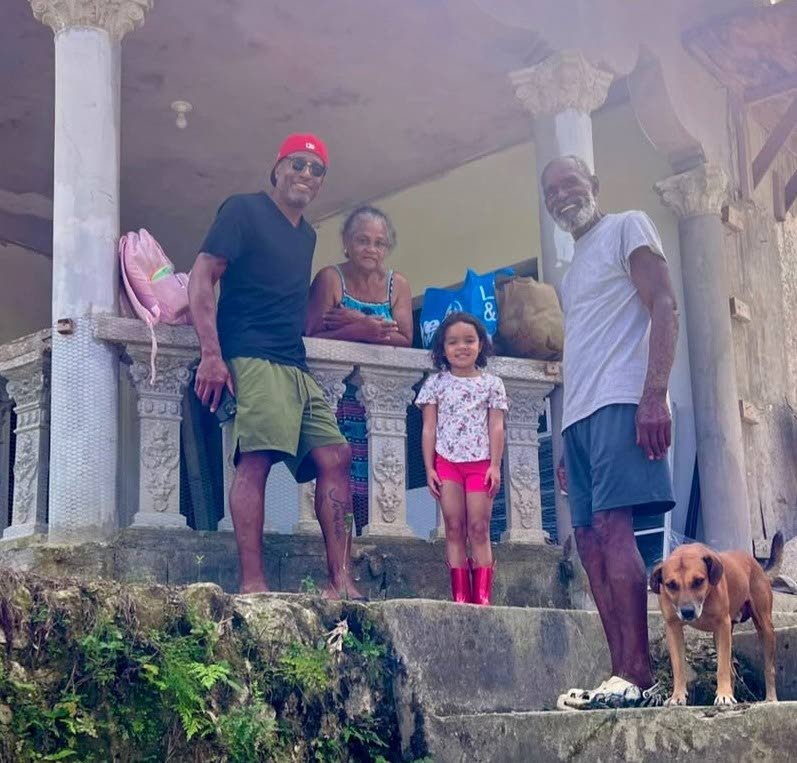
For nearly four decades, Winston Watson Jr. has marked Father’s Day alongside his father, Winston Watson Sr. This year, that long-held tradition will be broken — not by death, but by a mysterious, month-long disappearance that has left his family grieving, frustrated, and still clinging to hope.
The 78-year-old Watson Sr., who received a formal dementia diagnosis back in 2018, was last seen at his home in Jamaica’s Hanover Parish Lethe District around 5 p.m. on May 19, according to official reports from Ramble Police. Witnesses describe him as a slim, dark-complexioned man standing 6’2”, who was wearing a black muscle tee, black athletic shorts, and white Crocs when he vanished.
As Watson Jr. told local outlet the Jamaica Observer, his father had developed a consistent daily routine even after his dementia diagnosis: tending to the small family farm just steps from his home. On the day he went missing, Watson Sr. left for the fields as usual, but never returned at his expected time. It was his stepmother, Vernica Watson, who first raised the alarm.
“Normally, she would call and say she couldn’t find him because he would often wander, but it was the first time she had called me so late,” Watson Jr. recalled. “He’s always farmed, reared animals and grown crops, and he would just walk the property and be back home before nightfall. When she called at 7 o’clock, I knew something was wrong.”
At the time of the call, Watson Jr. — a serving police officer — had just arrived at his post in St James. He immediately explained the urgent situation to his supervisor, left for Hanover, and began searching for his father right away. When that first search turned up nothing, he and Vernica filed an official missing person report with local law enforcement.
In the weeks that followed, the search effort swelled far beyond the immediate family. Friends, neighbors, and local residents of Lethe District joined the ground search, and even relatives who lived overseas flew back to Jamaica to help with the effort. All of those collective efforts have so far come up empty.
Watson Jr. shared that after the first day of fruitless searching, the family got a tip that an elderly man matching his father’s description had been spotted in Paradise, a small community between Savanna-la-Mar and Ferris Cross in neighboring Westmorland Parish. He and his brother rushed to the area, canvassed streets, put up missing person posters, and interviewed locals, but again found no trace of Watson Sr. The next day, they returned to Westmorland alongside uniformed police officers, expanding the search corridor from Beirut District all the way to Little London. Multiple witnesses reported seeing a man matching the description just a day prior, so the search team spent a full week combing the area between Little London and Negril with no breakthrough.
The weeks of uncertainty have been an emotional roller coaster for the entire family, Watson Jr. said, with frustration growing with each passing day that yields no new information. To incentivize tips from the public, the family put forward a JMD $500,000 reward for any information that leads to locating Watson Sr., but no credible leads have been submitted to date.
As Father’s Day approaches, the pain of the uncertainty has grown sharper. This will be the first time in 37 years that Watson Jr. cannot personally wish his father a happy Father’s Day.
“I just wish I could reunite with my dad. My days start with that wish, and they end with that wish,” he said. “I honestly thought we would find him within the first week, given how many people were working on the search. But as Father’s Day gets closer, it just gets harder.”
The weight of the moment hit him unexpectedly recently, when his three-year-old grandson asked him, “Dad, have you found grandpa?” The question drove home how deeply the disappearance has shifted the entire family’s dynamic. Even as he navigates his own grief and worry, Watson Jr. said he feels obligated to maintain a sense of normalcy for his own two sons.
Last Friday, both of his boys had school events planned ahead of Father’s Day, requiring his attendance at two different campuses. When his younger son’s teacher asked if he would like to give a short Father’s Day address to the group, he had to turn her down.
“I don’t think I have the mentality or the strength to go up in front of other fathers and say anything positive at this point,” he explained. “I’m just trying to be there for my boys, but the general excitement of it all just isn’t there. I put on a brave face for them, because they look forward to Father’s Day every year, and I don’t want to let them down. I’m just doing what I can to get through it.”
What makes the disappearance all the more baffling for the family is that Watson Sr. is a well-known figure across western Jamaica. For years he worked in the tourism industry running his own tour operation, and before that he worked as a truck driver, meaning people across multiple parishes would recognize him on sight. He lives in a tiny, tight-knit community where every local knows he has dementia and is prone to wandering, making his vanishing all the more puzzling.
“The community is so small where we live that if he leaves the house, somebody has to see him,” Watson Jr. said. “Even the night he went missing, people were still out gathered around the town square talking. When we put up posters in Westmorland, most people said they knew him — he was always in those areas when I was growing up. It’s a complete mystery how he can be missing for a month and nobody has seen him. How is that possible?”
As the weeks stretch on without answers, Watson Jr. admitted he has begun to question the unthinkable, wondering if his father is still alive. Even so, he said he is holding out hope that his father is simply lost, wandering somewhere across Jamaica, and will be found soon.
Anyone with any information about the whereabouts of Winston Watson Sr. is asked to contact Ramble Police at 876-822-5211, the national police emergency line at 119, or the nearest local police station.