标签: Jamaica

牙买加

  • Hambani lifts First Rock ahead of $700-m test

    Hambani lifts First Rock ahead of $700-m test

    Jamaica-based real estate firm FIRST Rock Real Estate Investment Limited has announced a critical breakthrough at its flagship Hambani Estates luxury development, with cumulative sales now covering all outstanding project costs and enabling structured debt repayment – a positive development that comes as the company navigates a $700-million bond maturing this month and ongoing delays to its audited annual financial results.

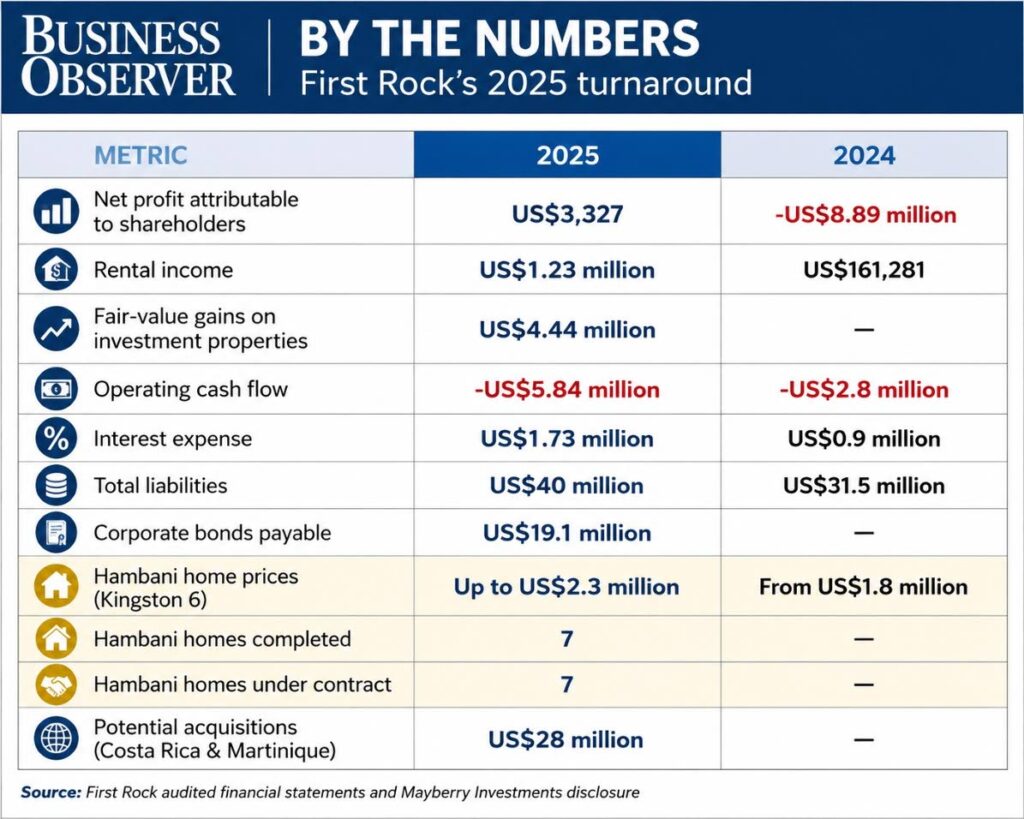
    According to Mayberry Investments Limited, the financial firm that structured the project’s post-receivership refinancing, seven of the development’s 12 planned luxury townhouses in Kingston 6, St Andrew, have achieved practical completion and are already under sales contract. Proceeds from these transactions, alongside pre-completion sales, are sufficient to cover every projected cost associated with delivering the full Hambani Estates project. This update was publicly released on April 30, the exact same day First Rock confirmed a second extension to the publication timeline for its 2025 audited financial statements. After missing an initial March 1 deadline, the company now targets release of the completed reports by May 15.

    The Hambani Estates project, a 12-unit luxury townhouse development targeted at high-net-worth buyers and real estate investors in Liguanea, has endured a turbulent recent history. In early 2025, Sagicor Bank Jamaica placed the development into receivership after First Rock defaulted on project repayment obligations, triggered by widespread construction delays and weaker-than-projected initial sales. After the receivership appointment, Mayberry Investments stepped in to arrange a new corporate note refinancing package, a restructuring that has now positioned the project to begin phased early repayments to noteholders thanks to the stronger-than-expected sales performance.

    First Rock was able to regain full control of the Hambani Estates development in September 2025, after paying off the outstanding Sagicor Bank facility using a new $15-million US dollar note that carries a 14% annual interest rate and is scheduled to mature in March 2027.

    In a statement accompanying the project update, Mayberry Investments Chief Executive Officer Patrick Bataille noted that both the pace of construction progress and the strength of buyer demand at Hambani Estates have outperformed all post-restructuring projections. Mayberry also confirmed that unit values have risen sharply since the project launched: initial asking prices sat around $1.8 million per unit, and current pricing now sits at roughly $2.3 million. Additional price hikes are projected as more units reach completion and hit the market.

    Public filings for First Rock covering the nine-month period ending September 2025 lay out the company’s current financial position. Total liabilities increased to $40.5 million US dollars, up from $31.5 million at the close of 2024, a jump that the company attributes to increased borrowing to complete the project debt refinancing. As of the end of September, the firm held $5.36 million in cash and cash equivalents. For the nine-month period, First Rock reported a net profit of $1.04 million, with a $31,000 net profit recorded in the third quarter alone.

  • How mentorship shaped Jamaican-Canadian scholar’s journey

    How mentorship shaped Jamaican-Canadian scholar’s journey

    Against the backdrop of a year defined by both professional triumph and personal grief, 31-year-old Kayonne Christy has emerged as one of the most promising rising sociologists in North America, recently inducted into Yale University’s elite Edward A. Bouchet Graduate Honor Society. Her path from a first-generation university student uncertain of her calling to an acclaimed doctoral researcher exploring diaspora, culture and identity has been shaped far more by collective support than individual achievement, she says.

    Christy, currently a sociology PhD candidate at the University of Michigan, did not start her academic career aiming for the social sciences. As the first member of her family to pursue higher education, she enrolled in McMaster University’s life sciences program with plans to attend medical school. For a time, she dismissed her lingering dissatisfaction as a normal part of university life, telling herself that post-secondary study was not meant to be an enjoyable experience. But a persistent pull toward questions of systemic inequality and social justice, nurtured through campus organizing and community engagement, eventually led her to rethink her trajectory.

    That turning point came when she gained a spot on a qualitative research project examining the social determinants of health. There, she discovered she could merge her foundational scientific training with her deep curiosity about how social structures shape individual lived experiences, sparking a lasting passion for sociology. Like every step of her journey, this professional shift was not navigated alone: Christy cites a network of supportive mentors as the backbone of every milestone she has reached.

    Among the most influential of these guides was Juliet Daniel, a Barbadian-born cancer biologist at McMaster University and the first Caribbean woman with a PhD Christy ever met. Daniel passed away on the same day Christy sat for an interview about her career, adding a layer of poignancy to her reflections on her path. “Seeing someone who looked like me, who shared a similar background, made me believe that [a PhD] was possible. That mattered more than I can explain,” Christy said of Daniel. She also credits additional mentors including Dr. Lawrence Grierson, Dr. Meredith Vanstone, and Dr. Gerry Veenstra for opening doors and encouraging her through moments of uncertainty. “If it weren’t for them, I don’t know if I would be doing a PhD right now,” she added.

    A suggestion from one mentor led Christy to a graduate program at the University of British Columbia, where she worked alongside Veenstra, one of Canada’s leading scholars on racial health disparities. There, she grew to appreciate sociology’s flexibility: the discipline allowed her to pursue overlapping interests in race, power, health and inequality while staying rooted in the social justice questions that first drew her away from medicine. That focus eventually led her to the University of Michigan, home to one of the world’s top-ranked sociology departments.

    For Christy, her research is not just an academic pursuit—it is deeply personal. Though born in Canada, her connection to her Jamaican roots deepened in her early 20s, when a family reunion trip made her realize the island felt like home. Today, she is based in Kingston for her fieldwork, studying how Jamaican diaspora members contribute to the city’s growing cultural and creative economy, and how that engagement shapes urban development.

    “Culture is such a central part of the Jamaican diasporic experience,” she explained. “As Kingston moves toward culture-led development, there are new opportunities for the diaspora to engage and contribute. But there are also challenges, and I want to understand both.”

    Christy adheres to the philosophy of “lifting as you climb,” a value shaped by her own experience of receiving support from a community of mentors, family and educators. “Anything I’ve done is a product of people who poured into me,” she said. “Mentors, family, and community made this possible.” With her PhD on track for completion in 2027, Christy remains focused not just on finishing her dissertation, but on carrying forward the legacy of support that made her success possible.

  • Brokers hike commission rates on equity trades

    Brokers hike commission rates on equity trades

    Against a backdrop of strong profit growth across Jamaica’s securities brokerage sector, three top local investment firms have moved to raise equity trading commissions and adjust a range of service fees, passing higher operational and regulatory costs to retail and institutional investors.

    The most recent adjustment comes from Barita Investments Limited (BIL), which notified clients of a new fee structure taking effect on June 1. The change covers not just equity trading commissions, but also cheque processing fees, outgoing real-time gross settlement (RTGS) transfer charges, and credit facility fees. Under the new rules, a flat 2% commission will apply to all local equity trades, with a minimum $550 charge for any transaction below $27,500. For trades exceeding $1 million, commission rates can be negotiated between 1% and 2%, a departure from BIL’s previous structure that charged just 0.75% for all transactions executed through JtraderPro, the Jamaica Stock Exchange’s (JSE) digital electronic trading portal.

    In a client notification email, BIL explained the fee updates are designed to ensure its services align with current industry benchmarks, support its expanding suite of financial solutions, and accurately reflect the value the firm delivers to clients.

    Months earlier, Jamaica Money Market Brokers Limited, operating as JMMB Investments, rolled out its own broad fee adjustments on April 17. While the firm cut the GOJ/BOJ bid placement fee from 0.146% to 0.10% (keeping the $5,175 minimum fee intact), it raised charges for RTGS transfers, cheque services, and return/recall transfers. For equity traders using JMMB’s digital Moneyline platform, the published commission rate rose from 0.50% to 0.70%, translating to an actual effective rate increase from 0.435% to 0.609%. Clients requiring assisted trades outside the digital platform saw their commission jump from 1.50% to 2.00%.

    JMMB Securities Limited (JMMBSL), the group’s brokerage arm, earned second runner-up honors from the JSE Best Practice Committee in December 2025 for its 2024 revenue and market activity. JMMB Group’s 2025 annual report ranks JMMBSL first in total number of trades, second in trading volume, and sixth in trading value for 2024. The fee hike comes as the JSE’s Main Market and Junior Market posted $60.58 billion and $6.36 billion in total traded value respectively for 2025, creating an opportunity for brokers to boost top-line revenue through higher commission rates.

    JMMB noted in its client communication that regular fee reviews are standard industry practice, conducted to balance the firm’s operational needs with client requirements. The latest adjustments, it said, align with the firm’s guiding principle of fair fee application, its core values, and its commitment to acting in clients’ best interests.

    The third major adjustment came from VM Wealth Management Limited, which implemented changes effective March 1, mirroring Barita’s move to eliminate discounted digital trading rates. Previously, VM Wealth charged 0.75% for trades executed on JtraderPro, and 1.5% to 2.00% for in-branch assisted trades. Under the new structure, all equity transactions carry a 2.50% trading fee, with an additional $1,500 charge for transaction requests submitted outside VM Wealth’s digital client portal.

    VM Wealth told clients the fee adjustments will allow the firm to continue investing in upgraded digital infrastructure, expanded service channels, and specialized client support teams. The firm emphasized its commitment to delivering efficient, secure, high-quality services to help clients meet their long-term financial goals.

    For years, Jamaican brokers have offered discounted commission rates for digital self-service trades, which require less hands-on staff interaction than assisted transactions. This strategy was designed to incentivize more frequent online trading, ultimately driving higher total revenue through increased transaction volume. Today’s fee adjustments mark a clear strategic shift, driven in large part by brokers’ need to prepare for the upcoming “twin peaks” regulatory framework and other upcoming regulatory changes impacting parent financial groups.

    The adjustments come at a time of robust overall performance for Jamaica’s securities sector. Unaudited data from the Financial Services Commission (FSC) shows total sector revenue grew 17% year-over-year to $87.77 billion for the 2025 calendar year ending December. The FSC attributes this revenue growth to expanded non-interest income, primarily driven by strong profits from debt securities trading. Total sector expenses fell 5% to $72.51 billion, pushing combined pre-tax profit (PBT) for the 19 reporting primary securities dealers to $15.26 billion.

    The FSC noted that the double-digit jump in pre-tax profit stems from concurrent growth in operating revenue and a decline in operating costs. For comparison, the 2024 pre-tax profit figure was restated from an original $0.87 billion gain to a $1.54 billion pre-tax loss, though no explanation has been provided for the revision.

    Despite the strong profit performance, the sector saw a 1% contraction in total assets to $973.43 billion, though total equity and capital improved 2% to $147.96 billion. The aggregate capital adequacy ratio for the 19 reporting firms rose from 20.41% to 22.49% — double the 10% statutory minimum required by regulators.

    Total broker funds under management (FUM) grew 10% year-over-year to a record $1.83 trillion, with collective investment schemes (including unit trusts and mutual funds) rising 9% to $416.47 billion from $383.11 billion in 2024. While FUM is at an all-time high, year-over-year growth has slowed in recent years: FUM stood at $1.72 trillion in December 2022 and $1.59 trillion in December 2021, meaning growth has moderated even as total values hit new records. Equity holdings within managed funds are also growing at a slower pace than in previous periods.

    The overall picture shows that even as Jamaica’s banking and securities sectors deliver rising earnings, consumers and investors are facing higher fees for a growing range of services — even as those services continue to shift to lower-cost digital delivery models.

  • ‘Bunny’ Shaw’s Man City win WSL title

    ‘Bunny’ Shaw’s Man City win WSL title

    In an unexpected turn of events that has reshaped the final standings of England’s top-flight women’s football, Manchester City has claimed the 2023-24 FA Women’s Super League championship without kicking a ball in their final match, following Arsenal’s dramatic 1-1 draw away to Brighton & Hove Albion on Wednesday. This title ends a 10-year drought for the Manchester side, while also bringing an end to Chelsea’s dominant six-year consecutive title streak.

    Arsenal, who finished the campaign in third place, entered Wednesday’s fixture with everything to play for. Fresh off a crushing exit from the UEFA Women’s Champions League at the hands of Lyon at the weekend, the Gunners held three games in hand on league-leading Manchester City, giving them a clear path to overtake at the top of the table. Manager Renee Slegers went into the Brighton match fully aware that nothing less than three points would keep their title hopes alive.

    The opening 45 minutes saw Arsenal take an early lead through Japanese midfielder Fuka Tsunoda, who netted her first half opener to put the Gunners on track for the win they needed. But Brighton refused to fold, and in the 62nd minute, forward Friday Maanum equalized for the home side. Despite late pushes from Arsenal’s attacking line, they could not find the decisive winning goal, leaving the score locked at 1-1 when the final whistle blew.

    The result immediately confirmed Manchester City as league champions, marking a fairy-tale first season in charge for manager Andree Jeglertz. This is City’s first WSL title since their 2016 victory, capping a consistent season that saw the side grind out results through every challenge. In an interview following the title confirmation, Jeglertz expressed his overwhelming pride in his squad, saying that steering the club to the championship would be a memory he carries forever. He praised his players for confronting every obstacle head-on throughout the campaign, noting that their unity through both high and low moments was the key to their success — a hallmark of all great championship sides.

  • RA Williams targets growth from expanded eyecare portfolio

    RA Williams targets growth from expanded eyecare portfolio

    Jamaican pharmaceutical distributor RA Williams Distributors Limited has unveiled a strategic expansion of its ophthalmic product line, positioning the company’s eyecare segment as a key new driver of long-term revenue growth. The move builds on a 14-year distribution partnership with Aristopharma Limited, and adds three new dry eye and ocular surface treatments — Drylief, Neotear, and Hypomer Gel — to the company’s existing portfolio. The expansion is designed to widen local patient access to advanced specialized ocular care, while cementing RA Williams’ footprint in the high-value, prescriber-led eyecare market.

    In an interview with Jamaica Observer and Business Observer this week, RA Williams CEO Audley Reid emphasized that the latest portfolio addition aligns with the firm’s core mission: to deliver quality pharmaceutical solutions that connect global medical innovation to Jamaica’s local healthcare needs. “Fourteen years ago, we entered the eyecare market with Aristobet-N, and our mission remains the same,” Reid explained. “As a pharmacist-led organisation, this expansion into ocular health is not just a product launch; it is a strategic move to capture high-value market share in a segment with strong patient retention and consistent demand.”

    The new range of Aristopharma ocular lubricants directly addresses fast-rising local demand for dry eye and ocular surface therapies, a trend fueled in large part by soaring daily screen time and the growing prevalence of computer vision syndrome. By offering tiered treatment options that cater to everything from mild eye irritation to chronic dry eye conditions, the new products give local clinicians greater flexibility to tailor care to individual patient needs.

    Against a backdrop of recent industry headwinds, including hurricane-related supply disruptions and broad macroeconomic challenges that weighed on the firm’s performance in prior quarters, Reid noted that the timing of the ophthalmic expansion is well-calendar to deliver steady incremental revenue growth over the next 18 to 24 months, supported by the category’s consistent, non-cyclical demand. “By diversifying our portfolio into the ‘wellness and lifestyle’ space, we aim to capture a broader share of consumer spending while insulating revenue against fluctuations in any single sector,” he said.

    The eyecare expansion is the latest step in RA Williams’ broader push to diversify beyond traditional pharmaceuticals into fast-growing wellness and preventive care segments. The firm already notched a notable financial turnaround recently: for the first quarter ending January 31, 2026, RA Williams reported a net profit of JMD $33.5 million, double the profit recorded in the same period a year prior, on total revenues of JMD $541.9 million, reversing losses reported in the previous quarter.

    Earlier this year, the company entered a new partnership with Jamaican dermatologist Dr Romario Thomas to distribute his clinical-grade skincare brand Absolut Skin, and has ramped up efforts to place both new and existing wellness products in the country’s largest retail chains. Reid confirmed that Absolut Skin is in the final onboarding stage for MegaMart, one of Jamaica’s leading big-box retail chains, with products set to hit shelves by the end of the week. “This move complements our existing presence in the pharmacy network as we push to bring clinical-grade skincare to a wider supermarket demographic,” Reid said.

    Established wellness lines from RA Williams have already seen growing traction across alternative retail channels. The brand’s popular Sir Henry Turmeric Immunity Shots have gained a loyal consumer base across warehouse clubs, convenience stores, and gas station networks across the island. “Our retail push has been allowing us to tap into the growing ‘on-the-go’ wellness trend across multiple networks,” Reid added.

    Moving forward, RA Williams will continue to pursue a dual-track growth strategy that balances its core traditional pharmaceutical business with its expanding wellness portfolio. Management will prioritize filling unmet gaps in chronic disease care, while also scaling promising local Jamaican brands with national distribution potential. Reid highlighted that supporting local innovation is a core pillar of the firm’s long-term growth plan.

    “Lines like Sir Henry and Absolut Skin are world-class Jamaican brands, and we see ourselves as the bridge bringing them to a wider national audience,” Reid said. “Whether it is a life-saving medication in a pharmacy or a wellness shot in a supermarket, we are ensuring that R A Williams is present wherever the Jamaican consumer prioritises their health. By combining specialised medical treatments with high-velocity wellness products, we are building a diversified portfolio that is resilient, accessible and uniquely Jamaican.”

  • Policewoman injured as service vehicle overturned

    Policewoman injured as service vehicle overturned

    A sudden tire blowout on a Jamaica police service vehicle has left two law enforcement officers receiving medical care and triggered hours of traffic chaos on one of the island nation’s busy commuter corridors. The incident unfolded on Wednesday afternoon along the Long Hill main road in St. James, involving officers assigned to the nearby Hanover Police division, local law enforcement sources confirmed. According to initial investigative reports, the two officers – one woman and one man – were en route along the roadway when the front tire of their marked service vehicle suffered an unexpected blowout. The sudden loss of air pressure left the driver unable to maintain control of the vehicle. The out-of-control SUV veered off the paved surface, climbed a steep roadside embankment, and flipped completely over before coming to a stop. Emergency first responders were dispatched to the scene within minutes of the crash being reported via 911 calls from passing motorists. The female officer sustained a deep laceration to her forehead during the rollover, though her injuries are not believed to be life-threatening. She was quickly stabilized at the scene by paramedics before being transported to a nearby regional hospital for urgent treatment and observation. Her male colleague was also taken to the same medical facility for a full preventative medical examination, to rule out any hidden internal injuries from the impact. Following the clearing of the injured parties, a heavy-duty wrecker was called to remove the overturned police vehicle from the accident site. However, the process of extracting the wreck and clearing the roadway took more than an hour, resulting in a massive traffic pileup that stretched for several kilometers along the already heavily traveled commuter route. Commuters traveling between St. James and Hanover faced extensive delays, with many forced to find alternate rural routes to reach their destinations, leading to further travel disruptions across the region Wednesday evening. Local traffic authorities have reminded motorists to regularly check the condition of their vehicle tires, particularly during periods of fluctuating temperature that can increase the risk of sudden blowouts on high-traffic roadways.

  • Pioneering CNN founder Ted Turner dead at 87

    Pioneering CNN founder Ted Turner dead at 87

    American media entrepreneur Ted Turner, the trailblazing innovator who redefined 20th-century broadcast journalism with the 1980 launch of the world’s first 24-hour cable news network CNN, has passed away at 87 years old, CNN confirmed in an official announcement Wednesday.

    A mustachioed Southern native, avid competitive yachter, and prominent philanthropist who built a multi-faceted media and sports empire over his decades-long career, Turner had been living with Lewy Body Dementia, a progressive neurodegenerative disease, in his later years.

    When Turner launched Cable News Network, it upended the traditional broadcast news model that had dominated American television for decades. Unlike existing outlets that restricted news coverage to fixed time slots, CNN committed to continuous, around-the-clock breaking news coverage — a radical concept at the time that would soon reshape global journalism.

    The network catapulted to international fame for its unflinching live coverage of the 1990-1991 Gulf War, a milestone that cemented its reputation as a trusted global news source. Over the following decades, CNN brought live on-the-ground reporting to nearly every major global event, from the dissolution of the Soviet Union to other breaking developments across every continent. Most notably, the network’s decision to keep correspondents stationed in Baghdad through the height of U.S. bombing raids solidified its status as an indispensable source of frontline news, unmatched by competing broadcasters at the time.

    In a statement released following Turner’s death, Mark Thompson, Chairman and CEO of CNN Worldwide, paid tribute to the network’s founder, calling him a towering figure whose innovation laid the groundwork for modern cable news. “Ted is the giant on whose shoulders we stand, and we will all take a moment today to recognise him and his impact on our lives and the world,” Thompson said, adding, “He was and always will be the presiding spirit of CNN.”

    Born Robert Edward “Ted” Turner III in Cincinnati, Ohio in November 1938, Turner’s early life was marked by upheaval. He attended a military boarding school in Tennessee and enrolled at Brown University, but was expelled before completing his degree. When Turner was just 24 years old, his father — struggling with severe financial despair over the family’s struggling advertising company — died by suicide, leaving the young Turner to take over the failing business.

    After stabilizing the company, Turner began expanding into broadcast media, first acquiring a handful of small radio stations across the Southeastern U.S. In 1970, he purchased a struggling Atlanta television station, marking his first major entry into the television industry. A decade later, that local station became the flagship of his newly formed national Turner Broadcasting System, and the steady profits from the venture allowed Turner to invest in his most ambitious project yet: the launch of CNN.

    The unprecedented success of CNN sparked a global revolution in broadcast news, inspiring the launch of dozens of competing 24-hour news networks around the world, including long-time rival Rupert Murdoch’s Fox News, MSNBC, and countless other cable and satellite news outlets across every region.

    Beyond CNN, Turner’s media empire grew to encompass a diverse portfolio of entertainment and niche cable networks, including TBS and TNT for sports and general entertainment, Turner Classic Movies for classic cinema, and Cartoon Network for children’s programming, turning Turner Broadcasting into one of the largest cable media groups in the world by the 1990s.

  • WHO says two hantavirus cases confirmed, five suspected on cruise ship

    WHO says two hantavirus cases confirmed, five suspected on cruise ship

    GENEVA, Switzerland – The World Health Organization (WHO) issued an official update Tuesday confirming two laboratory-verified hantavirus infections and five additional suspected cases among passengers and crew aboard a cruise ship anchored off the coast of Cape Verde, with three people already dead from the outbreak.

    In a formal statement, the UN health agency outlined that as of May 4, 2026, the cluster of infections includes one patient in critical condition and three others experiencing only mild symptoms. The vessel, the MV Hondurus operated by Dutch expedition cruise company Oceanwide Expeditions, was carrying a total of 147 people representing 23 nationalities when the outbreak unfolded during a voyage from Ushuaia, Argentina, to its destination off West Africa. The first onset of illness among those affected was recorded between April 6 and April 28, 2026.

    Symptoms of the infection reported on the ship follow the typical severe profile of hantavirus: patients initially develop fever and gastrointestinal distress, which progresses rapidly to pneumonia, acute respiratory distress syndrome and life-threatening shock. Further epidemiological and clinical investigations are still underway to map the origin and spread of the virus, per WHO.

    The first two fatalities were a Dutch married couple: the husband died on board the vessel on April 11, and his wife, who had already developed gastrointestinal symptoms, disembarked at Saint Helena to accompany his remains for repatriation. She grew progressively worse during a commercial flight from Saint Helena to Johannesburg on April 25, and died after arriving at a South African emergency department the following day. Her infection was confirmed as hantavirus via PCR testing on May 4. In response to this exposure event, WHO has launched contact tracing efforts to reach every passenger who shared that April 25 flight with the infected woman, to screen for potential new cases.

    Of the seven confirmed and suspected cases, three have already left the MV Hondurus, while four remain on the stranded vessel. A third fatality, a German national, died on board on Saturday. According to Oceanwide Expeditions, a British passenger is currently receiving treatment in intensive care in Johannesburg, while two additional crew members – one British and one Dutch – require urgent medical intervention.

    The ship currently holds passengers and crew from a wide range of origins, including the United Kingdom, Spain, the United States and the Philippines, where most of the crew hail from.

    WHO experts emphasized that while the outbreak is concerning for those on the ship, the overall risk of widespread transmission to the global population remains classified as low. The agency noted it will continue maintaining active surveillance and monitoring of the situation as investigations progress.

    As a pathogen, hantavirus causes rare but often severe, potentially fatal infections in humans. Most infections are acquired through direct or indirect contact with urine, feces, or saliva from infected rodent populations. However, WHO confirmed that limited human-to-human transmission has been documented in past hantavirus outbreaks in other regions.

  • PPV operators will have to wait longer for 16% fare hike, says Vaz

    PPV operators will have to wait longer for 16% fare hike, says Vaz

    Jamaica’s public passenger vehicle (PPV) operators, already grappling with skyrocketing fuel costs driven by ongoing Middle East conflict, will face an extended wait for a long-promised 16 percent fare adjustment, the country’s transport minister confirmed this week.

    Addressing the House of Representatives Tuesday during debate on the 2026/27 national sectoral budget, Transport Minister Daryl Vaz acknowledged the mounting pressure facing the island’s public transport sector. The push for a fare increase began immediately after fuel prices started climbing in late February, when the United States and Israel launched a military strike on Iran that sent global energy markets into volatility. Even after a fragile ceasefire took effect on April 8, oil prices have maintained their upward trajectory, triggering cascading price increases across nearly all other goods and services in Jamaica’s import-dependent economy.

    “I am aware that Jamaica’s public passenger vehicle sector is under extreme strain from both surging fuel costs and the long-outstanding 16 percent fare adjustment,” Vaz told lawmakers.

    The minister noted that unforeseen disruptions have repeatedly derailed the government’s timeline for implementing the promised adjustment. “As I’ve said before, the 16 percent fare adjustment remains under active consideration, with close attention to its potential impact on overall national inflation. As the local saying goes, bad luck is worse than obeah – every time we approach a final decision, a hurricane or another unexpected crisis throws off our economic forecasts and plans,” Vaz explained. “But I can give a firm assurance: the commitment we made will be honored.”

    Vaz outlined the severe financial pressures pushing the sector to the brink: fuel alone now makes up as much as 65 percent of a PPV operator’s monthly operating costs, on top of rising toll fees, climbing insurance premiums, and growing maintenance expenses. All of these combined, he acknowledged, are “threatening the sector’s very sustainability.”

    To address the immediate crisis, Vaz confirmed the government is accelerating the groundwork for the 16 percent adjustment, including developing a coordinated public communication strategy to prepare commuters for the change. Alongside the planned fare hike, officials are exploring a suite of targeted relief measures, including cuts to mandatory insurance premiums, concessionary discounted toll rates for PPV operators, and stricter regulatory enforcement to crack down on unlicensed illegal transport operators that siphon revenue from licensed services.

    For the long term, the government is advancing structural reforms to stabilize the sector. Key initiatives include updating national vehicle age rules to enable fleet modernization, offering financial incentives for operators to transition to electric and hybrid vehicles, expanding access to technical and business training for sector workers, and investing in upgraded public parking infrastructure across the island.

    “These targeted interventions are designed to strike a careful balance between the pressing financial needs of operators and the affordability concerns of commuters,” Vaz said. “Our goal is to protect the long-term viability of a sector that is absolutely critical to Jamaica’s national mobility, domestic commerce, and overall economic resilience.”

  • WATCH: Truck driver escapes injury after unit overturns on Spur Tree Hill

    WATCH: Truck driver escapes injury after unit overturns on Spur Tree Hill

    MANCHESTER, Jamaica — A truck driver walked away with barely a scratch after a harrowing crash on one of Jamaica’s most dangerous stretches of roadway Tuesday morning. The incident unfolded just after 8 a.m. along the Spur Tree Hill main road in Manchester, when the driver lost control of their box truck while navigating a sharp bend, leading the vehicle to tip and overturn.

    The force of the rollover left the truck’s cargo hold significantly damaged, releasing dozens of boxes filled with grocery goods that spilled across the full width of the road. Local authorities have confirmed no instances of looting have been reported in the wake of the crash, a rare positive detail amid the disruption.

    This latest incident is far from an isolated event on the notoriously dangerous highway, which has seen three serious collisions in just over a month. Only two weeks prior, two elderly motorists escaped major harm when their car veered off the road and plunged down a steep cliff face near the same stretch of Spur Tree Hill. On April 7, two people lost their lives when a cement-carrying heavy truck left the roadway in another fatal crash.

    The string of crashes has reignited questions about road safety measures along Spur Tree Hill, a route long flagged by local communities as high-risk for accidents due to its winding, hilly terrain.